
Hiring decisions are increasingly based on more than interviews, résumés and candidate-submitted documents.
Organizations today give employees access to customer data, financial systems, intellectual property, company assets, confidential information, physical facilities and business-critical technology. For employers, the question is therefore no longer only:
“Does this candidate appear suitable for the role?”
A second question matters just as much:
“Can the important information provided during hiring be independently verified?”
This is where professional Background Screening Companies play an important role.
A reliable background screening programme is not designed to search for something negative about every candidate. It is designed to verify information relevant to the position, identify material discrepancies, understand the available evidence and help employers make better-informed decisions.
For companies hiring across India, professional Background Verification Companies and Background Verification Agencies can also bring consistency to a process that would otherwise be difficult to manage across multiple employees, cities, institutions and previous employers.
Why Are Background Screening Companies Needed Today?
Modern recruitment is more geographically distributed than ever.
A candidate working in Delhi may have completed education in Jaipur, worked previously in Bengaluru and maintained a permanent address in Lucknow. Another candidate may work remotely for a Mumbai-based organization while living in Hyderabad.
Verifying this information internally can require communication with multiple employers, educational institutions, databases, references and other relevant sources.
That complexity increases further during bulk recruitment.
Professional Background Screening Companies in India create a structured verification process that can help organizations:
- independently validate important candidate information;
- identify material differences between declared and verified information;
- maintain consistent screening standards;
- document verification results;
- conduct relevant checks according to job responsibilities;
- handle multi-location recruitment;
- support contractor and workforce verification;
- improve hiring due diligence; and
- Provide HR teams with reviewable verification reports.
Background screening should therefore be viewed as an information-verification process, not as an automatic judgment about an individual.
A Smarter Approach: Screen According to Role and Risk
One screening package should not automatically be applied to every employee.
Consider the differences between a software engineer, a finance manager, a warehouse employee and a healthcare professional.
A software employee may receive access to proprietary code and customer information.
A finance employee may have access to financial systems or transactions.
A healthcare professional may require verification of educational and professional credentials.
A logistics or field employee may operate outside the organization’s main workplace.
Their responsibilities are different. Their verification requirements may therefore also be different.
This is why experienced Background Verification Companies increasingly focus on role-relevant screening.
Instead of asking:
“How many background checks can we conduct?”
Employers should ask:
“Which information genuinely matters for this position?”
That approach can make background screening more focused, proportionate and useful.
What Do Background Screening Companies Verify?
The exact scope varies according to the job, industry, employer policy, candidate information, authorization and source availability.
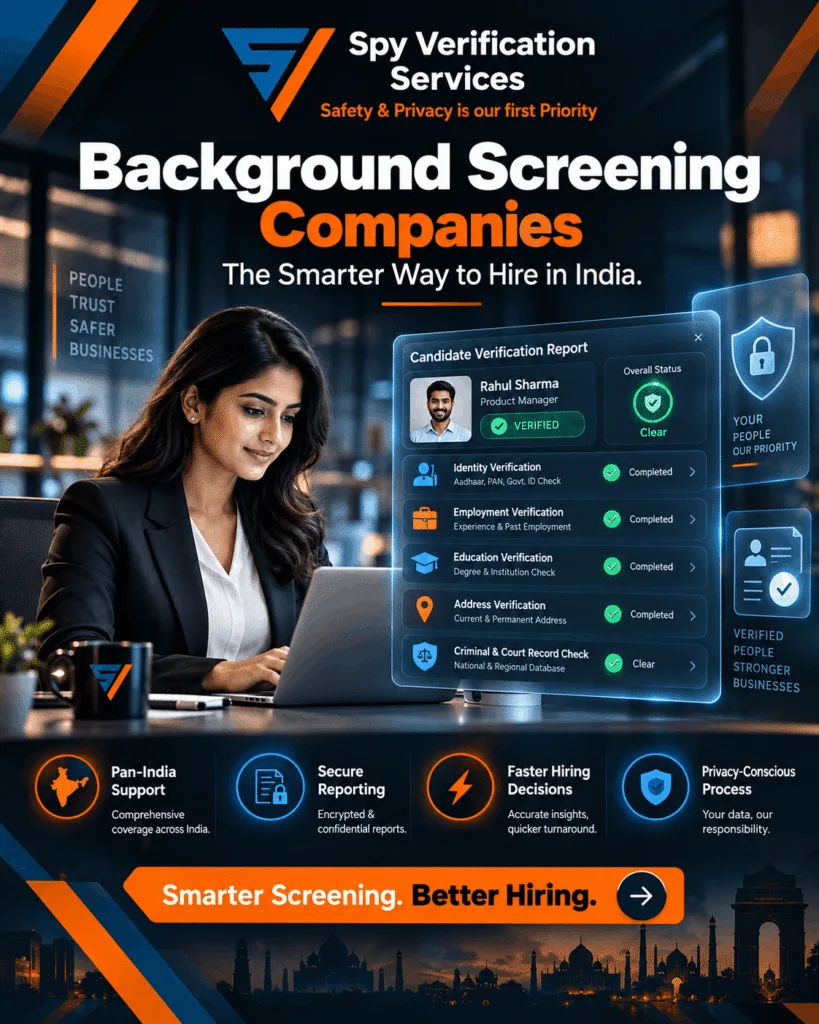
Spy Verification Services provides multiple verification categories that organizations can select individually or combine into a role-based screening programme.
Employment Verification
Employment history often has a significant influence on recruitment decisions.
Employment verification can help confirm available information relating to:
- previous employer;
- employment period;
- designation;
- work records;
- employment status; and
- other appropriate professional details that can be independently verified.
The objective is to compare information submitted by the candidate with information available through relevant sources.
Education Verification
Qualifications can be critical for technical, managerial, healthcare, professional and specialized positions.
Education verification may help validate:
- institution;
- degree or qualification;
- course;
- enrolment details;
- completion details; and
- other relevant academic information.
Older records, institutional procedures and archive availability can affect turnaround time, which is why experienced screening providers should communicate source limitations transparently.
Identity Verification
Reliable screening begins with identifying the correct individual.
Identity verification may use appropriate documents and authorized information sources to establish whether the details being verified correspond to the correct candidate.
This step is important because a database result has limited value if the identity itself has not been correctly matched.
Address Verification
Depending on the employer’s requirements, address verification may involve current or permanent residence information.
Verification may use suitable documentary, digital or field-based approaches depending on the service scope and location.
Criminal and Court-Record Verification
Where appropriate and legally permissible, employers may include criminal or court-record verification.
Coverage can depend on jurisdiction, record availability, candidate details and accessible sources.
Responsible Background Screening Companies should explain these limitations rather than presenting every search result as absolute or complete.
Professional Reference Verification
Professional references may provide additional context relating to previous working relationships, responsibilities or employment experience.
Reference checks should focus on information relevant to employment rather than unnecessarily collecting personal information.
Financial or CIBIL Verification
Certain positions involve significant financial authority or access.
Where appropriate and properly authorized, financial verification may be considered for relevant roles.
It should not automatically become a standard requirement for every candidate simply because the verification is available.
Certificate and Document Verification
Depending on the organization’s requirements, additional qualifications, certificates or other submitted records may require verification.
Spy Verification Services also lists identity, taxation, certificate, financial, social-media and other verification categories among its available services.
A Practical Risk-Based Background Screening Framework
Organizations can determine their screening requirements by looking at four broad areas.
1. Identity Risk
Is confirming the candidate’s identity fundamental to onboarding?
Identity-related checks may form the foundation of the verification programme.
2. Qualification Risk
Does the person require particular education, professional experience or credentials?
Education, employment and relevant certificate verification may be appropriate.
3. Access Risk
Will the employee receive access to customer information, confidential systems, funds, intellectual property or sensitive infrastructure?
Additional role-relevant checks may be justified.
4. Operational Risk
Will the employee work independently, operate from client locations, handle valuable assets or perform field-based responsibilities?
The screening scope can then be adjusted accordingly.
This framework makes background verification more meaningful than applying the same checklist to every employee.
How Spy Verification Services Conducts Background Verification
Spy Verification Services describes its approach as purpose-led, source-led and role-relevant, with clear reporting and human review.
A typical verification workflow can involve:
Step 1 – Define the Purpose
Identify why verification is required and which checks are genuinely relevant.
Step 2 – Collect Appropriate Candidate Information
Obtain the necessary candidate information, documentation and required permissions for the agreed screening scope.
Step 3 – Validate Submitted Information
Review the information supplied before beginning relevant source checks.
Step 4 – Conduct Source-Led Verification
Depending on the check, information may be verified using employers, institutions, available records, references, authorized databases, documentation or field verification.
Step 5 – Compare Findings
Compare verified information against candidate-provided information.
Step 6 – Investigate Material Differences
Review significant discrepancies rather than automatically treating every mismatch as wrongdoing.
Step 7 – Quality Review
Check whether findings are sufficiently supported and clearly categorized.
Step 8 – Employer-Ready Reporting
Present confirmed information, discrepancies, unavailable information and limitations in a format suitable for human review.
The objective is not merely to produce a “pass” or “fail” status.
The objective is to provide reviewable evidence.
From More Than 1.5 Million Company-Reported Verifications: Why Context Matters
Experience becomes meaningful when it improves how unusual records and discrepancies are handled.
Spy Verification Services reports more than 1,500,000 completed verifications, 100+ clients and 10+ years of operations, with a network supported by 300+ operational professionals and PAN-India associates.
Practical verification experience demonstrates why findings cannot always be reduced to simple labels.
For example, records may differ because:
- a previous employer changed company names;
- internal and external job designations differ;
- An old educational record requires archive retrieval;
- candidate names appear differently across documents;
- employment dates differ slightly because of payroll or joining-date conventions;
- A former employer has closed;
- An institution requires additional information before confirming a record; or
- A source is temporarily unavailable.
Experienced Background Verification Agencies should investigate and explain these situations rather than automatically categorizing every difference as adverse.
Practical Scenario: A Job-Title Discrepancy
Consider a candidate who mentions the designation Senior Sales Executive, while a former employer confirms the position as Sales Executive – Grade II.
The titles differ.
However, that difference alone does not prove misrepresentation.
The employer may use internal grade structures that differ from external titles used by employees.
A responsible verification process should therefore identify:
- the candidate’s declared information;
- What the employer confirmed;
- the nature of the difference;
- the source of the information; and
- whether additional clarification is required.
That distinction is important for responsible, evidence-based reporting.
What Should Happen When a Discrepancy Is Found?
A background verification discrepancy should trigger review-not automatic rejection.
Employers can consider:
- What information differs;
- whether the difference is material to the job;
- which source produced the finding;
- whether additional documents are available;
- whether the candidate can reasonably clarify the difference; and
- What organizational policy requires?
Spy Verification Services specifically states that a discrepancy does not automatically prove wrongdoing and that employers should review relevance and allow clarification or supporting documentation where appropriate.
This human-review principle is one of the most important elements of responsible background screening.
Privacy, Consent and Responsible Use of Candidate Data
Background screening involves personal data. This means privacy cannot be treated as an afterthought.
Organizations should determine what information is necessary, why it is required, who should have access to it and how it should be protected.
India’s Digital Personal Data Protection Act, 2023, together with the Digital Personal Data Protection Rules, 2025, forms an important part of the country’s current digital personal-data framework.
Among other principles, the DPDP Act states that consent, when used as a basis for processing, should be free, specific, informed, unconditional and unambiguous and should relate to the personal data necessary for the specified purpose.
For background screening, organizations should therefore avoid collecting information merely because it is available.
A stronger principle is:
Collect and verify information because it is relevant to a legitimate, defined screening purpose.
Organizations should obtain appropriate permissions and legal guidance for their individual requirements where necessary.
What Background Screening Cannot Guarantee?
Trustworthy Background Screening Companies should also be clear about what verification cannot prove.
A background screening report cannot guarantee:
- how someone will behave in the future;
- that misconduct will never occur;
- that every historical record still exists;
- that every employer or institution will respond;
- that every database contains complete information;
- absolute availability of records across every jurisdiction; or
- whether the employer should ultimately hire a candidate.
Background screening provides evidence within an agreed scope.
The final hiring or onboarding decision remains with the organization.
How Long Does Background Screening Take?
There is no responsible universal turnaround time for every verification.
Timelines can depend on:
- verification type;
- employer response;
- institution response;
- record availability;
- geographic location;
- holidays;
- quality of submitted documentation;
- archive requirements; and
- whether additional clarification is required.
Some digitally supported verifications may progress relatively quickly, while manual employment, education, court, reference or field checks may require more time.
A trustworthy screening provider should set realistic expectations rather than promise an unrealistic universal turnaround time.
Why PAN-India Background Screening Capability Matters
India’s workforce is increasingly mobile.
A company headquartered in Delhi may recruit candidates with education, employment and residence history across Noida, Gurugram, Mumbai, Bengaluru, Hyderabad, Chennai, Pune, Kolkata, Jaipur, Ahmedabad, Lucknow, Chandigarh, Kochi and Tier II or Tier III cities.
Spy Verification Services supports PAN-India background verification assignments, while clearly stating that feasibility and timelines can differ by verification type, location and source accessibility.
PAN-India capability can be particularly useful for:
- IT and software organizations;
- BPO and KPO businesses;
- BFSI companies;
- healthcare organizations;
- manufacturing companies;
- logistics and transportation businesses;
- retail chains;
- hospitality companies;
- staffing agencies;
- pharmaceutical companies;
- telecommunications companies; and
- organizations conducting high-volume recruitment.
A centralized verification workflow can help organizations maintain more consistent screening standards even when their workforce is geographically distributed.
How to Compare Background Screening Companies
Employers comparing Background Screening Companies, Background Verification Companies or Background Verification Agencies should look beyond pricing alone.
Ask potential screening providers:
- What verification methods are used?
- Which sources are checked?
- Can job roles customize verification packages?
- How are discrepancies reported?
- How are unavailable records handled?
- Is candidate clarification supported?
- How is sensitive personal information protected?
- Is PAN-India verification available?
- Can the provider support bulk recruitment?
- Are turnaround times explained realistically?
- Are field and digital verification options available where appropriate?
- Does the final report distinguish confirmed information from limitations?
A cheaper verification report provides little value if HR teams cannot understand how its conclusions were reached.
Why Organizations Work With Spy Verification Services
Spy Verification Services was established in Delhi in 2016 and provides background verification support across India.
According to the currently published company figures, its experience includes:
- 10+ years of operations
- 1,500,000+ completed verifications
- 100+ client relationships
- 300+ operational professionals and PAN-India associates
- PAN-India verification support
- Multiple verification categories
- Role-relevant screening programmes
- Source-led verification
- Clear reporting of discrepancies and limitations
- Privacy-conscious information handling
- Human review rather than automated assumptions
This experience supports organizations ranging from individual hiring requirements to ongoing and high-volume verification programmes.
Background Screening Is About Better Evidence, Not More Suspicion
The strongest employee-screening programmes do not begin by assuming candidates are dishonest.
They begin with a simpler principle:
Important hiring information should be verifiable.
Professional Background Screening Companies help organizations establish a consistent process for determining what should be checked, finding appropriate evidence, identifying meaningful discrepancies and communicating limitations clearly.
Whether your organization is comparing Background Verification Companies, evaluating Background Verification Agencies, building a new BGV programme or improving an existing screening process, the objective should remain the same:
Verify what matters. Understand what the evidence supports. Protect candidate information. Keep human judgment at the centre of the decision.
Need Background Screening Across India?
Whether you need to verify a single candidate, onboard contractors, conduct high-volume recruitment, or build a role-based employee screening programme across multiple Indian locations, Spy Verification Services can help define a practical screening scope.
Speak with the Spy Verification Services team about your hiring volume, locations, job roles and required verification checks.
Build a background verification programme around the information that genuinely matters to your organization.
Contact Spy Verification Services today for PAN-India Background Screening and Background Verification Services.

Frequently Asked Questions About Background Screening Companies
1. What are Background Screening Companies?
Background Screening Companies are professional organizations that independently verify selected information about job applicants, employees, or contractors. Depending on requirements, screening may include employment, education, identity, address, professional references, records and other job-relevant information.
2. Why do employers use Background Verification Companies?
Employers use Background Verification Companies to validate important candidate information, identify material discrepancies, standardize screening processes and make hiring decisions using independently checked information rather than relying entirely on declarations and documents.
3. What is the difference between background screening and background verification?
The terms frequently overlap. Background screening can refer to the broader assessment process, while background verification often refers specifically to confirming individual pieces of information, such as employment, education, identity, or address.
4. What checks should be included in background screening?
There is no universal package suitable for every employee. Appropriate checks depend on responsibilities, access, industry, seniority, organizational policy and applicable requirements. A role-based approach is generally more useful than automatically applying every available check.
5. Can Background Verification Agencies work across India?
Yes. Providers with suitable operational networks can support multi-location requirements. Spy Verification Services provides PAN-India verification support, although feasibility and turnaround can vary depending on location, check type and source accessibility.
6. How long does employee background verification take?
Turnaround varies according to the check. Employment, educational, court, field or reference verification may depend on external source responses and record availability. Employers should therefore ask providers for check-specific expectations rather than relying on one universal turnaround claim.
7. Does a discrepancy mean that a candidate has lied?
No. A discrepancy simply means that verified information differs from information originally provided. There may be legitimate administrative or contextual explanations. Significant differences should be reviewed and clarified before conclusions are reached.
8. Is candidate consent important in background screening?
Organizations should have an appropriate legal basis and, where applicable, obtain permissions for their screening processes. Personal information should be collected for defined purposes and handled in accordance with applicable data-protection requirements and organizational policies.
9. Can Background Screening Companies support bulk hiring?
Yes. Professional screening providers can establish standardized workflows for high-volume recruitment, contractors and distributed workforces while maintaining consistent verification and reporting processes.
10. Why consider Spy Verification Services for background screening?
Spy Verification Services has operated since 2016 and reports more than 1.5 million completed verifications, 100+ client relationships, PAN-India capabilities and a network supported by 300+ operational professionals and associates. Its published methodology emphasizes source-led verification, role-relevant checks, privacy-conscious handling, transparent reporting and fair human review.