
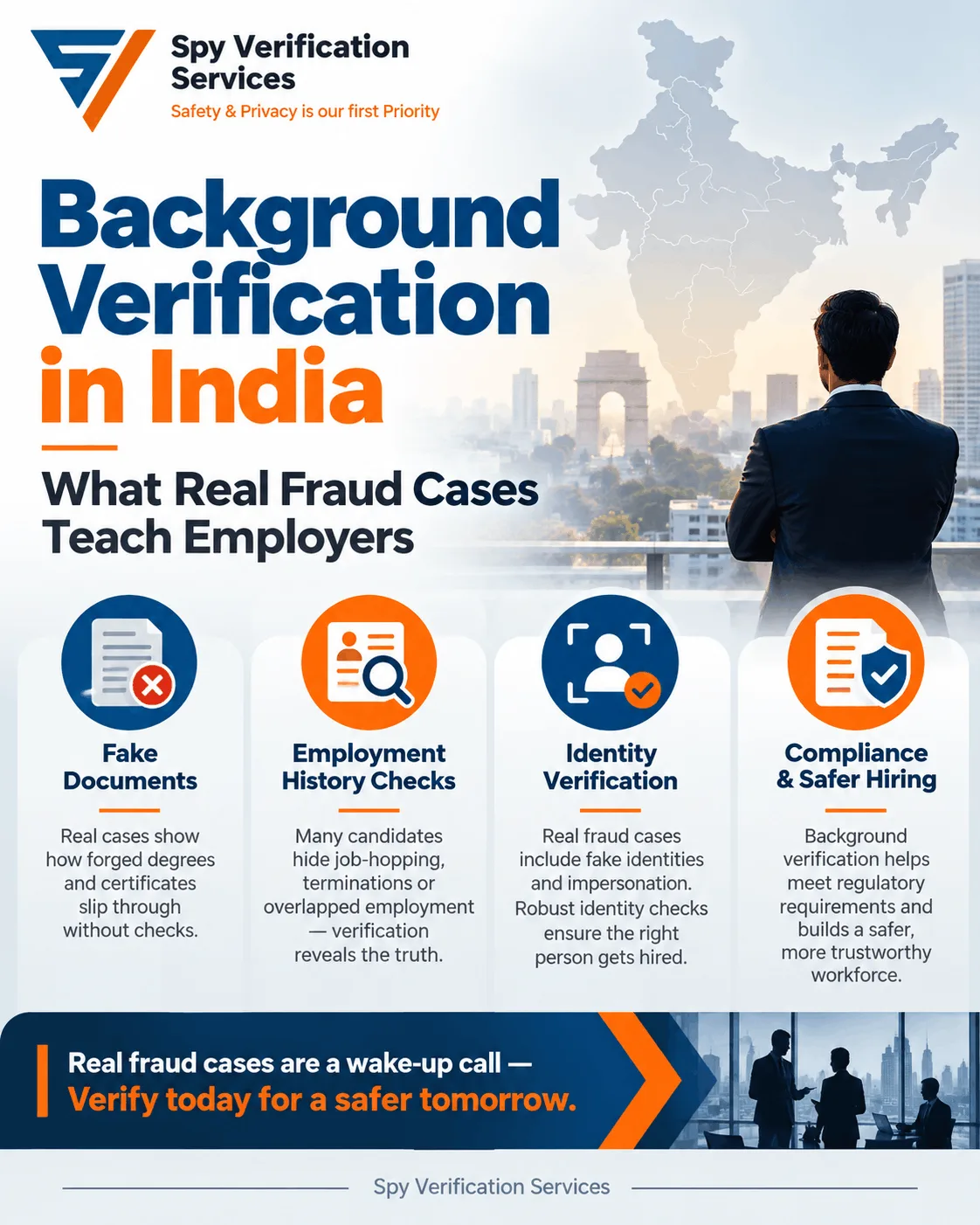
A résumé tells an employer what a candidate says about their experience. An interview helps assess communication, skills and suitability. Documents provide supporting information.
But an important question remains:
Can the information influencing the hiring decision be independently verified?
That is where Background Verification becomes important.
Background Verification, often referred to as BGV Verification, is crucial for Indian employers to validate key information such as identity, employment history and credentials, thereby ensuring safer hiring decisions.
For organisations hiring across India, the purpose of BGV should not be to find reasons to reject candidates. Instead, it should foster confidence by helping HR teams distinguish verified information, genuine discrepancies, unavailable records and information needing clarification.
Spy Verification Services has operated in the verification sector since 2016 and currently reports 1,500,000+ completed verifications, 100+ client relationships and a PAN-India network supported by 300+ operational professionals and associates.
This practical experience reinforces an important principle:
Good Background Verification is about evidence, context and responsible decision-making-not simply ticking boxes.
What Is Background Verification?
Background Verification is the independent validation of information submitted by a candidate, employee, contractor or other individual.
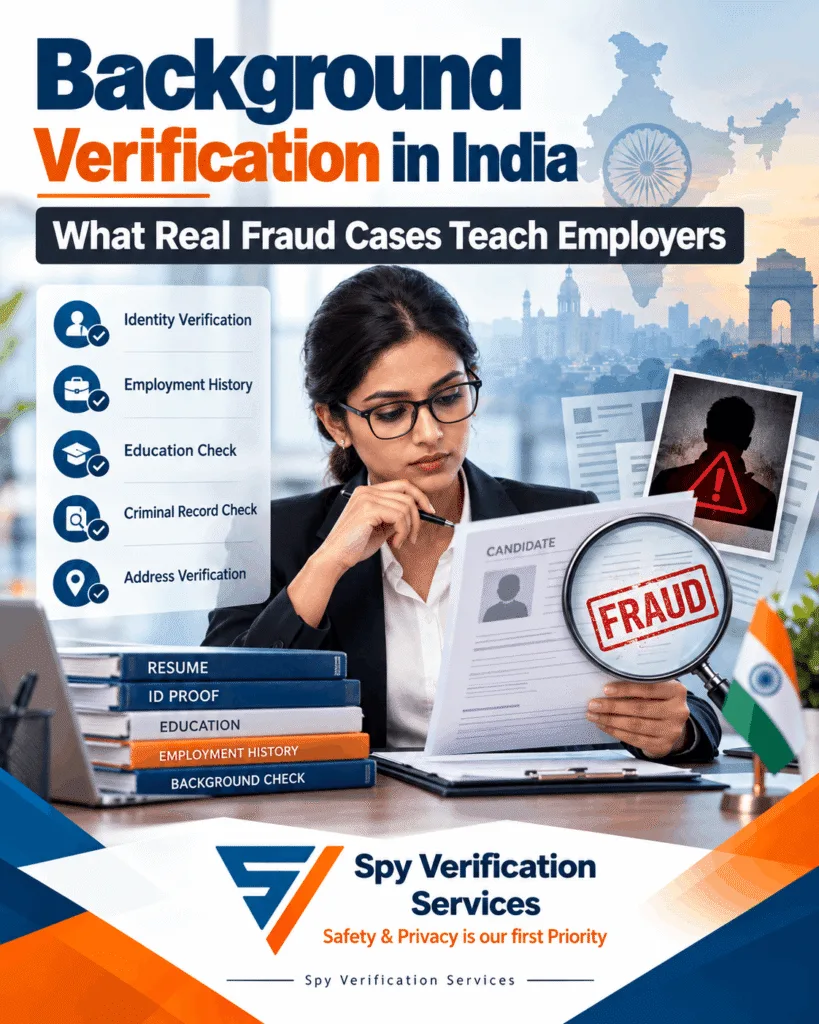
Depending on the role and legitimate business requirement, verification may include:
- Identity Verification
- Employment Verification
- Education Verification
- Address Verification
- Criminal or Court Record Verification
- Professional Credential Verification
- Reference Verification
- Certificate Verification
- Financial checks were appropriately relevant
- Social Media Verification, where appropriately scoped
- Other role-specific checks
Professional Background Verification Companies generally use relevant sources rather than relying only on candidate-submitted documents.
For example, education details may require confirmation from an institution, while employment information may be verified with an appropriate previous employer.
The result should give the employer a clearer picture of what could be confirmed, what differed and what could not be conclusively verified.
Why Is There a Need for Background Verification?
1. Candidate Information Is Usually Self-Reported
Recruiters initially depend heavily on information supplied by applicants.
Most candidates may provide accurate information, but independently validating important claims adds another layer of assurance before access, responsibility or employment is granted.
2. Forged or Misused Documents Can Look Convincing
A photocopy, PDF, identity document, certificate or appointment letter may look authentic without necessarily proving that the person presenting it is entitled to use it.
Real-world fraud cases show why relying solely on the appearance of documents isn’t enough; verification helps Indian employers detect and prevent impersonation and forgery.
3. Hiring Has Become Geographically Distributed
A company headquartered in Delhi may recruit somebody educated in Lucknow, previously employed in Bengaluru and currently living in Pune.
That creates a need for PAN-India Background Verification capable of coordinating information across different states, institutions, employers and sources.
4. Different Jobs Carry Different Risks
The verification required for a software developer may differ from that required for:
- a doctor;
- a finance professional;
- a warehouse employee;
- an X-ray technician;
- a driver;
- a senior executive;
- a person handling confidential customer information.
Background Verification should therefore follow role-related risk, rather than applying every possible check to every employee, enabling HR managers to feel confident in tailoring their approach effectively.
5. Verification Helps Employers Make Evidence-Based Decisions
BGV doesn’t replace interviews, skill assessments or management judgment.
It adds independently checked information to the decision-making process.
Real Case Study 1: One Identity, Multiple X-Ray Technician Jobs and Nearly ₹4.5 Crore
One of the clearest examples of why identity verification matters emerged from Uttar Pradesh’s healthcare system.
What Happened?
In 2025, an online verification exercise uncovered an alleged impersonation scheme involving X-ray technician positions in the Uttar Pradesh health department.
Multiple individuals were found working under the identity details of Arpit Singh across different districts.
According to the reporting by The Times of India, the individuals were using the same name, father’s name and date of birth. Investigators reported the use of forged Aadhaar documents and cloned appointment letters. The arrangement allegedly continued for about nine years, with approximately ₹4.5 crore in salaries collectively drawn before the issue came to light.
A subsequent investigation expanded beyond the initial six cases. Hindustan Times reported in October 2025 that authorities identified dozens of additional suspected fraudulent appointments while reviewing X-ray technician profiles.
Background Verification Lesson
This case demonstrates the potential relevance of:
Identity Verification – Does the person correspond with the identity being presented?
Identity-document validation – Do submitted identity details correspond appropriately with the individual and other records?
Employment/appointment Verification – Is the employment or appointment documentation genuine and linked to the correct individual?
Cross-record checking – Do identical details unexpectedly appear across records that should belong to different individuals?
The lesson isn’t that Background Verification can prevent every form of fraud.
It is that checking an identity against appropriate sources can reveal inconsistencies that document collection alone may miss.
Real Case Study 2: Fake Doctors and a Reported ₹2.5 Crore Pharma Fraud
Identity verification is important beyond traditional recruitment.
A separate case reported from Noida illustrates how professional impersonation can also affect business transactions.
What Happened?
In 2026, police reported busting a gang accused of impersonating doctors and cheating pharmaceutical businesses.
According to The Times of India, the accused allegedly posed as doctors, placed orders for medicines and provided bogus cheques. Police linked the group to dozens of fraud cases across cities including Ghaziabad, Delhi, Jaipur and Ahmedabad, with reported losses of approximately ₹2.5 crore.
The alleged scheme reportedly involved creating the appearance of legitimate medical buyers before medicines were collected and fraudulent payment instruments were discovered.
Background Verification Lesson
For situations involving healthcare professionals or high-value commercial transactions, relevant checks may include:
Identity Verification – Is the person actually who they claim to be?
Professional Registration Verification – Is the claimed doctor or professional appropriately registered with the relevant professional authority?
KYC Verification – Do relevant identity and business details correspond with reliable records?
Credential Verification – Can the claimed professional qualification or association be independently supported?
The broader lesson is simple:
A professional title should not automatically be treated as proof of professional identity.
Verification of credentials can be especially important where medical, financial or other regulated responsibilities are involved.
What We Commonly Learn From Practical Background Verification
After years of verification work, one important lesson is that not every mismatch indicates fraud.
Spy Verification Services notes that practical screening can involve situations such as:
- spelling variations in names;
- employment-date differences;
- closed employers;
- relocated organisations;
- delayed HR responses;
- older academic records;
- incomplete documentation;
- unavailable historical records.
These situations require investigation and context rather than an automatic negative conclusion.
For example, imagine a candidate states:
Employment: January 2022 – December 2024
But the previous employer confirms:
Employment: February 2022 – November 2024
That is a discrepancy.
But it does not automatically establish deliberate falsification.
A responsible process should assess the significance of the difference, review available evidence and, where appropriate, allow the candidate to provide clarification.
Major Types of Background Verification
Identity Verification
Identity Verification evaluates whether the supplied identity information appropriately corresponds with the individual being verified.
Identity checks can form the foundation for other verification activities because checking the wrong individual can undermine everything that follows.
Employment Verification
Employment Verification may validate relevant information such as:
- organisation name;
- employment tenure;
- designation;
- available employment records;
- other authorised employment information.
Education Verification
Education Verification can help validate:
- institution;
- degree or qualification;
- course;
- attendance or completion information;
- other available academic records.
Address Verification
Depending on requirements and available methods, address details may be reviewed through documentary, digital or field-based processes.
Criminal and Court Record Verification
Relevant court-record searches may be used where appropriate for the role and permitted purpose.
Results require careful interpretation because similar names, incomplete data or jurisdictional differences may require human review.
Professional Registration Verification
For regulated occupations such as healthcare, professional registration can be particularly significant.
A degree certificate and an active professional registration answer different questions and may therefore require separate verification.
Financial Verification
Financial checks should generally be used only where appropriately relevant, authorised and justified by the nature of the position.
Social Media Verification
Where legitimately required, publicly available professional information may sometimes form part of screening.
This should not become unrestricted surveillance into irrelevant aspects of a candidate’s private life.
Role-Based BGV: The Same Package Shouldn’t Be Used for Everyone
Experienced Background Verification Agencies should help employers decide what needs to be verified, rather than simply maximising the number of checks.
For example:
Healthcare Roles
Consider identity, education, employment history, professional registration and appropriate record checks.
BFSI and Financial Roles
Identity, employment, education and other checks relevant to financial responsibility may be appropriate.
IT and Data-Access Roles
Identity, employment history, education and other role-relevant screening may support access-control decisions.
Logistics and Field Workforce
Identity, address, employment history and other responsibilities-specific checks can be relevant.
Senior Leadership
Employment history, qualifications, references and role-specific credentials may require deeper validation.
The right question is:
“Which information matters for this person’s responsibilities?”
not:
“How many background checks can we sell?”
How Does the Background Verification Process Work?
A structured BGV process commonly follows these stages:
Step 1: Define the Purpose
Identify the position, responsibilities and relevant verification requirements.
Step 2: Collect Required Information
Obtain only the information and documents needed for the agreed verification scope.
Step 3: Provide Appropriate Notice and Obtain Necessary Authorisation
Candidate information should be handled in accordance with applicable requirements and defined purposes.
Step 4: Verify Through Relevant Sources
Depending on the check, this could involve employers, educational institutions, professional bodies, applicable databases, court sources, field resources or other appropriate records.
Step 5: Review Discrepancies
Compare candidate-submitted information against findings and investigate material differences.
Step 6: Quality Review
Check the report for accuracy, clarity and completeness.
Step 7: Report Findings
A useful report should clearly differentiate among information that is:
- verified;
- matched;
- discrepant;
- pending;
- unavailable;
- insufficient for a conclusion.
Step 8: Human Decision-Making
The employer remains responsible for the final employment decision.
Background Verification provides evidence; it should not replace human judgment.
Privacy and Responsible Background Verification in India
Background Verification can involve personal data.
India’s Digital Personal Data Protection Act, 2023, establishes a framework for processing digital personal data for lawful purposes, including requirements relating to consent and notice in applicable circumstances. The Digital Personal Data Protection Rules, 2025, were notified in November 2025 with phased commencement provisions.
Organisations should therefore consider responsible principles such as:
- collecting information for a defined purpose;
- limiting collection to relevant information;
- giving appropriate notice;
- obtaining required consent or authorisation where applicable;
- controlling access;
- protecting verification reports;
- avoiding unnecessary retention;
- providing appropriate mechanisms for clarification.
Specific obligations depend on the facts, applicable law and implementation timeline, so organisations should obtain professional legal guidance where needed.
What Background Verification Cannot Tell You
This section is just as important as understanding what BGV can verify.
Background Verification cannot guarantee:
- future employee performance;
- loyalty;
- cultural fit;
- future behaviour;
- professional success;
- that every historical record exists;
- that every external source will respond.
No responsible Background Verification Company should suggest that screening can eliminate every hiring risk.
BGV answers a narrower question:
Can the relevant information used in this hiring decision be independently supported by available evidence?
How Candidates Can Make BGV Verification Smoother
Background Verification should also be easier for candidates when expectations are clear.
Candidates can help by:
- entering accurate employment dates;
- providing complete employer details;
- submitting readable documents;
- using consistent identity information;
- mentioning relevant name changes;
- supplying accurate institution information;
- responding promptly to clarification requests;
- avoiding overstating job titles or qualifications.
Accurate information at the beginning can reduce unnecessary delays later.
PAN-India Background Verification
Background Verification in India often requires both digital capabilities and local operational reach.
A candidate may:
- live in Delhi;
- have studied in Jaipur;
- previously worked in Bengaluru;
- hold documents from Uttar Pradesh;
- and apply for a position in Mumbai.
A PAN-India verification network can therefore become important when an organisation hires across multiple locations.
Spy Verification Services was founded in Delhi in 2016 and currently reports PAN-India verification capabilities supported by 300+ operational professionals and associates. Its publicly stated service coverage includes employment, education, identity, address, financial, certificate, social media and criminal/court record verification.
What Should Employers Look for in Background Verification Companies?
When comparing Background Verification Companies, price should not be the only consideration.
Ask:
- How does the provider actually verify information?
- Does it have relevant industry experience?
- Can it support PAN-India hiring?
- How does it protect candidate information?
- How are discrepancies classified?
- Is human review available?
- Does the report explain unavailable information?
- Are turnaround estimates realistic?
- Can checks be customised according to role?
- What happens when a source doesn’t respond?
These questions can help distinguish a verification process from a simple data-collection service.
Why Spy Verification Services?
Spy Verification Services brings practical verification experience built over the past 6 years.
According to the currently published company figures:
1,500,000+ verifications completed
100+ clients
10+ years of operations
300+ operational professionals and PAN-India associates
Spy Verification Services’ approach focuses on:
- source-led verification;
- PAN-India support;
- role-relevant screening;
- human review;
- clear discrepancy reporting;
- privacy-conscious handling;
- verification limitations communicated transparently.
The company supports screening requirements across industries, including healthcare, BFSI, IT, manufacturing, logistics, retail, telecom, BPO, hospitality, aviation and other workforce environments.
Background Verification Is About Evidence, Not Suspicion
The strongest BGV programme doesn’t begin by assuming a candidate is dishonest.
It begins with a question:
“What information matters to this hiring decision and can we verify it responsibly?”
The X-ray technician impersonation case illustrates what can happen when an identity is allegedly replicated across employment records. The fake-doctor case shows how professional identity itself can become a tool for commercial fraud. Neither example means Background Verification will prevent every fraudulent act, but both demonstrate why important identity and credential claims deserve independent validation.
For employers, the purpose of Background Verification should ultimately be straightforward:
Verify what matters. Understand discrepancies. Protect personal information. Make better-informed decisions.
Build a More Informed Hiring Process With Spy Verification Services
Every employment decision involves trust.
The purpose of verification is not to remove trust from hiring-it is to support trust with evidence.
Whether you’re hiring one senior professional or screening employees, contractors and workforce teams across multiple Indian locations, Spy Verification Services can help develop a Background Verification programme suited to your roles and requirements.
Need Background Verification across India?
Talk to Spy Verification Services about identity, employment, education, address, professional credentials and customised BGV Verification requirements.
Spy Verification Services
PAN-India Background Verification Support
Phone: +91 98181 34951 / 011 4166 9655
Email: info@spyverificationservices.com
FAQs About Background Verification
1. What is Background Verification?
Background Verification is the process of independently validating selected information supplied by a candidate or individual, such as identity, education, employment, address and professional credentials.
2. What is BGV Verification?
BGV stands for Background Verification. BGV Verification commonly refers to employee or candidate screening performed before or during employment.
3. Why is Background Verification important before hiring?
It helps employers determine whether important candidate information can be independently supported and identifies discrepancies that may require clarification.
4. Which checks are included in Background Verification?
Depending on the role, checks can include identity, employment, education, address, court records, professional registration, references, certificates and other authorised verification.
5. How long does Background Verification take?
There is no universal turnaround time. Timing depends on the type of check, source responsiveness, location, record availability and documentation quality.
6. Does a discrepancy mean the candidate committed fraud?
No. A discrepancy is a difference between two pieces of information. The reason should be reviewed before a conclusion is reached.
7. Can Background Verification be conducted across India?
Yes. Spy Verification Services provides PAN-India support, although feasibility and timelines depend on the check, location and accessibility of relevant sources.
8. Is every employee required to undergo the same checks?
No. A role-based verification strategy is generally more appropriate because different jobs carry different responsibilities and risks.
9. How should employers choose among Background Verification Agencies?
Evaluate experience, methodology, geographical reach, data-handling practices, reporting quality, discrepancy management, support and role-specific screening capabilities.
10. Can Background Verification guarantee a safe or successful employee?
No. Background Verification validates selected information within an agreed scope. It cannot predict future performance or behaviour.