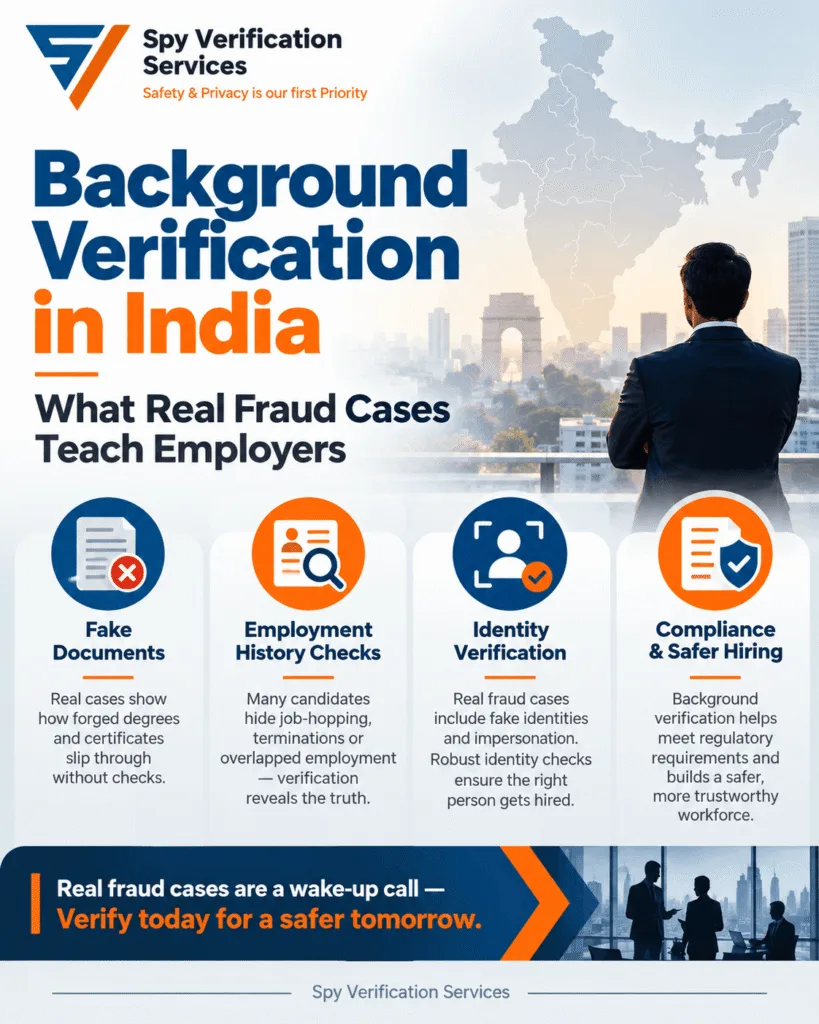
A candidate submits a polished resume, relevant qualifications and impressive employment experience. The interview goes well and the hiring team is ready to proceed.
But there is still an important question:
Can the information provided by the candidate be independently verified?
That question is at the heart of the Background Check Process.
A professional background check is not about trying to find something negative about a candidate. It is a structured process for verifying relevant information through appropriate sources, enabling employers to make better-informed hiring and onboarding decisions.
This becomes increasingly important as recruitment moves online, organisations hire across multiple states and candidates may have studied, lived and worked in different parts of India.
Spy Verification Services, headquartered in Delhi-NCR, has been operating since 2016 and provides source-led Background Verification Services across India. According to its currently published company information, its operational experience includes 1.5 million+ completed verifications and 100+ clients, with an approach focused on role-relevant checks, human review, transparent reporting and privacy-conscious information handling.
This guide explains how the Background Check Process in India works-from deciding what to check to reviewing discrepancies and preparing the final verification report.
What Is the Background Check Process?
The Background Check Process is the systematic verification of information provided by a candidate, employee, contractor or applicant.
Instead of accepting every resume claim or document at face value, relevant information is compared with information available from suitable sources.
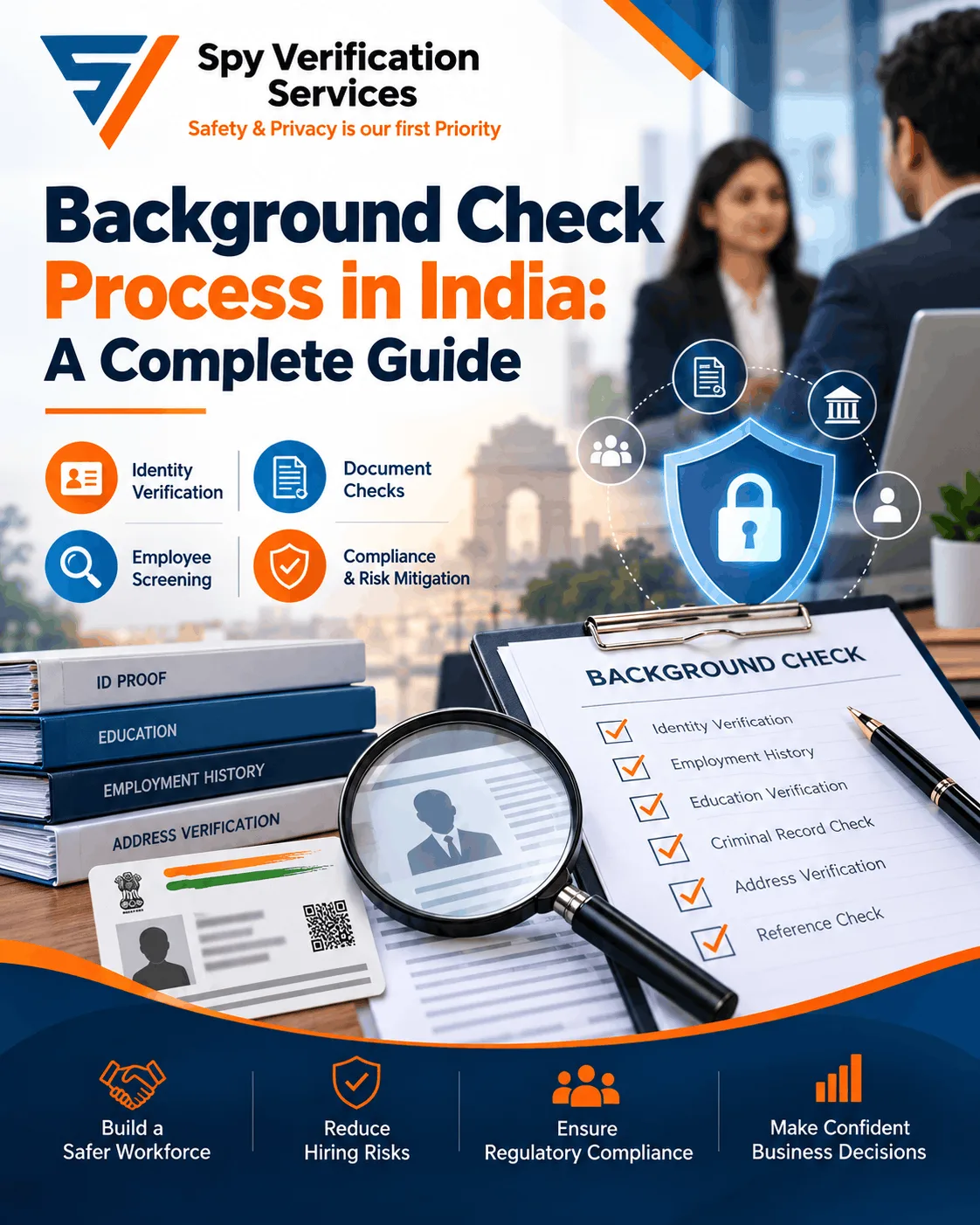
Depending on the job and organisation, the process may include Identity Verification, Employment Verification, Education Verification, Address Verification, Criminal and Court Record Verification, Professional Reference Checks, Document Verification, Certificate Verification, Financial Verification and other role-specific checks.
A key principle is relevance.
A Background Verification Process should not collect or investigate information simply because it may be available. The verification scope should correspond to the responsibilities and risks associated with the position.
For example, the verification required for a software developer may differ from that required for a finance professional, a field employee, a healthcare professional, or a senior executive.
Why Is There a Need for Background Check Services?
A resume is primarily candidate-provided information.
An interview allows employers to understand a candidate’s communication skills, experience and suitability.
A skills test can demonstrate ability.
But none of these independently confirms whether the underlying identity, qualifications or employment history is accurate.
That is why organisations use professional Background Check Services.
To independently verify candidate information.
Background screening provides an additional layer of evidence by checking relevant information through employers, educational institutions, available records, authorised sources, or other appropriate verification channels.
To identify important discrepancies
Employment dates, job titles, university information, names, addresses or supporting documents may sometimes differ from source records.
The purpose of professional verification is to accurately identify and document those differences.
To support safer and more consistent hiring
A defined Employee Background Verification Process can help organisations adopt a more consistent screening approach rather than relying entirely on informal judgments.
To protect sensitive business functions
Employees may receive access to customer information, financial systems, confidential company data, physical assets or operational facilities. Role-relevant screening provides organisations with more information before granting access.
To strengthen hiring due diligence
Background Verification does not guarantee future employee behaviour, but it helps employers demonstrate that important candidate information was reasonably checked before a decision was made.
How Does the Background Check Process Work?
A reliable background check is better understood as an information journey:
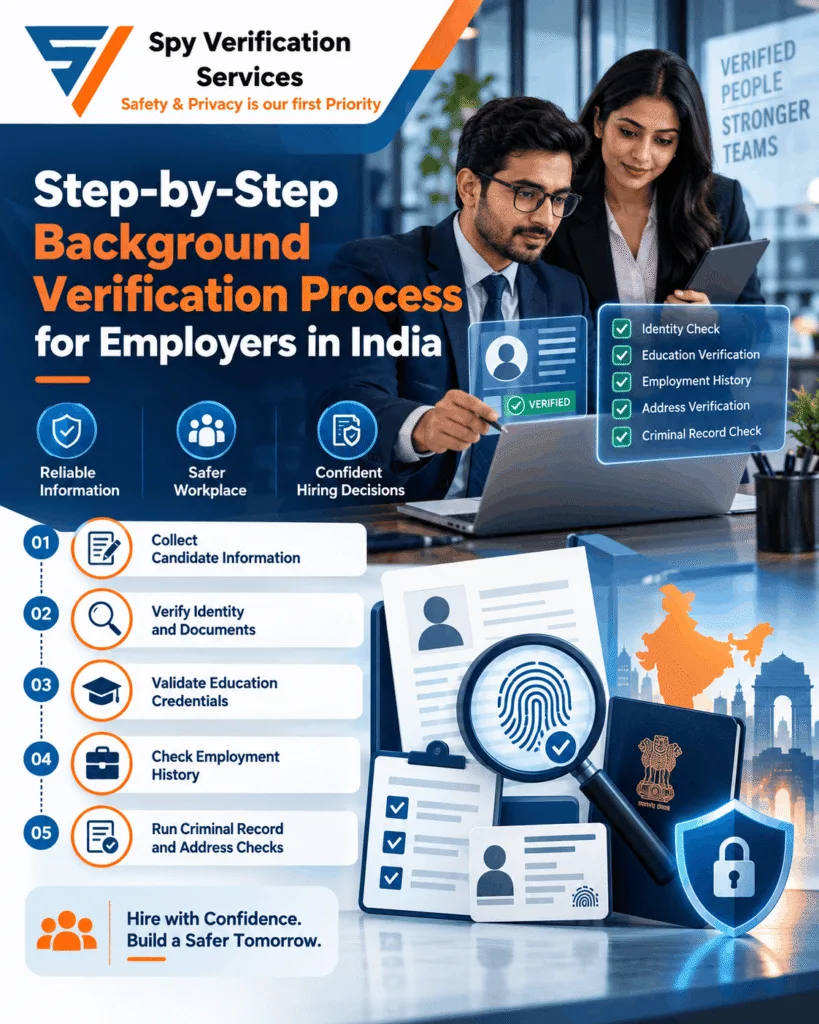
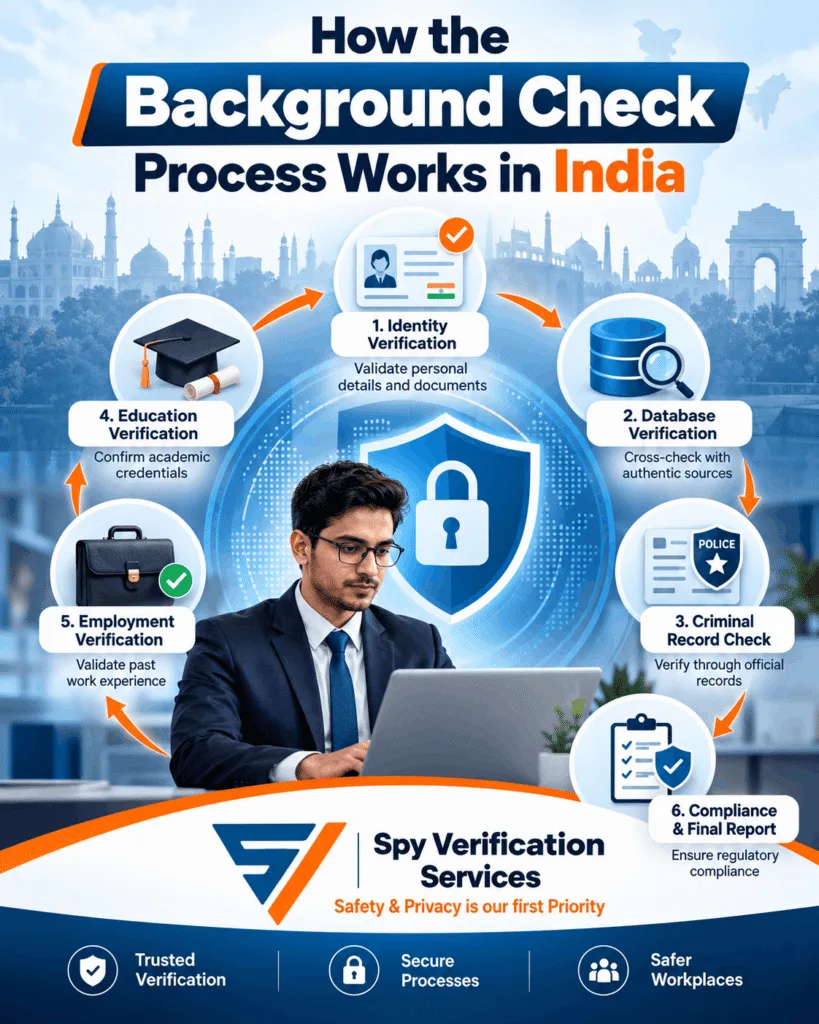
Define the scope → collect relevant information → verify through appropriate sources → compare results → investigate discrepancies → conduct quality review → prepare the report → employer reviews findings.
Spy Verification Services publicly describes a similar methodology built around defining scope and purpose, collecting candidate information with appropriate authorisation, conducting source-led verification, reviewing quality and discrepancies and producing clear, reviewable reporting.
Here is how each stage works.
Step 1: Define the Verification Scope
Background screening should begin by understanding the job rather than immediately ordering every available check.
The organisation should consider the candidate’s:
- Position and seniority
- Job responsibilities
- Industry
- Work location
- Access to financial information
- Access to confidential data
- Customer interaction
- Professional qualification requirements
- Access to company assets
- Applicable internal or regulatory requirements
This creates a role-based Background Screening Process.
For instance, professional credential verification may be especially important when recruiting a healthcare professional, while identity and address verification may be particularly relevant for large field workforces.
Better verification is relevant verification-not simply more verification.
Step 2: Candidate Information and Appropriate Authorisation
Once the screening scope is established, relevant information and supporting documents are collected.
Depending on the required checks, information may include identification details, employment history, educational qualifications, residential details, professional certificates and references.
The candidate should understand the purpose and scope of the screening.
Data privacy is especially important because Background Verification can involve personal information.
India’s Digital Personal Data Protection Act, 2023, establishes a framework for processing digital personal data for lawful purposes while recognising individuals’ right to protect their personal data. Different provisions may commence on different dates as notified by the government, so employers should consider the legal requirements applicable when processing candidate information.
Responsible screening, therefore, starts with a simple question:
Is this information genuinely necessary for the verification purpose and relevant to the hiring decision?
Step 3: Identity Verification
Identity Verification forms the foundation of many other checks.
Before verifying a degree, employment record or legal record, the verification process must minimise the risk of checking information belonging to another individual.
Depending on the verification scope and authorised method, identity checks may examine the consistency of candidate-provided identity information and supporting records.
Correct identity matching matters because people may share similar or identical names.
A name match alone should not automatically be treated as proof that another record belongs to the candidate.
Step 4: Employment Verification
Employment history is one of the most important parts of many Pre-Employment Screening Processes.
Depending on what the source is authorised or able to disclose, Employment Verification may seek to confirm details such as the employer, period of employment, designation, or other relevant work history information.
However, real-world employment verification is not always straightforward.
Previous companies may have closed. HR teams may respond slowly. Company names may have changed following an acquisition. Historical records may be archived. Candidates may remember approximate rather than exact joining or relieving dates.
This is where verification experience matters.
Spy Verification Services notes that practical screening frequently involves issues such as name variations, employment date mismatches, closed employers and delayed source responses. Its published methodology emphasises investigating and communicating such situations rather than forcing every case into a simplistic positive-or-negative classification.
Step 5: Education Verification
Education Verification checks whether the academic information provided by a candidate matches the information available from the relevant institution or an appropriate source.
Depending on the requirement, verification may examine:
Institution → Course → Qualification → Completion information → Other relevant academic details.
This becomes especially important where a qualification is fundamental to the job.
Older academic records can sometimes take longer to verify because the institution may need to retrieve archived records or request additional information.
An unavailable result should not be presented as a confirmed negative result.
That distinction is an important part of trustworthy Background Verification.
Step 6: Address Verification
Address Verification helps confirm residential information provided by the candidate.
Depending on the agreed methodology, it may involve appropriate documentation, authorised digital methods or field-based verification.
Address verification can be particularly relevant for field employees, contractors, drivers, delivery personnel, customer-facing workers and employees receiving company assets.
For businesses hiring across India, a verification provider’s geographical capabilities also matter, as a candidate may live in Delhi, have studied in Jaipur and previously worked in Bengaluru.
Step 7: Criminal and Court Record Verification
Criminal and court record checks require careful interpretation.
One of the most important principles is:
A matching name does not automatically mean a matching person.
Similarly, the appearance of a matter in a legal record should not automatically be interpreted as a conviction.
Relevant identifying information, jurisdiction, case details and available record context must be reviewed carefully.
Spy Verification Services specifically notes that criminal and court record verification requires careful interpretation and that a legal record or name match should not automatically be attributed to the screened individual.
This human-review layer is particularly important because incorrect matching can create serious consequences for candidates and employers.
Step 8: Professional Reference Verification
Professional references add context to the factual verification process.
Depending on company policy and what the referee is comfortable providing, a reference check may help clarify the candidate’s previous professional relationships, responsibilities, or work context.
Reference checks should not, however, replace objective Employment Verification or Education Verification.
A referee’s opinion and an official employment record answer different questions.
Step 9: Document and Professional Credential Verification
Certain roles depend on specialised credentials.
Verification may therefore extend to:
- Professional licences
- Technical certificates
- Training certificates
- Registration documents
- Supporting employment documents
- Other role-relevant credentials
The important question is not simply whether a document looks genuine.
Where reasonably possible, verification should connect the individual, the document and the appropriate source record.
Step 10: Role-Specific Background Checks
A common mistake is applying the same Background Check package to every employee.
Screening should instead reflect actual responsibilities.
For example, authorised financial verification may be relevant where the role involves responsibility for money, transactions or financial systems.
Professional credential checks may carry greater importance in healthcare or specialist technical roles.
Address and identity verification may receive greater emphasis when organisations onboard large distributed field teams.
Social Media Screening, when used, should remain within an appropriate professional scope rather than becoming an unrestricted investigation into someone’s private life.
What Happens When a Background Check Finds a Discrepancy?
This is one of the most misunderstood parts of the Background Verification Process.
A discrepancy means that information obtained during verification differs from the information originally supplied.
It does not automatically mean fraud.
Consider an illustrative example:
A candidate states that employment ended on 30 June, but the previous employer’s record indicates 5 July.
That difference may require clarification, but by itself it does not establish dishonesty.
Possible explanations could include payroll processing dates, relieving dates, administrative records or incorrect recollection.
A responsible discrepancy workflow generally follows this approach:
Difference identified → information reviewed → source evidence assessed → supporting clarification considered where appropriate → difference documented → employer reviews relevance.
Professional screening should distinguish between an administrative difference and a potentially material inconsistency.
Spy Verification Services states that its approach is to document and review differences rather than automatically treating every discrepancy as a negative outcome.
What Can a Background Verification Report Show?
A clear verification report should help the employer understand what actually happened during the check.
Depending on the reporting methodology, results may indicate that information was:
Verified: Relevant information was successfully confirmed.
Discrepant: Information differed from the information supplied and requires review.
Pending: Verification has not yet been completed.
Unable to Verify: The appropriate source or required information could not be obtained.
Insufficient Information: Additional information may be required to continue the verification.
The most trustworthy report is not necessarily the one with the most data.
It is the one that clearly separates what was confirmed, what differed, what could not be verified and what limitations affected the result.
What Can Delay the Background Check Process?
Background Verification depends on external sources, which means every check cannot be responsibly promised within the same timeline.
Delays may occur due to incomplete candidate details, unavailable HR contacts, closed organisations, archived university records, slow institutional responses, name variations, older records, or the need for additional clarification.
Some digital verifications may move quickly while employer, educational, legal or field-based checks may require more time.
This is why organisations should value turnaround transparency instead of unrealistic instant-verification promises.
What Candidates Should Expect During Background Verification
Background Verification can also be easier when candidates understand the process.
A candidate may typically be asked to provide information and supporting documents relevant to the checks selected by the employer.
The verification provider then conducts the agreed checks and may request clarification if important information is missing or inconsistent.
Candidates can help prevent unnecessary delays by providing accurate employment dates, complete institution names, correct contact details and readable supporting documentation.
Where an important discrepancy arises, context matters.
Professional verification should report evidence clearly rather than automatically assuming that every difference represents misrepresentation.
What Background Checks Can-and Cannot-Tell Employers.
Background Verification has clear value, but it also has limits.
It can help organisations verify specific information within an agreed scope.
It cannot predict whether a candidate will become the company’s highest-performing employee.
It cannot guarantee future behaviour.
It cannot establish someone’s complete character.
And it should not automatically convert every inconsistency into a rejection recommendation.
The purpose of Background Check Services is to provide better information for human decision-making, not to replace human judgment.
Spy Verification Services explicitly states that Background Verification reports should support hiring decisions rather than make the final hiring decision for the organisation.
Privacy-Conscious Background Verification
Background checks may involve personal and potentially sensitive information, so responsible handling is essential.
Spy Verification Services’ published approach emphasises having a clear screening purpose, collecting information relevant to that purpose, restricting unnecessary access, using appropriate authorisation processes and avoiding unnecessary checks simply because information might technically be obtainable.
This principle also improves verification quality.
Collecting more information does not automatically create a better Background Check.
Collecting the right information for a legitimate purpose is more important.
Background Check Process Across India
Hiring is increasingly location-independent.
A company headquartered in Delhi NCR may recruit an employee currently living in Pune who studied in Lucknow and previously worked in Hyderabad.
That means effective Background Verification Services in India require a workflow that coordinates checks across multiple locations.
Spy Verification Services is headquartered in Azadpur, Delhi and supports verification assignments throughout Delhi-NCR and PAN India, including requirements involving metropolitan areas, Tier II cities and other locations.
This PAN-India capability is particularly relevant for organisations managing multi-city recruitment, remote employees, field teams, contractors and large hiring volumes.
Why Choose Spy Verification Services for Background Checks?
The quality of a Background Verification Company should not be judged only by how many checks appear on its service list.
Employers should also examine how those checks are performed.
Spy Verification Services has operated since 2016 and currently reports 1.5 million+ completed verifications, 100+ clients and 10+ years of operations. Its stated approach focuses on source-led verification, role-relevant screening, clear reporting, privacy-conscious information handling and human review.
The company provides verification support across areas, including:
Identity Verification • Employment Verification • Education Verification • Address Verification • Criminal & Court Record Verification • Professional References • Document & Certificate Verification • Financial Verification • Social Media Screening • Role-Specific Verification
Experience across large numbers of verification cases can be particularly valuable when records do not fit neatly into a standard template.
A previous employer may no longer exist.
An old university record may be archived.
A candidate’s name may appear differently across documents.
Employment dates may differ slightly.
The value of professional Background Check Services lies not simply in discovering these situations, but in investigating, contextualising and reporting them accurately.
Build a More Reliable Background Check Process
Hiring decisions often begin with information supplied by candidates.
Professional Background Verification adds an important next step:
independent verification.
The strongest Background Check Process does not simply collect data. It defines what matters, checks information through appropriate sources, distinguishes genuine discrepancies from administrative differences, protects candidate information and presents findings clearly enough for responsible human review.
For organisations hiring across Delhi-NCR and PAN India, Spy Verification Services provides structured Background Check Services tailored to the role, hiring requirement and verification scope.
Need Background Check Services for Your Organisation?
Connect with Spy Verification Services to discuss Background Verification requirements for individual candidates, ongoing recruitment, high-volume onboarding or PAN-India hiring.
Verify what matters. Report what can be supported. Make better-informed hiring decisions.
Frequently Asked Questions About the Background Check Process
1. What is a Background Check Process?
A Background Check Process is the structured verification of relevant information supplied by a candidate or employee, such as identity, employment history, educational qualifications, address or other role-specific information.
2. What does a Background Check include in India?
Depending on the job, it may include Identity Verification, Employment Verification, Education Verification, Address Verification, Criminal and Court Record Checks, Reference Verification, Document Verification and other role-relevant checks.
3. Why do employers need Background Check Services?
Background Check Services help employers independently verify candidate-provided information, identify relevant discrepancies and make better-informed hiring and onboarding decisions.
4. How does Employment Verification work?
Relevant employment information may be checked with previous employers or other appropriate sources. The exact information available can depend on the employer’s records and what the source is authorised or willing to confirm.
5. What happens if a discrepancy appears in Background Verification?
The discrepancy should be reviewed and documented. Employers should consider its significance and, where appropriate, additional context or clarification rather than automatically treating every difference as fraud.
6. Does a discrepancy mean the candidate has failed the Background Check?
No. A discrepancy indicates only that verified information differs from the information originally supplied. Some differences are administrative or minor, while others may require more detailed review by the employer.
7. How long does the Background Check Process take?
There is no universal turnaround time. Timelines depend on the verification type, source availability, employer or university response, location, record age, candidate documentation and whether clarification is required.
8. Can Background Verification guarantee that someone will be a good employee?
No. Background Verification confirms or reviews information within an agreed scope. It cannot predict future job performance, behaviour or complete suitability. The employer remains responsible for the final hiring decision.
9. Can Spy Verification Services conduct Background Checks across India?
Yes. Spy Verification Services supports Background Verification assignments across Delhi-NCR and PAN-India. Feasibility and completion time can vary depending on the check, location and accessibility of the relevant source.
10. What should employers look for in a Background Verification Company?
Employers should evaluate the provider’s verification methodology, operating experience, available checks, source quality, geographic coverage, data-handling approach, discrepancy process, reporting quality and ability to tailor verification to different job roles.