A candidate’s resume may list previous employers, qualifications and professional achievements. But the recruitment decision often depends on a different question: which claims have actually been checked against appropriate sources? A background verification report (BGV report) helps an employer answer that question without confusing an incomplete check with a negative finding.
Quick answer: A background verification report is a structured record of the checks requested, the information examined, the findings and any limitations. It may cover identity, employment, education, address and other job-relevant checks. The report should distinguish confirmed information from discrepancies, pending checks and information that could not be verified. It informs an employer’s decision; it does not make the hiring decision.
This guide explains how to read an employee background verification report, assess the underlying evidence and respond fairly when a result needs clarification. If your business needs a tailored screening programme, see Background Check Services from Spy Verification Services.
What should an employee background verification report contain?
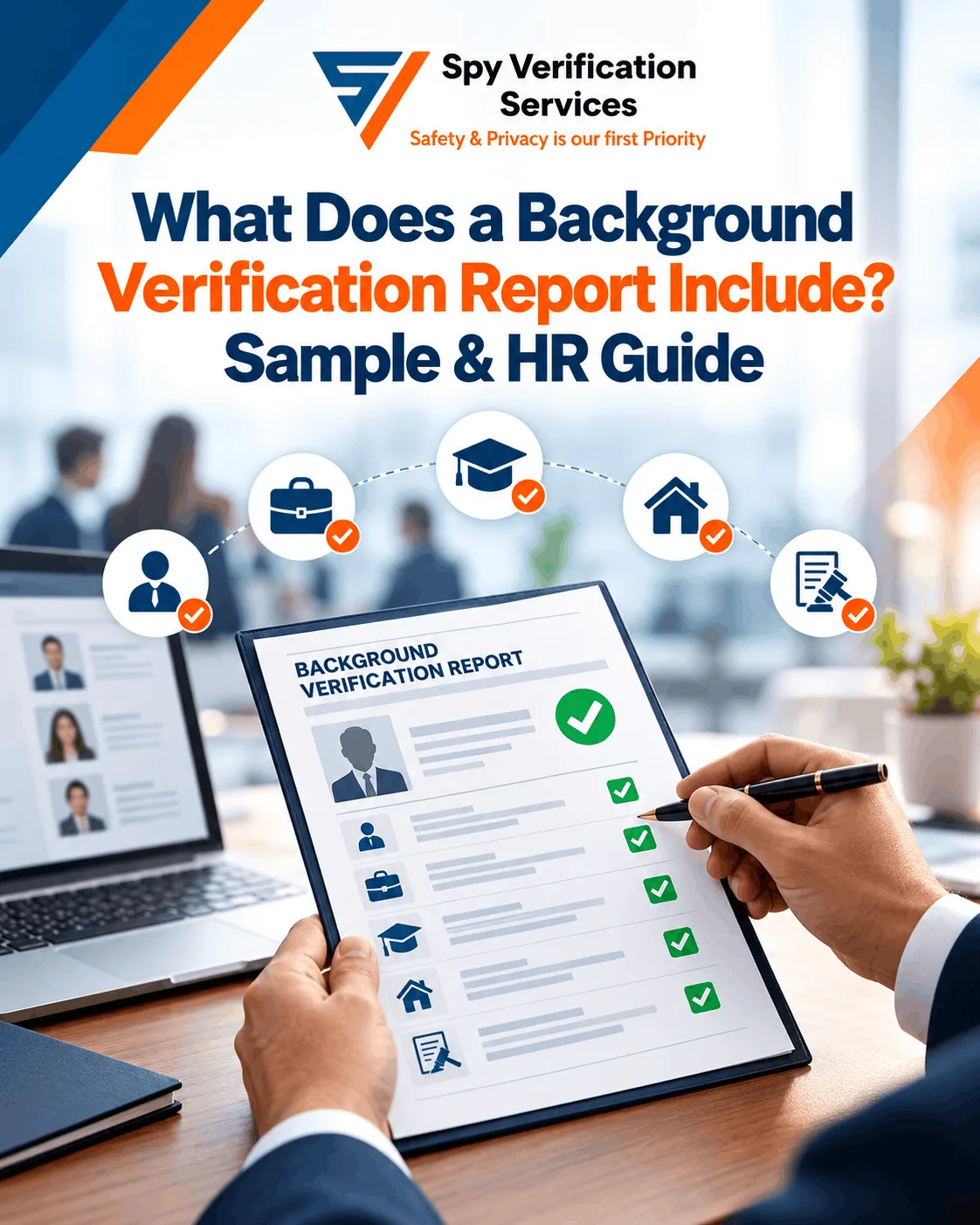
A useful BGV report makes its scope and findings clear. There is no universal format used by every provider, but HR teams should expect enough detail to understand the difference between a completed check and an unresolved question.
| Report section | What HR should look for |
|---|---|
| Case details | Candidate reference, requesting organisation, checks ordered and report date |
| Scope of checks | Which checks were included—and which were not requested |
| Submitted information | The specific claim or document presented for checking |
| Source or method | The relevant verification route, described as far as security and confidentiality allow |
| Finding | What the source or other appropriate evidence actually supported |
| Status | Verified, discrepancy, pending, unable to verify or another clearly defined outcome |
| Limitations | Source unavailable, records incomplete, identity ambiguity or pending clarification |
| Review trail | Follow-up notes, amended findings and dates when corrections were recorded |
For example, an employment check might establish that a person worked for a named employer but reveal that the joining date differs by two days. That is materially different from finding no evidence of the employment at all. An informative report preserves the distinction.
Illustrative BGV report: how to read each result
The following sample is fictional and provided for training purposes. It is not an actual candidate record, a client case or a reproduction of Spy Verification Services’ report template. It shows the level of context HR teams can request in a sample report.
Candidate: Candidate A (fictional) Role: Accounts Executive Report issue date: 19 October 2026 Overall position: HR review required; one check pending.
| Check | Candidate-submitted detail | Illustrative finding | Status / HR next step |
|---|---|---|---|
| Identity | Name and date of birth as submitted | Identifiers consistent with authorised check | Verified; record result |
| Employment | Joined 01 January 2022 | Appropriate source records 03 January 2022 | Discrepancy; request explanation |
| Education | B.Com completed in 2021 | Qualification and award year confirmed | Verified |
| Address | Current residential address | Field-source confirmation not yet completed | Pending; do not present as negative |
| Court-record search | Relevant search requested | No attributable record found within defined sources and search scope | State search limitations; do not imply a universal guarantee |
A coloured dashboard may show green, amber or red indicators, but colours are provider-defined labels, not a universal legal verdict. Ask the provider for the exact criteria behind them.
What does “verified” mean?
The relevant information was supported by the applicable method or source. It does not mean every aspect of the candidate’s background was investigated. If employment dates were checked, a verified status should not be interpreted as confirmation of performance or behaviour.
What is a “discrepancy”?
A discrepancy is a difference between submitted information and a result obtained during verification. Its significance depends on context. A two-day difference in employment dates and an unsupported claim to a regulated professional qualification deserve different types of review.
What do “pending” and “unable to verify” mean?
Pending means the check has not reached a final result. Unable to verify generally means available methods or sources did not support a reliable conclusion. A closed employer, unavailable archived records or unanswered institutional request can produce this outcome without proving dishonesty.
Does “no record found” mean the candidate has no criminal history?
No. A scoped court-record search describes what was found, or not found, in the sources and jurisdictions searched. A name-only match is not sufficient to attribute a record reliably to a particular person. The report must describe the scope and any identifying limitations.
A five-step HR workflow for reviewing a discrepancy
1. Identify the precise claim. Which field differs—start date, employer name, institution, qualification or another detail? Avoid treating an entire report as failed because one field needs review.
2. Evaluate the source and reliability. Was the information obtained from a relevant issuing institution, employer or authorised source? Could abbreviations, record migrations or a source mismatch explain the difference?
3. Seek an explanation through the appropriate channel. Where required and appropriate, allow the candidate to clarify the discrepancy and provide supporting documents. Do not ask for unrelated sensitive information.
4. Request a documented recheck if justified. An updated source response or additional identifying detail may resolve an ambiguous finding. Record whether the review changes the original result.
5. Make a proportionate decision. The employer considers the verified facts, the responsibilities of the role, its policy and applicable law. The verification provider supplies findings, not an automatic hire-or-reject instruction.
Worked example: In the fictional report above, HR would ask Candidate A about the two-day date difference, while tracking address verification separately. If documentary evidence explains the date difference, the case record should show that explanation and any adjusted conclusion. A pending address check should remain visibly pending until resolved or closed with a clear limitation.

Which checks belong in a background check report?
Only checks that are appropriate for the role and actually ordered should appear. Common categories include identity, employment, education, address, professional registration and relevant record searches. Each answers a different question.
An Employment Verification Service may assess declared employer and tenure information. An Education Verification Service may confirm the institution, credential and award details. An appropriate address check may address whether a supplied location can be confirmed through the agreed method.
A provider should distinguish reviewing a document from obtaining independent source confirmation. For example, receiving a degree certificate does not establish that an issuing institution confirmed the qualification. When a source cannot be contacted, an honest report should describe the limitation.
Seven quality checks before HR accepts a BGV report
Check scope: Does the report list all checks ordered, including those not completed?
Check attribution: Is the record reliably associated with the correct candidate rather than a similar name?
Check evidence: Is the source or method sufficiently described to understand the finding?
Check dates: Are the report date, source response date and any amendments distinguishable?
Check wording: Does the report separate facts, inferred concerns and unavailable information?
Check secure handling: Is the report accessible only to appropriate authorised recipients?
Check correction procedure: Can a contested or demonstrably incorrect finding be reviewed and amended?
Requesting a fully anonymised sample report can reveal much more about a screening provider than broad claims about speed or accuracy. When comparing Background Verification Agencies in India, ask whether their samples explain pending checks, conflicting records and search limitations.
Can a candidate correct an inaccurate BGV report?
An employee or candidate may identify a name mismatch, outdated record or incorrect employment date. Employers should provide an appropriate channel for raising such concerns and asking the verification provider to review the disputed field. The result may remain unchanged, be corrected or be classified as inconclusive depending on the evidence.
A good correction record identifies what was challenged, what additional material was reviewed, whether the result changed and when the revised report was issued. Avoid silently overwriting earlier findings without an audit trail.
Data privacy: what should employers protect?
A BGV report can contain personal information and potentially sensitive findings. Employers should define a legitimate screening purpose, provide appropriate notices, establish the applicable lawful basis or authorisation, limit collection to relevant information, control access, use secure sharing methods and set retention rules according to applicable requirements.
India’s Digital Personal Data Protection Act commencement notification and DPDP Rules, 2025 specify phased commencement. As of October 2026, not every substantive provision has commenced. Organisations should assess which obligations are currently in force alongside other applicable employment, contractual and sector-specific requirements; they should obtain legal advice where needed.
For practical handling, an HR team can set access to individual reports by role, avoid sending documents to large email groups and remove or archive reports according to a documented retention schedule. These are recommended practices, not a claim that one retention period is mandatory for all employers.
When should employers request a customised report format?
A startup hiring a small team may need a compact per-candidate summary. A large employer reviewing workers across departments may need a consolidated dashboard alongside individually reviewable findings. In both cases, the detailed result should remain intelligible and should not hide source limitations behind a single percentage or colour.
Ask a provider to show how it records unresolved cases, escalations, corrections and checks that were not requested. If your organisation is considering screening for outsourced workers, the companion guide on contract employee background verification explains how reporting responsibility can be shared between staffing vendors and client HR teams once that article is live.
Why this matters for Indian employers
Spy Verification Services is a Delhi-based background verification company established in 2016 and providing verification services for organisations across India. Its published service pages describe employment, education, identity, address and other role-relevant checks. The practical purchasing question is not simply whether a provider produces a “clear” report; it is whether the report explains what was verified, what differed and what still requires a decision.
Employers who want to discuss relevant checks and reporting requirements can request Background Check Services. Ask for a current anonymised sample and confirm the exact scope before placing an order.
Conclusion
A useful Background Verification Report communicates evidence, uncertainty and next steps. HR teams should judge a report by whether each important result is understandable and reviewable, not by the presence of an attractive dashboard or an unexplained “pass” label.
For employment, education and other appropriately authorised checks, contact Spy Verification Services about Background Check Services and request a scope-specific reporting sample.
Frequently asked questions about BGV reports
1. What is a BGV report?
A BGV report is a written record of authorised background verification findings, their status and important limitations. It supports an employer’s review but does not itself determine employment suitability.
2. What does a background verification report include?
It normally identifies the requested checks, information examined, findings, statuses and any unresolved issues. Individual content varies with the screening package and role.
3. Does “red” status automatically mean a candidate failed?
No. Red, amber and green labels are provider-specific. Employers should examine the underlying finding and documented criteria before making a decision.
4. What is the difference between a discrepancy and unable to verify?
A discrepancy describes conflicting information; unable to verify indicates that available evidence did not establish a reliable conclusion. Neither phrase alone proves deliberate misrepresentation.
5. Can a verification report be final if some checks are pending?
A provider may issue an interim or partially completed report, but pending checks must be marked clearly. Whether onboarding may proceed is an employer policy and legal question, not an automatic consequence of the report.
6. Can the candidate ask for a report correction?
Candidates should have an appropriate route to raise factual errors and provide clarification, subject to applicable law and policy. The provider or employer should document any resulting recheck or correction.
7. How long should employers keep BGV reports?
There is no universally appropriate retention period for all employers. Retention should reflect applicable legal duties, a legitimate purpose, contractual terms and documented information governance practices.
8. Can a BGV report guarantee that a candidate has no adverse record?
No. A report reflects the authorised checks, sources, time and search scope used. It cannot prove the absence of every possible record or predict future behaviour.
9. Who should review the report before a hiring decision?
An authorised HR, compliance or other designated employer reviewer should assess findings according to a documented process. The screening provider should not make the final employment decision on the employer’s behalf.
10. What should an employer ask before buying background check services?
Ask for check-wise scope, sources or methods, a sample report, defined status categories, escalation and correction procedures, realistic timelines and data protection arrangements.