Hiring begins with information, but good hiring decisions require confidence in that information.
A candidate may submit a strong résumé, educational certificates, letters of employment and identity documents. In most cases, these records may be genuine. However, employers cannot always determine authenticity simply by looking at a document.
That is where Background Verification Companies in India become important.
Professional background verification helps organizations independently validate the information that matters before placing an individual in a position of responsibility.
This may involve confirming a candidate’s identity, educational qualifications, previous employment, professional credentials, address, or other job-relevant information.
The purpose is not to assume that applicants are dishonest.
The purpose is to answer a much more practical question:
Can the information influencing the hiring decision be independently verified?
For organizations comparing Background Screening Companies or India Background Check Companies, understanding this distinction is essential.
At Spy Verification Services, we believe that effective background screening should be evidence-based, relevant to the role, privacy-conscious and transparent about what can-and cannot-be verified.
What Are Background Verification Companies?
Background Verification Companies are professional service providers that independently validate relevant information provided by candidates, employees, executives, vendors, or other individuals as part of hiring and due diligence processes.
If a candidate writes on a résumé that they graduated from a particular university, that is a declaration.
If the candidate provides a certificate, that is supporting documentation.
If the relevant qualification is confirmed through an appropriate authorized source or verification process, that becomes independently verified information.
Professional Background Screening Companies provide this additional layer of checking.
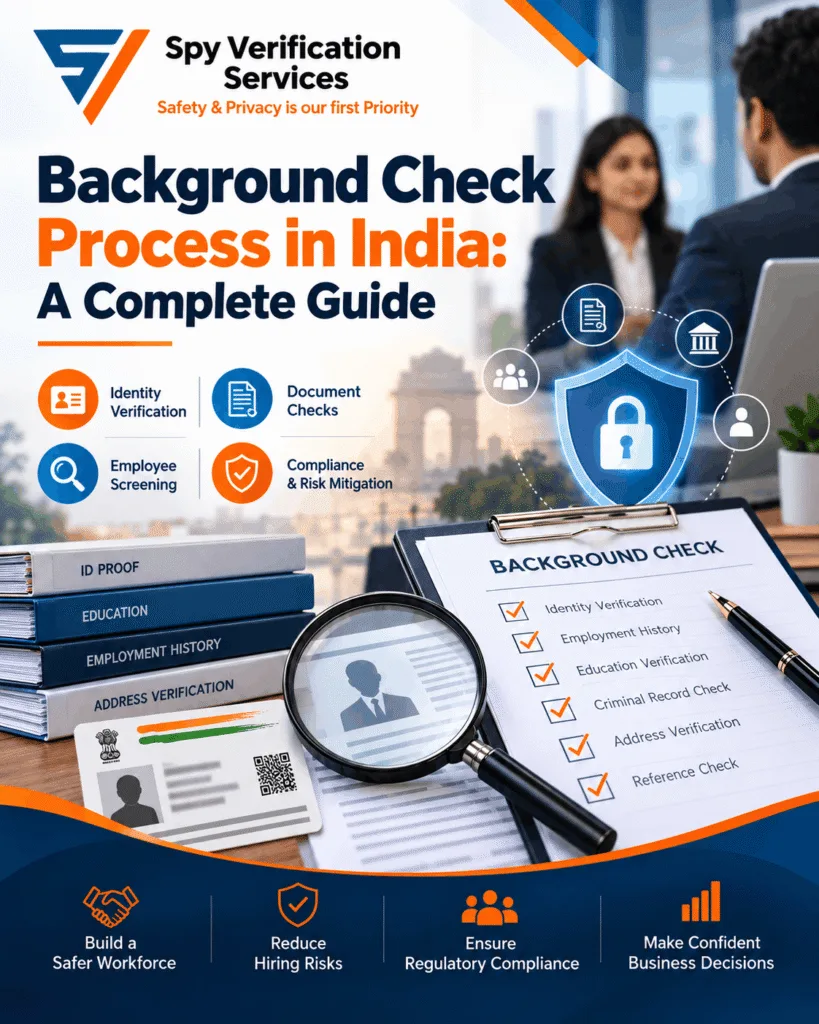
Depending on the position and legitimate business requirement, screening may include:
- Identity verification
- Education verification
- Employment verification
- Address verification
- Document verification
- Professional reference checks
- Professional qualification verification
- Role-specific due diligence
- Appropriate court or record searches
Not every candidate needs every check.
A good verification program should match the level of screening to the responsibilities associated with the position.
Why Background Verification Matters More Than Simply Checking Documents
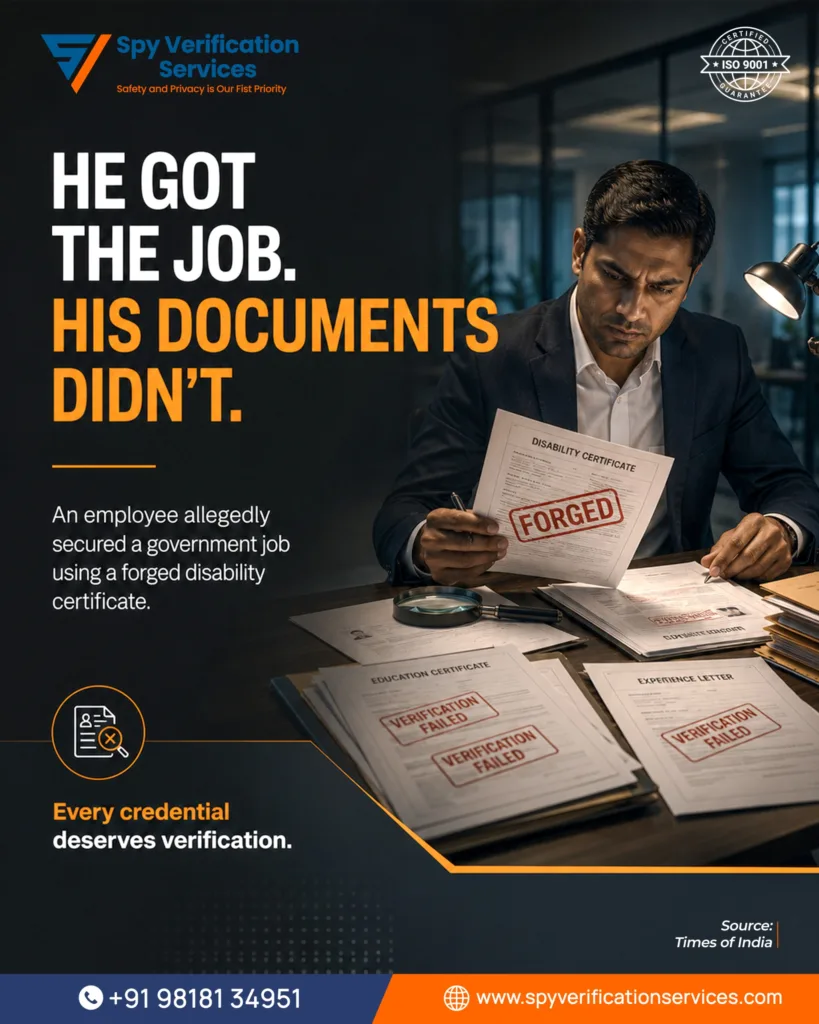
One of the biggest misconceptions about background verification is that receiving documents means verification has been completed.
It has not.
A convincing document can still contain false information.
A genuine document can be misused by someone other than its rightful owner.
A legitimate employee’s credentials can potentially be copied or manipulated.
An employment letter can contain information that does not match the issuing organization’s actual records.
Recent Indian cases illustrate these risks clearly.
Case Study 1: Shalarth ID Teacher Recruitment Scam
Profession: Teachers and Education Officials
The Shalarth case in Maharashtra demonstrates why identity, education and document verification can be critical even where an official digital system exists.
Shalarth is a government system used to manage employee records and process salaries for teaching and non-teaching employees.
Investigators examining suspected irregularities collected information relating to around 4,000 Shalarth IDs. At one stage of the investigation, 580 IDs were reported to be fake, generated through unauthorized manipulation of systems in the deputy director of education’s office.
The wider investigation involved allegations of unauthorized teacher appointments, fake or unqualified staff, forged documentation and fraudulent salary payments.
Subsequent investigations widened considerably, so the figure of 580 should be understood as a documented stage of an ongoing, broader investigation.
How was the system allegedly exploited?
According to public reporting, fraudulent Shalarth IDs were allegedly created for people who were not legitimately entitled to appointments.
Other allegations involved forged documents, unauthorized appointments and salary benefits being drawn through records that should not have existed.
Investigators also examined cases involving educational documents and appointment records.
The case eventually expanded beyond individual employees and brought school management personnel, education officials, teachers and other parties under investigation.
Background verification relevance
The case highlights three particularly important verification areas.
Identity Verification
An employer or authority needs confidence that the individual connected to a personnel record genuinely corresponds to the person being appointed.
Digital IDs alone cannot eliminate fraud if the information entering the system has not been properly validated.
Education Verification
Teaching positions generally depend on specified educational and professional qualifications.
Where those qualifications influence eligibility, employers should verify them rather than relying solely on photocopies or uploaded certificates.
Document Verification
Appointment orders, approvals, certificates and supporting records can carry significant consequences.
Important documents should therefore be examined for consistency and, where appropriate, confirmed against reliable issuing sources.
The lesson for employers
The most important lesson from the Shalarth case is not that digital systems are unreliable.
It is that a digital record is only as trustworthy as the information and controls behind it.
Technology can strengthen verification, but robust processes are still required to determine whether the identity, qualifications, appointments and documents entering that system are genuine.
Public reporting on the investigation has continued to evolve and allegations remain subject to the relevant investigative and judicial processes.
Source: The Times of India and other publicly reported investigation coverage.
Case Study 2: X-Ray Technician Identity Scam – Nearly ₹4.5 Crore
Profession: X-Ray Technicians
A second case from Uttar Pradesh demonstrates an entirely different background screening risk: identity impersonation.
The case involved multiple individuals allegedly working as X-ray technicians under the same identity.
According to public reporting, a genuine candidate named Arpit Singh had been selected as an X-ray technician during a 2016 recruitment exercise.
Investigators later discovered that multiple alleged impersonators had obtained government jobs using the same core identity information.
Six X-ray technician positions across different districts were reportedly linked to the same name, the father’s name and the date of birth.
The alleged arrangement continued for approximately nine years.
During that period, salaries totaling nearly ₹4.5 crore were reportedly drawn across the positions.
How was the problem discovered?
The irregularity surfaced during an online verification process linked to the Uttar Pradesh government’s human resource system.
Cross-checking records revealed repeated identity information associated with multiple employees.
Investigators subsequently examined allegations involving forged Aadhaar details, cloned appointment documentation and impersonation.
What had apparently remained unnoticed when records were considered separately became much more visible when information was compared digitally.
Background verification relevance
This case has direct relevance for several forms of screening.
Identity Verification
A name on a document is not enough.
Verification should establish whether the individual presenting the credentials genuinely corresponds to the claimed identity.
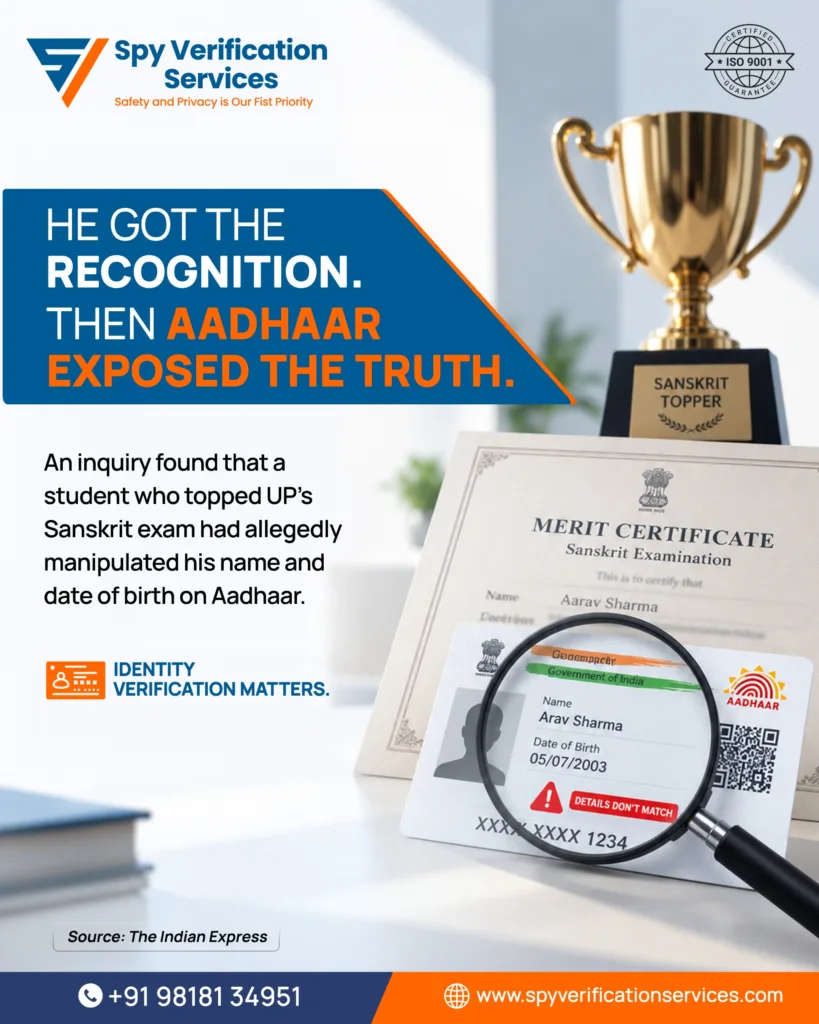
Aadhaar-Based Verification, Where Lawfully and Appropriately Permitted
Where an organization is legally entitled and appropriately authorized to use an Aadhaar-based verification method, identity information should be verified through permitted procedures rather than relying solely on an image or photocopy.
Possessing what appears to be an Aadhaar document should not itself be confused with independent identity verification.
Employment Verification
Cross-checking employment information can reveal unusual overlaps or inconsistencies that may require further investigation.
A person apparently holding multiple full-time positions simultaneously, for example, should create an obvious verification question.
The lesson for employers
The case demonstrates an important principle:
Verifying a document is not always the same as verifying the person presenting it.
A document may contain believable information.
But employers also need to determine whether that document genuinely belongs to the individual being screened and whether other information associated with that identity is consistent.
The Uttar Pradesh case later triggered broader scrutiny of additional appointments, illustrating how one verification anomaly can expose a much larger control problem.
Source: Public reporting by The Times of India and other media covering the UP health department investigation.
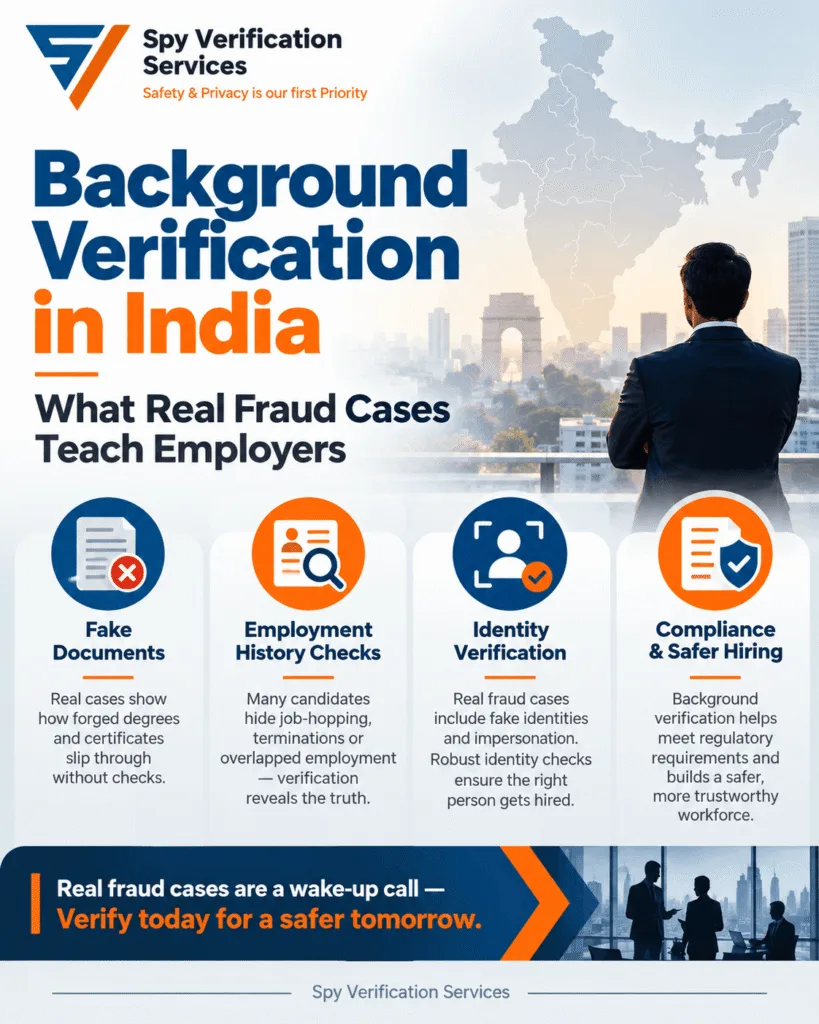
What Do These Two Cases Teach Employers?
The Shalarth teacher case and X-ray technician case involve different professions, states and alleged methods.
But they reveal a common weakness:
Information can appear legitimate when individual documents are viewed in isolation.
Effective verification asks deeper questions.
Does the identity belong to this individual?
Did the issuing institution actually award this qualification?
Did the previous employer actually employ this person?
Does the appointment document match official records?
Are multiple records unexpectedly linked to the same identity?
Does the timeline make sense?
Are there unexplained inconsistencies between documents?
These are the questions professional Background Verification Companies are designed to help organizations answer.
What Should Background Screening Companies Verify?
There is no universal background-check package appropriate for every employee.
Screening should be based on role, responsibility and legitimate organizational requirements.
1. Identity Verification
Identity verification establishes whether a candidate is genuinely the person they claim to be.
It provides the foundation for subsequent screening because employment and education checks are of limited value if they are associated with the wrong individual.
2. Education Verification
Education verification helps determine whether relevant qualifications, courses, institutions and completion information can be independently verified.
This becomes particularly important where a qualification determines eligibility for a job.
3. Employment Verification
Employment verification may confirm appropriate information such as:
- Employer name
- Employment dates
- Job designation
- Department or role
- Other information that the previous employer is permitted to disclose
The objective is not simply to find discrepancies.
It is to understand whether important employment claims can be supported by evidence.
4. Document Verification
Important employment, qualification and identity documents should be examined for authenticity and consistency.
Where appropriate, information should be independently confirmed rather than relying solely on documents provided by the candidate.
5. Address and Role-Specific Verification
Certain employers or positions may require additional verification.
The correct scope should depend on the legitimate purpose of the check rather than on collecting as much personal information as possible.
How Should Background Verification Companies Handle Discrepancies?
A professional verification company should never treat every mismatch as fraud.
Consider a candidate who declares that employment started in May 2024.
The former employer confirms June 2024.
That is a discrepancy.
But perhaps May was the candidate’s training period and formal payroll commenced in June.
Now consider a candidate describing their position as:
Senior Sales Executive
while the previous employer records:
Sales Executive – Grade II
Again, the information differs.
But the functional responsibilities could have been substantially the same.
Good verification identifies the difference and provides context.
The employer can then evaluate whether that difference is material.
“Unable to Verify” Does Not Mean “Fake”
This distinction is equally important.
Imagine a candidate worked for a small company seven years ago.
The company has since closed.
Its domain is inactive.
Its HR contact no longer exists.
Independent verification may therefore be impossible through normal channels.
The correct conclusion is not automatically:
Fake employment.
A more accurate conclusion may be:
Unable to independently verify through available sources.
That language matters.
Responsible India Background Check Companies should distinguish between:
- Verified information
- Discrepant information
- Information requiring clarification
- Information that could not be verified
This makes background reports more useful and fair.
Background Verification Is Not Surveillance
Good employee verification does not mean investigating every aspect of someone’s personal life.
The screening should have a legitimate purpose.
If a software engineer’s academic qualifications matter to the hiring decision, verify those qualifications.
If an accountant will control significant company funds, relevant employment and identity verification may carry greater importance.
If a healthcare professional requires specific credentials, verify them.
The principle should be:
Verify what is relevant-not everything that can be discovered.
Candidate information should also be handled carefully, with appropriate authorization, access controls and privacy practices.
What Should You Look for in India Background Check Companies?
Businesses choosing between India Background Check Companies should evaluate considerably more than price.
Ask potential providers:
- How is each verification performed?
- What information sources are used?
- How are discrepancies classified?
- What happens when a source cannot respond?
- How is candidate information protected?
- Do trained personnel review complex cases?
- Can screening be customized according to role?
- How are verification limitations disclosed?
- What escalation process exists for questionable results?
- How clearly does the final report explain its findings?
A cheap report that creates a misleading conclusion may cost an employer far more than the verification itself.
The Spy Verification Services Approach
At Spy Verification Services, we believe background verification should help businesses make informed decisions-not create automatic judgments about candidates.
The foundation of a responsible verification process is straightforward:
Verify the relevant information.
Document the source or verification method appropriately.
Identify genuine inconsistencies.
Separate discrepancies from assumptions.
Explain information that could not be independently verified.
Provide the employer with clear information to support further decision-making.
Where different roles carry different risks, screening requirements should also differ.
The objective is not maximum investigation.
It is appropriate verification.
Frequently Asked Questions
What are Background Verification Companies?
Background Verification Companies independently validate relevant candidate or employee information, such as identity, education, employment, documents and other role-specific credentials.
Why do employers conduct employee background verification?
Employers use background verification to validate key candidate claims, identify relevant inconsistencies and make hiring decisions based on more reliable information.
Are Background Screening Companies and Background Verification Companies the same?
The terms are often used interchangeably. Background verification generally focuses on confirming specific claims, while background screening refers to the broader set of checks performed on a candidate.
Can background verification detect fake educational certificates?
Educational verification can help determine whether an institution and its relevant records support a candidate’s claimed qualifications. The ability to verify individual records depends on the available and authorized verification source.
Does a background verification discrepancy mean fraud?
No. A discrepancy means two pieces of information do not match. The reason should be assessed before concluding whether the inconsistency is material or intentional.
Why is identity verification important?
Identity verification helps establish that the credentials and information being checked actually belong to the individual presenting them.
Can background verification eliminate hiring fraud?
No.
Background verification reduces information gaps and can identify certain inconsistencies, but no verification process can guarantee that all misconduct or future risk will be detected.
Better Hiring Begins With Better-Verified Information
The Shalarth teacher recruitment investigation and Uttar Pradesh X-ray technician case demonstrate why employers should look beyond the appearance of documents.
In one case, investigators uncovered hundreds of allegedly fake Shalarth IDs and irregular appointments.
In another case, multiple employees were reportedly connected to the same identity for years before digital cross-verification exposed the problem.
The larger lesson is simple.
Trust should be supported by verification when the information matters.
Professional Background Verification Companies help organizations determine whether important identity, education, employment and document claims can be independently supported.
For employers comparing Background Screening Companies and India Background Check Companies, the right screening partner should offer more than a checklist.
Look for accuracy.
Look for transparent methodology.
Look for responsible handling of personal information.
Look for context when discrepancies appear.
And above all, look for a provider that reports what the evidence actually shows.
Spy Verification Services helps organizations approach background verification as structured, evidence-based due diligence-so employers can make important hiring decisions with greater confidence.