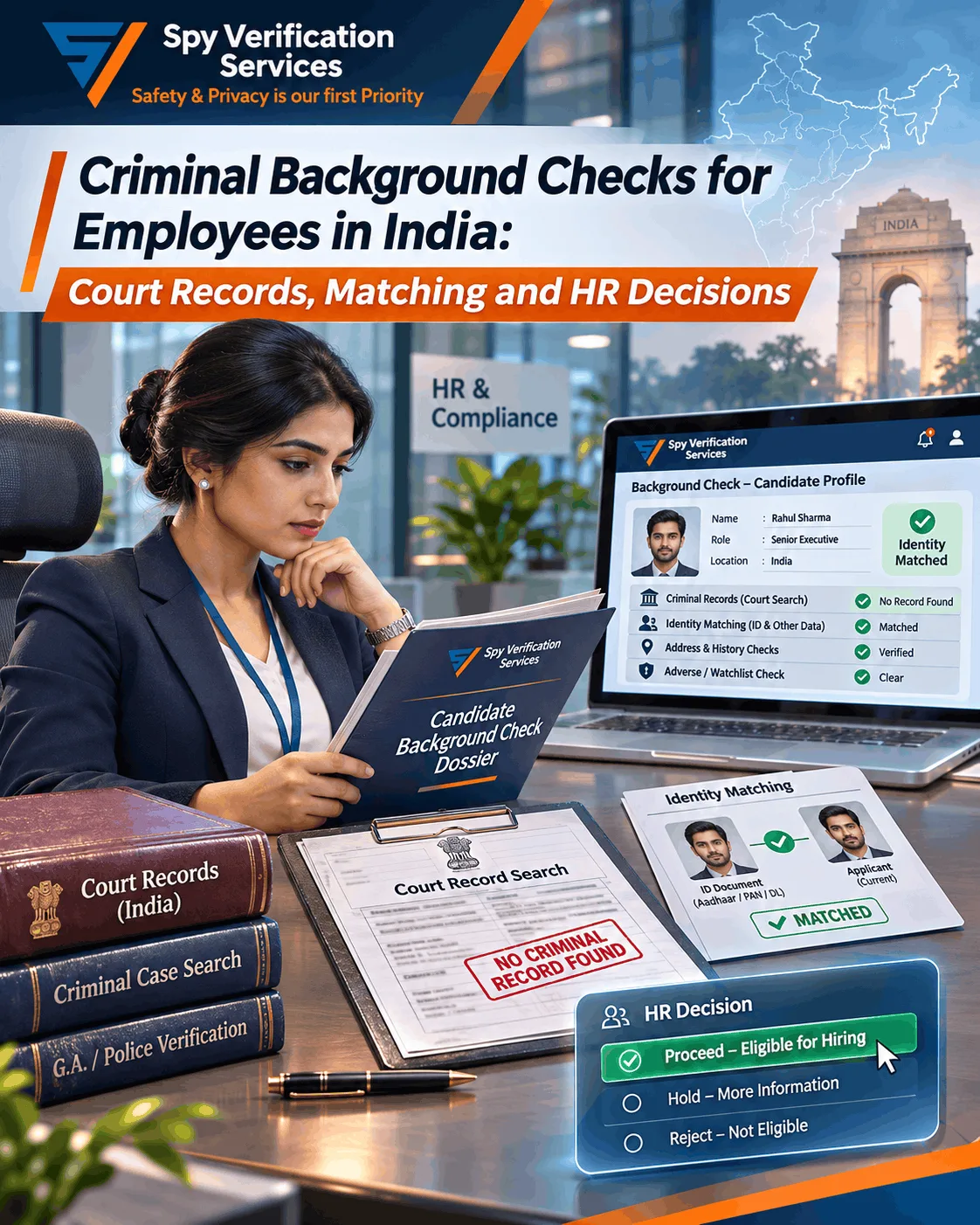
An employer reviewing an unfamiliar court-record entry must answer more than “Does this name appear in a database?” It must consider whether the record belongs to the candidate, what the proceeding concerns, what its current status is, which sources were searched and whether the information is relevant and lawful to consider for the role.
These questions matter because India’s courts deal with many types of proceedings. People may share similar names; a record may relate to a civil dispute rather than a criminal charge; a criminal case may be pending or disposed of; and a person’s involvement in a proceeding does not necessarily imply guilt.
Quick answer: A criminal background check for employees is an appropriately scoped review of relevant available criminal or court-record information associated with a candidate, using lawful sources and careful identity matching. A useful result states the search scope, evidence, case status and limitations. It does not equate a common-name match, an allegation or a pending case with a conviction.
This guide explains what employers should ask for, how public court-search systems work, why identity matching matters and how HR can evaluate findings fairly. Businesses requiring a service discussion can review Criminal and Court Record Verification from Spy Verification Services.
What is an employee criminal background check?
Employee criminal background screening is one possible component of a broader employment verification programme. It seeks to identify information within a clearly defined, lawful scope that may be material to a business decision. Depending on the assignment and legally available sources, this may involve relevant court records, case status information and authorized verification methods.
It is not a license for unrestricted searches into every part of a person’s private life. Nor is it a guarantee that no undisclosed matter exists. A report is limited by the records searched, the time of the search, available identifiers and jurisdictional coverage.
A complete Background Check Service can include employment, education and identity verification as well. Those checks answer different questions; a criminal-record search cannot prove a degree is authentic or an employment history is accurate.
Why case status matters more than a headline
A case record may display words such as “pending,” “disposed,” “petitioner,” “respondent” or “accused.” Those terms should not be collapsed into a single adverse label. A matter awaiting adjudication is not the same as a finding of guilt and a disposed case may have ended in different ways.
| Record concept | General meaning | What HR should avoid assuming |
| Pending proceeding | The matter is recorded as not finally disposed of in the selected system | That the subject has been convicted |
| Disposed proceeding | A case has reached a recorded disposition | That the result was necessarily a conviction |
| Civil case | A dispute addressed through civil judicial proceedings | That it represents criminal conduct |
| Possible name match | Search result resembles a candidate’s name | That both records relate to the same person |
| Court order or judgment | A judicial document associated with proceedings | That a summary label tells the whole story |
| No relevant result in searched records | The selected query returned no identified match | That no relevant record exists anywhere |
These are explanatory descriptions, not a substitute for interpreting a specific case record with qualified advice. The original order, chronology, parties and jurisdiction may be important.
How Indian eCourts searches work
The government-operated eCourts District and Taluka Courts case-status service provides several search options, including party name and case number. The eCourts help guide explains that a party-name search can return petitioners, respondents, plaintiffs, accused persons and other parties. That is a key reason not to assume every name hit represents an adverse criminal record.
High Court information is available through the separate High Court eCourts service. Availability and completeness of digital information vary across courts and types of proceedings.
An appropriate screening procedure should define which jurisdictions, record classes, identifiers and dates are relevant. It should document the sources actually consulted and avoid promising that a single central search conclusively covers every Indian criminal or court record.
What does a CNR number tell you?
The eCourts system uses a case-specific CNR identifier. If the correct CNR is available, it can help retrieve the corresponding case record more precisely than a broad common-name search. However, the case must still be matched correctly to the candidate before being considered in screening.
Where a possible entry is found using a name, the provider should avoid asserting identity based on a first name or surname alone. Additional lawful matching context may be needed; if adequate confirmation cannot be obtained, the finding may remain unresolved.
The biggest risk: matching the wrong individual
Imagine a candidate named R. Kumar in Delhi. A public search returns a case involving another R. Kumar in the same state. A fast name-only system may present the hit, but there is not yet a basis to conclude it belongs to the candidate.
Identity matching may require an appropriate combination of name, known location, age or other legally available identifiers and review of source documents. Not every record exposes reliable personal identifiers. The absence of sufficient information may justify an inconclusive result, not a forced match.
The verifier should ask: What information links this court entry to the actual person being screened? Is it corroborated by an authorized source? Does the case relate to the requested jurisdiction and period? Could the matching data belong to someone else? These questions should be documented.
For a separate explanation of matching identity records, see ID Verification Services.
Step-by-step process for responsible court-record screening
Step 1: establish a role-relevant purpose
The employer should first determine whether a criminal or court-record search is appropriate for the position and permissible under the applicable legal and contractual requirements. The need to check a professional credential and the need to search court records are not interchangeable.
Step 2: define the requested scope
Document the relevant jurisdictions, record categories, time or other limits as appropriate and the desired reporting detail. An ambiguous “all India complete criminal history” instruction should be clarified rather than treated as an unlimited promise.
Step 3: explain the screening to the candidate
Use appropriate notices and lawful authorization procedures. The applicable basis may vary with the type of processing, workplace context and governing law. Avoid suggesting that one generic consent checkbox automatically validates any possible search.
Step 4: establish identity matching requirements
Confirm the person’s relevant identifying information through appropriate methods before associating a court record with them. This reduces the chance of a false positive.
Step 5: search appropriate permitted sources
Use the selected official or other legally accessible sources. Where eCourts data is relied upon, note the court/jurisdiction and search method; do not imply unrestricted access to private police databases or court records.
Step 6: review possible matches manually
Check the case category, participants, available identifiers, dates and current procedural status. If the record is ambiguous, seek suitable additional confirmation rather than treating an unverified match as an established fact.
Step 7: record limitations and uncertainty
A report should distinguish relevant confirmed information, possible matches, searches that returned no identified result, pending review and sources that were unavailable. Explain scope limitations visibly.
Step 8: allow an appropriate employer decision process
The verification company should not automatically decide employment suitability. Authorized HR or compliance reviewers should consider law, relevance, accuracy, status, time elapsed where appropriate and the person’s response.
This process aligns with a broader Background Screening Policy for Indian Employers, which covers governance and review responsibilities.

What should a court-record screening report contain?
A one-word “red” or “green” outcome tells HR too little. A useful report explains the check requested, sources searched, date or period, relevant jurisdictions, factual record observations, matching limitations and pending clarifications.
| Report field | Why it helps |
| Candidate reference | Connects findings to the correct authorized case |
| Requested scope | Prevents overinterpretation beyond the approved check |
| Source and jurisdiction | Explains where the information came from |
| Search date | Records when the observation was obtained |
| Identity matching status | Shows whether a possible record was appropriately linked |
| Case status | Distinguishes ongoing and disposed proceedings |
| Evidence or record reference | Allows authorized review of the underlying information |
| Limitations | Discloses unavailable sources, uncertain matches and incomplete data |
| Correction path | Gives a route to review factual mistakes or confusion |
Some employers may request a concise summary, but the summary should not hide important caveats. Read What a Background Verification Report Includes for result definitions and examples.
Is every pending criminal case relevant to a hiring decision?
No blanket conclusion follows from the existence of a pending case. Employers should assess relevance, reliability, lawful decision criteria and the individual’s opportunity to clarify. A pending matter may not establish liability or guilt. Civil and criminal proceedings must also be distinguished.
A role-specific review may ask whether the underlying information has a demonstrable connection to duties, professional registration, regulatory requirements or access to particular resources. The answer will depend on the circumstances and applicable legal guidance.
Avoid automated rejection policies based on mere database hits and avoid publishing a candidate’s private information outside authorized channels. Any potentially adverse finding should be handled with particular care because errors can affect livelihoods and reputations.
Civil disputes, criminal allegations and convictions: three different concepts
HR teams sometimes treat “court case” as synonymous with “criminal background.” That is misleading. A civil claim, an allegation recorded in a criminal process and an adjudicated conviction are different legal circumstances.
For example, a person’s name could appear in a property dispute in which they are a plaintiff, or in an unrelated civil matter. Such a record should not be branded as evidence of criminal wrongdoing. Even within criminal proceedings, a case description is not a final finding.
The relevant records may require contextual interpretation by a qualified professional. Verification providers should communicate factual observations and sourcing; they should not invent legal conclusions that the underlying court materials do not establish.
Should employers use police verification instead of court-record screening?
Police verification, court-record review and identity verification are not interchangeable labels. Their lawful availability, purpose, source access and reporting can differ. Some particular roles or sectors may have requirements that are not satisfied by a generic web search.
Before contracting a service, ask which specific check is being offered, by whom, through what authority and with what geographic and record limitations. Do not advertise “police clearance guaranteed” simply because a public court-search tool can be queried.
When a certificate or official procedure is required for a regulated role, HR should confirm the exact statutory or institutional requirement with a suitable adviser or issuing authority.
An illustrative case of a wrong-name match
A fictional employer screens a warehouse supervisor named Amit S. The initial search returns a civil record involving Amit Sharma in another district. The names resemble each other but the candidate’s records do not establish a link to the court entry. The provider records the entry as a possible non-confirmed match, notes the jurisdiction and does not claim the candidate was a party.
The HR reviewer requests an appropriate clarification only if necessary and job-relevant. After reviewing available identifiers, the record remains unassociated with the candidate. The report documents that the search hit was not established as the candidate’s record.
This is a hypothetical teaching example, not a case handled by Spy Verification Services. Its purpose is to show why false-positive control matters as much as finding relevant records.
How employers can reduce false positives and unnecessary delays
First, use precise candidate reference numbers and correct identifiers. Second, define jurisdictions and the basis for each check. Third, keep a separation between possible matches and established findings. Fourth, set an internal escalation route when additional lawful evidence is required. Fifth, avoid promising that all records can be reviewed instantly.
A workable exception log can record the proposed match, source, date, identity indicators examined, unresolved questions, next action, reviewer and final outcome. This is a recommended HR template, not a representation that every vendor provides a built-in workflow tool.
For employers managing many workers, coordinate this reporting approach with Background Verification for Staffing Agencies, where multiple clients and worker categories may be involved.
Privacy and proportionality in employee criminal checks
Court records may contain sensitive personal details about candidates and others. Authorized users should access and share only what is necessary for a legitimate purpose. The Digital Personal Data Protection Rules, 2025 have phased commencement. As of 6 November 2026 not all substantive obligations are in force; current legal requirements and sector rules need individual assessment.
Avoid retaining screenshot collections indefinitely or sending reports to large distribution lists. Provide appropriately controlled access, security safeguards and a route for correction of factual errors. Decisions should be made under a documented employer policy with legal input where needed.
Do not assume that public availability of a court record means unrestricted reuse is appropriate in every business situation. The context, necessity and handling still matter.
How to Interpret an eCourts Search Without Overstating the Result
The official eCourts Services portal supports searches involving case details and party names. Its help instructions also explain that a party name may refer to a petitioner, complainant, defendant, accused or another party. A list of matching names is therefore a research lead, not an established finding about a particular candidate.
| Search observation | Not an acceptable automatic conclusion | Appropriate review question |
| Common-name entry appears | “This candidate has a criminal case” | Is there reliable evidence that the party is this individual? |
| Case marked pending | “The person is convicted” | What proceeding, jurisdiction and current status are recorded? |
| Entry is a civil dispute | “Criminal activity confirmed” | Is the case civil or criminal and why is it relevant? |
| No entry found in one search | “Nationwide clearance guaranteed” | What sources, locations and dates were actually covered? |
| Similar address or initials | “Perfect identity match” | Which identifiers can be independently supported? |
The result should also specify the scope of the search. Some records may be unavailable, incomplete, updated later or held in another jurisdiction. A report that states its limitations is more useful than a blanket declaration that every possible record has been checked.
India-specific HR review checklist
Before ordering: identify the position, purpose, lawful basis and geographic scope; confirm the vendor’s source access and report format. During the check: verify identity matching, distinguish pending/disposed matters and require documentation of uncertain hits. During review: assess job relevance, materiality, evidence strength and the candidate’s explanation.
Before the employment decision, ensure an authorized human reviewer has examined the actual result. Keep a consistent record of the rationale, avoid naming an unverified hit as an adverse fact and use suitable retention controls. A complete hiring decision also needs non-BGV controls such as workplace supervision, access restrictions and training when relevant.
Accurate matching protects employers and candidates
A reliable criminal background check for employees is not a search for red flags at any cost. It is a defined attempt to establish relevant facts while protecting against identity confusion, source gaps and unsupported conclusions. The strongest HR processes combine careful scope design, explainable reporting and appropriate human review.
Spy Verification Services supports businesses discussing relevant court and background verification requirements in India. Explore Criminal and Court Record Verification or request a verification discussion with your roles, locations and the specific purpose of the proposed check.
Frequently asked questions
1. What is a criminal background check for employees in India?
It is an appropriately scoped check of relevant criminal or court-record information, carried out through lawful sources with careful matching of records to the individual and transparent reporting of limitations.
2. Is an eCourts party-name search sufficient to establish that someone has a criminal record?
No. A name may appear in many roles and many types of proceedings. Search results need identity matching, case-type review and appropriate context.
3. Does a pending court case mean a candidate is guilty?
No. A pending case is not a conviction. Employers should not use it as an automatic substitute for a fair, lawful review.
4. Can two candidates have the same name in court records?
Yes. Shared names and incomplete identifiers can cause false matches. The verifier should assess sufficient lawful matching information before attributing a record.
5. Is a civil dispute the same as a criminal case?
No. They concern different legal processes. Reporting should identify the actual proceeding type rather than labeling all court entries “criminal.”
6. Can one website search guarantee no criminal cases exist anywhere in India?
No. Coverage depends on source availability, jurisdiction, record digitization and the defined search method. The report should describe its limits.
7. What should employers do after a possible match?
Review the source, confirm identity matching, assess relevance and seek appropriate clarification. Avoid automatic adverse decisions from an unverified result.
8. Is criminal checking compulsory for every job?
There is no universal identical screening requirement for every employment role. Specific roles and sectors may have applicable obligations; scope should be justified and lawful.
9. Can a verification provider reject a candidate?
The provider should report factual findings and limits. The employer or other designated authority makes the relevant hiring decision.
10. What should an employee criminal-screening report include?
It should disclose requested scope, sources and jurisdictions, matching status, case status where relevant, supporting observations, unresolved issues and an appropriate correction route.