A candidate sends a resume, a degree certificate and an identity document to a recruiter. The recruiter forwards them to a screening provider. A few days later, the provider discovers that the previous employer’s legal name is missing, the degree certificate has no usable registration number and the address listed is an old residence. The case must return to HR before meaningful checks can begin.
This fictional situation illustrates a common intake problem: collecting a large bundle of files is not the same as collecting the correct information for the agreed background verification. The best employee screening document checklist should tell HR what each record is for, whether it is relevant and what to do when the usual evidence is unavailable.
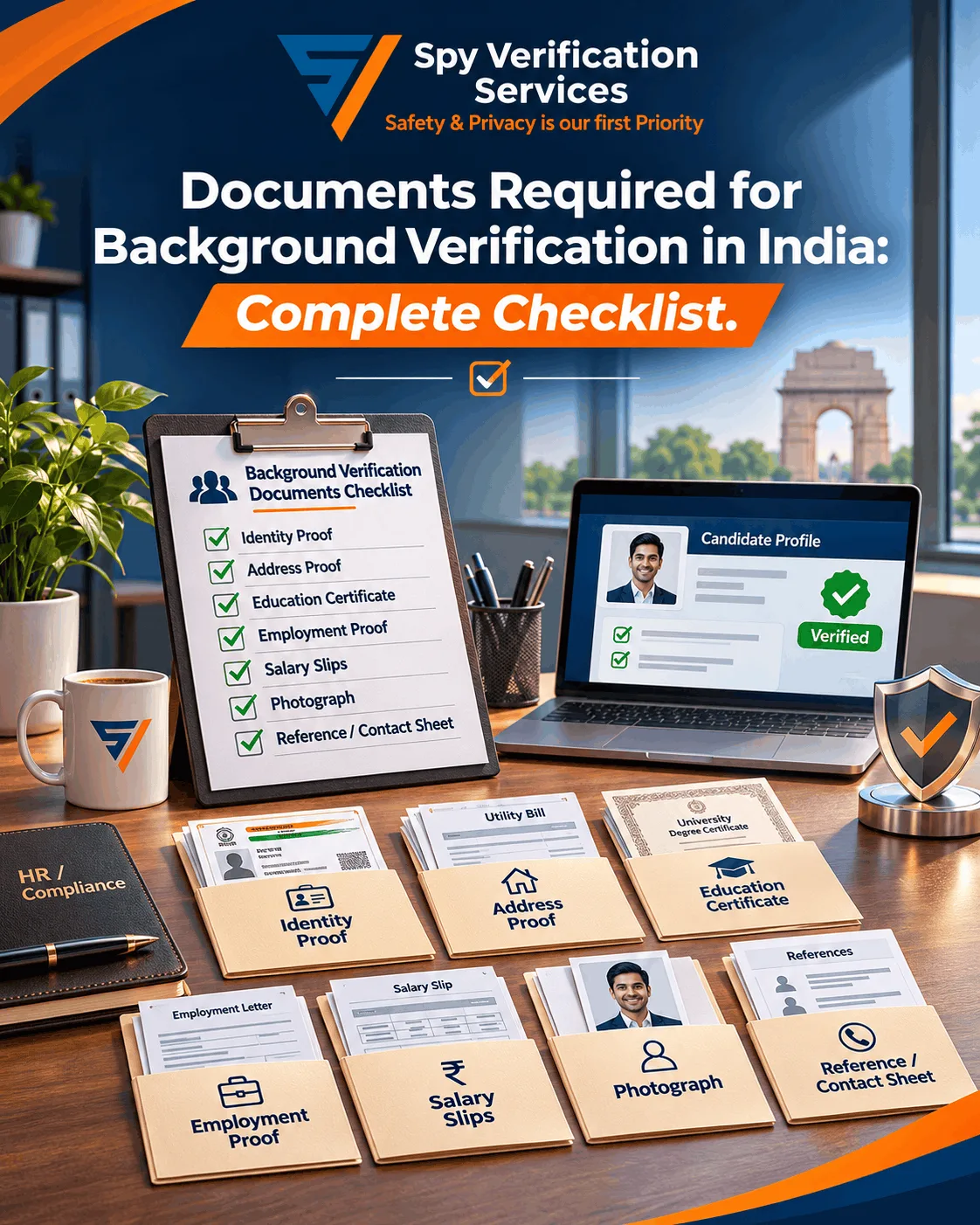
Quick answer: Documents required for background verification in India depend on the checks selected for the job. Common categories include suitable identity evidence, relevant education credentials, previous employer details and supporting employment records, and address information when that check is justified. The minimum request is the information needed for the selected check; a document that is merely available is not automatically required. Professional licences or additional identifiers may be required for specific checks. There is no universal document list that every applicant must supply.
At Spy Verification Services, employers can discuss the appropriate intake requirements through our Employee Background Verification Services page. This guide provides a check-wise preparation framework for HR professionals, recruitment teams and candidates.
Background verification documents: the check-wise master list
Before asking for files, identify the actual claims the employer intends to check. A document used for identity may also contain an address, but it does not establish that the address is current. Employment documents may contain salary information, but salary need not be reviewed if the only relevant question is employment tenure.
| Check requested | Potential documents or information | Important distinction |
| Identity | Accepted ID or authorized digital credential; necessary identifiers | Document authenticity and holder identity are separate questions |
| Previous employment | Legal employer name, dates, employee ID, appropriate HR contact, relevant letters | A submitted letter is not independent employer confirmation |
| Education | Institution, course, award year, enrolment identifier, degree or diploma | A certificate image is not proof that its issuer confirmed it |
| Address | Exact address being checked; suitable supporting evidence | A permanent address is not necessarily current residence |
| Court records | Relevant identifiers and location history for agreed searches | A similar name does not establish that a record belongs to the person |
| Professional registration | Registration number, credential and issuing authority | A qualification may not prove current professional authorization |
| References | Relevant referee and relationship information | Personal references do not replace official records |
This is a planning matrix, not a request for every document in every category. The scope and accepted evidence should be decided before collection, in accordance with applicable requirements and job relevance.
Minimum information versus additional supporting evidence
A document checklist works best when the recruiter distinguishes the information needed to initiate a check from evidence that may be necessary only if the first source cannot confirm it. The following intake rule is a starting point, not a mandatory legal list.
| Check | Start with | Request more only if needed |
| Employment history | Employer, declared dates and relevant employee identifier | Specific employment letter or other evidence for the unresolved claim |
| Academic qualification | Awarding institution, award name, year and record identifier | Particular certificate, transcript or issuer-confirmed alternative |
| Address | Address in scope and accepted evidence route | Relevant alternative if the chosen evidence is insufficient |
| Identity | Approved identity method and necessary fields | Clarification of a material mismatch using appropriate records |
For a new graduate, the absence of employment history does not trigger a request for salary records. For an experienced employee, an offer letter may be insufficient if the question concerns actual dates worked. Make the purpose explicit in each request so that a candidate is not encouraged to collect unnecessary records.
Identity documents required for employment background checks
An identity check should establish relevant identifying information using an appropriate method. HR should explain what is accepted for its actual process rather than automatically demanding a particular document without considering available alternatives.
What HR may need
Depending on the method, a candidate may provide an accepted government-issued record such as a PAN card, passport or driving licence, or participate in an applicable authorized Aadhaar or digital-document verification route. Required fields may include name, date of birth or other necessary identifiers. The appropriate document for payroll may differ from the most suitable evidence for a background screening question. Under the Aadhaar Act, voluntary Aadhaar verification has specific consent, purpose and alternative-identification safeguards. An offline verification-seeking entity cannot collect, use or store an Aadhaar number or biometrics outside the restrictions in that framework. Do not make an unmasked Aadhaar copy the default BGV intake requirement or assume a third party may perform offline verification on an employer’s behalf.
A name variation between records can arise because of initials, spelling, marriage, transliteration or a historical change. Ask which record contains the currently correct information and obtain appropriate supporting clarification if necessary. Do not assume inconsistency is proof of impersonation.
How to handle copies and digital evidence
A photograph of a card can be useful for intake, but its visual appearance alone does not establish authenticity. Where appropriate, verify the relevant details through an authorized source or document-signature method. If only a limited field or confirmation result is needed, avoid retaining unrelated data. The candidate should not be asked for private portal passwords or to forward OTPs as a substitute for an authorized workflow.
For further information on available check categories, explore Identification Verification Services.
Employment verification documents for experienced candidates
Employment screening often requires more than the last offer letter. The central question is which part of the work history the employer needs to confirm. A role requiring two years of a particular type of experience may require different evidence from a role whose eligibility does not depend on previous employment.
Primary intake information
Request the full legal employer name where known, name used during employment, declared joining and exit dates, designation and a relevant employee identifier if available. Where an applicant worked through an agency, identify the payroll employer separately from the client workplace. The verification request should reach a source capable of confirming the claim rather than a contact chosen simply because the brand name is familiar.
Supporting employment records
Possible supporting documents include appointment letters, experience certificates and relieving letters. An appointment letter may show an intended start date without confirming that the candidate actually joined. An experience letter may support the dates and role stated by the issuer, subject to authenticity and source reliability. A relieving letter may address employment ending details but not performance or every responsibility.
Where relevant and justified, additional evidence can include selected payroll records, Form 16 or authorized EPFO service-history information. These sources have limits. A salary credit does not independently establish a job title. A provident fund record may not cover every work arrangement. The EPFO official website provides member-service information; use only relevant records obtained through an appropriate authorized route. A failure to locate an EPFO record is not sufficient to disprove the stated employment. Do not ask candidates to provide an unredacted financial history simply because one limited payment record would be useful.
Refer to our employment verification services for the relevant service category. If a previous employer is unavailable, the detailed guide on employment verification when a previous company has closed explains alternatives and their limitations.
Education verification documents for freshers and professionals
The purpose of education verification is to establish whether a particular qualification, academic record or other relevant claim can be supported by its appropriate source. Recruiting teams should identify which credential is material before requesting multiple certificates and mark sheets.
Documents and details that may be required
Record the actual awarding institution, college or affiliated institution if relevant, qualification name, course or specialization, passing year, enrolment or registration identifier and a copy or appropriate digital record of the credential. If marks or attendance dates are essential to the check, identify those fields explicitly rather than including them by default.
In India, a college name and a degree-awarding university may differ. Verify the correct institution and programme for the relevant period. If the applicant provides a provisional certificate, distinguish that from the final award and ask what evidence is sufficient for the employer’s role requirement.
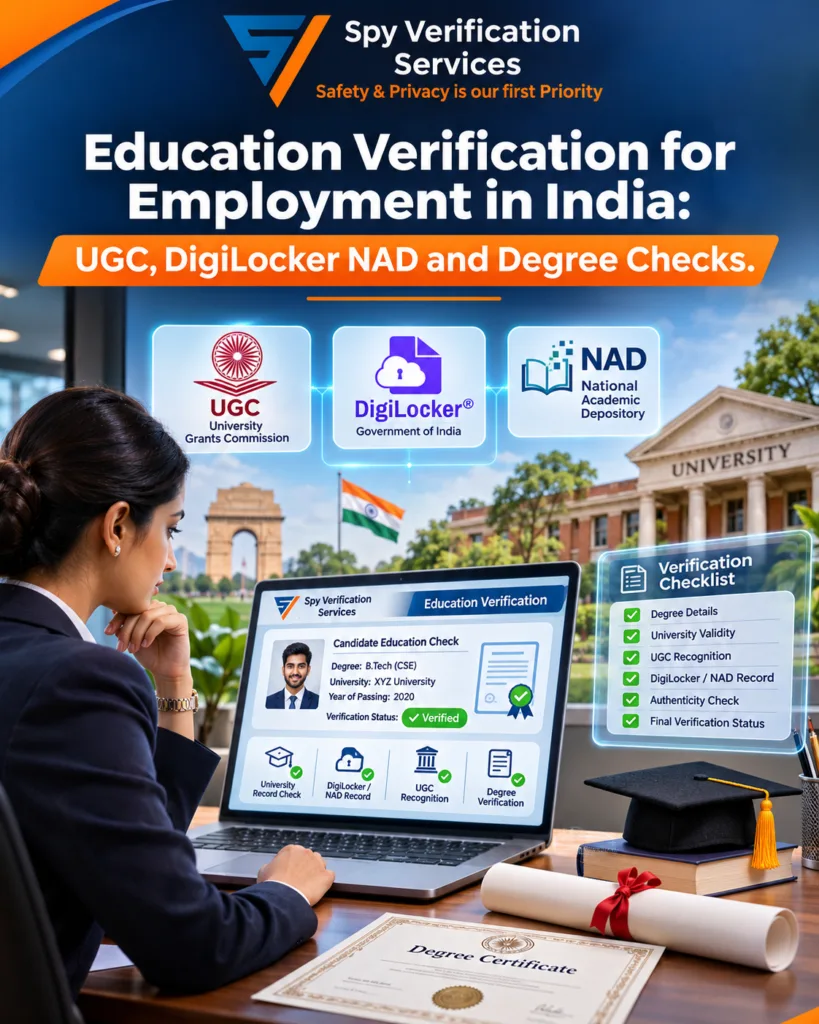
Using DigiLocker and academic records
The National Academic Depository supports digital academic awards issued by participating institutions. An issuer-provided record can be useful for authorized verification. A document uploaded by the user is a different type of record and should not automatically be treated as issuer-confirmed. Older awards and non-participating institutions may require alternate confirmation. The absence of a digital record does not prove the qualification is invalid.
For job-relevant credentials, visit our Education Verification Services page. Confirm the required document and issuer route for your particular assignment.
Address verification: which records should be collected?
When the approved screening scope includes address verification, start by identifying the specific address and the reason for checking it. Current, permanent, previous and correspondence addresses are different fields. A rental agreement or utility record may support a connection to an address, but it does not automatically establish present residence for every person named in the application.
Useful information may include the complete address, PIN code, duration of residence and relevant supporting documentation accepted by the agreed method. If the person is temporarily residing in a different city, record that accurately. For physical verification, clarify arrangements for a proportionate visit, appropriate candidate communication and respectful treatment of other residents.
Avoid collecting unrelated household information or assuming that the absence of a utility bill in the candidate’s name signals dishonesty. Many people live with relatives, share accommodation or move frequently. A suitable alternative method can be discussed with the provider of Address Verification Services.
Documents for criminal and court-record screening
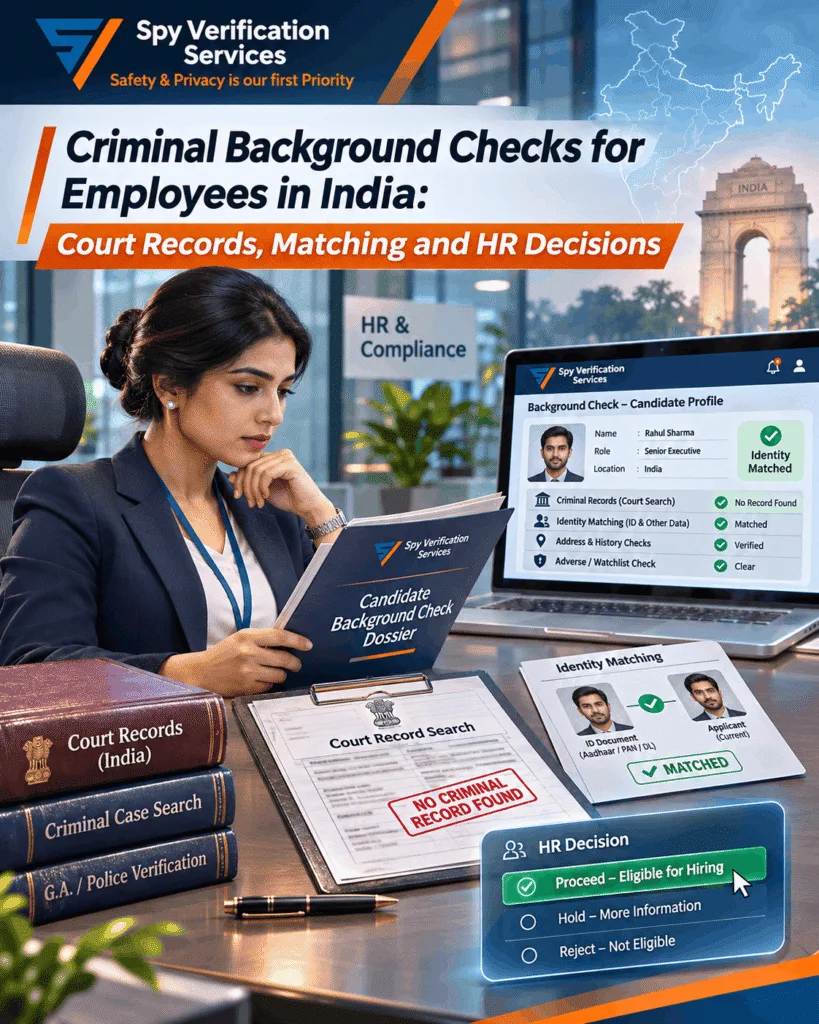
An appropriate record search needs enough contextual information to avoid confusing different individuals. The exact identifiers and geographical scope depend on the method and authorized purpose. A candidate’s relevant name variations and address history may assist matching. They should not be collected for an unrestricted search of private information.
A general court-record screening is not the same as a police clearance certificate. If a particular certificate is required, identify the authority responsible, the reason for the requirement and the actual process for obtaining it. A record associated with a similar name must not automatically be attributed to the applicant. Nor is the existence of a pending case the same as a conviction.
Employers should ask how the criminal and court-record verification service defines scope, examines matching evidence and reports ambiguous results. Additional identifiers should only be requested when genuinely necessary and appropriately handled.
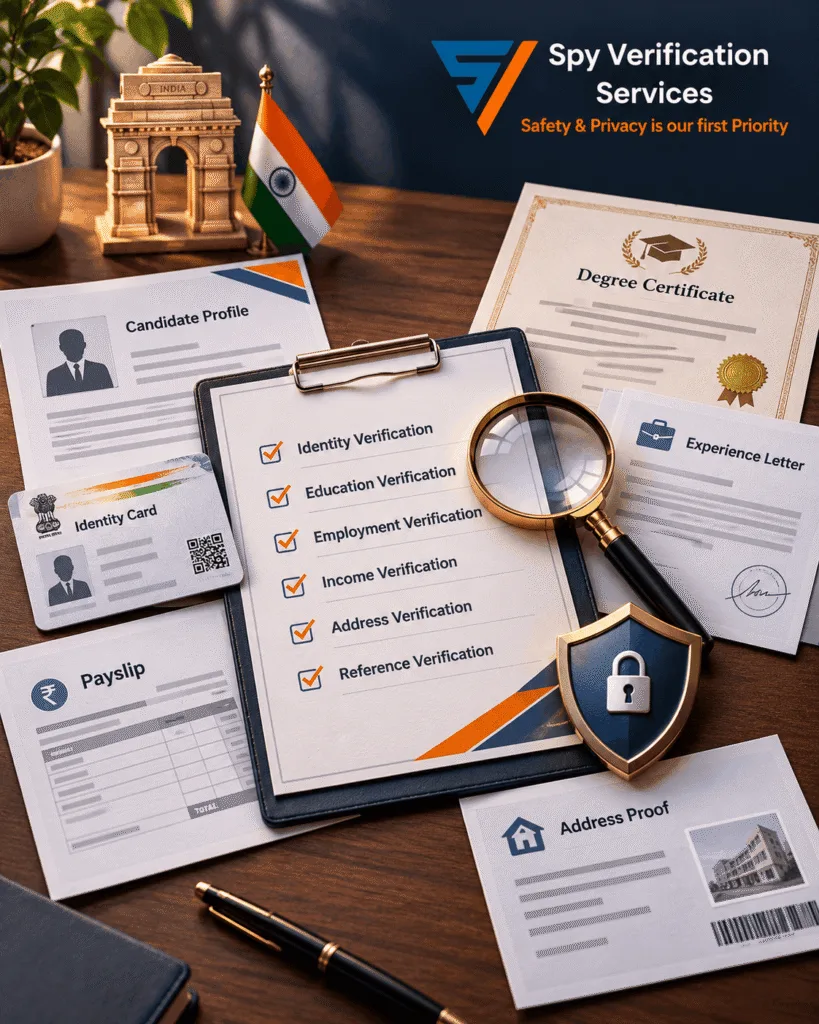
Background verification document checklist by candidate type
Recruitment teams can use the following three mini-checklists to avoid sending identical requests to everyone.
Freshers and first-time employees
Accepted identity information for the defined check.
Relevant academic credential, institution and award or completion information.
Internship or apprenticeship information only if it forms a material employment claim.
Address or professional registration records where the approved scope requires them.
A first-time employee should not be penalized for lacking experience letters from a previous full-time role that they never held. Where the role genuinely requires a qualification, verify it using the appropriate source instead of substituting a generic document-count rule.
Experienced employees
Accepted identity information and necessary matching identifiers.
Relevant previous employer names, dates and employment identifiers.· Appropriate experience, relieving or other supporting documents for the work history selected.· Essential education or professional credentials and any other justified check information.
The employment lookback period or number of employers should be agreed. A request to verify all employers since a person entered the workforce may be unnecessary for a role that relies on a defined recent period. Collect the information needed for the actual approved programme.
Contract and outsourced workers
The worker’s relevant identity and role-related credential information.
Correct identification of the staffing agency, legal employer and client site where relevant.
·Relevant experience and authorization information required for the assignment.
Address or other necessary check details based on the documented duties.
The staffing vendor and client should agree who collects data, who receives the verification report and who resolves exceptions. See the contract employee background verification guide and background verification for staffing agencies.
What if a required background verification document is missing?
Missing documentation is not a single type of result. It may reflect an unavailable original, the wrong document request, a source that uses a different record format or an applicant who needs clarification. An intake reviewer should identify which fact remains unsupported before requesting more material.
| Missing or problematic record | Potential next step | What remains important |
| Relieving letter | Relevant experience record, authorized employer response or other evidence | Verify dates through suitable sources where possible |
| Final degree | Provisional award, institution confirmation or issuer-provided digital record | Establish the actual completion or award status |
| Old payslip | Appropriate alternative employment evidence | Do not request unnecessary salary information |
| Utility bill in own name | Suitable rental or other approved address evidence | Consider actual residence arrangements |
| Old employer contact | Identify the legal employer, successor or appropriate records custodian | A company register cannot prove the person’s employment |
| Name differs across documents | Ask for an explanation and relevant supporting record | Evaluate materiality and identity context |
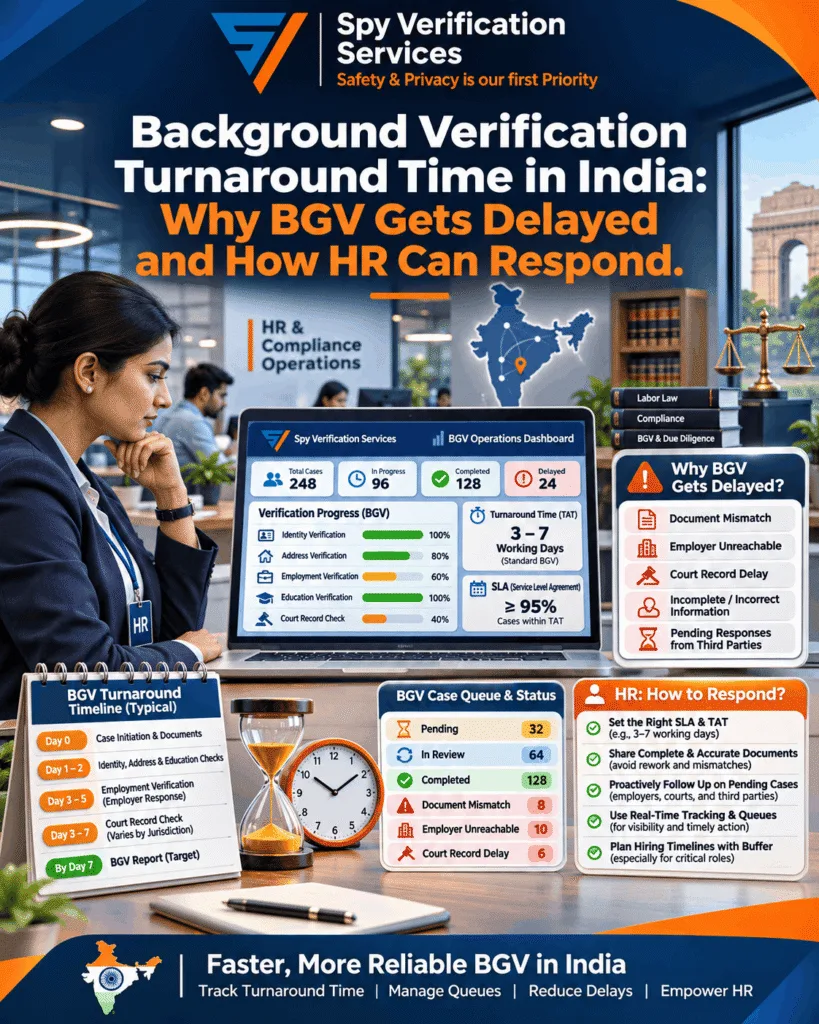
A provider may classify a check as pending, insufficient information or unable to verify according to the circumstances. These outcomes are distinct from a verified discrepancy. Employers should have an exception and review process rather than treating missing paperwork as an automatic failed BGV result.
How HR should collect background verification documents securely
Step 1: Send a role-specific request
Explain the job-related purpose, check categories, necessary documents and approved alternative routes. A short request with clear instructions is easier to complete than a list of every document theoretically obtainable. Make it clear where questions can be raised.
Step 2: Use a controlled channel
Use an approved channel with appropriate access restrictions. Avoid shared public folders or sending candidate records to broad distribution lists. The chosen method should protect personal information while allowing authorized parties to perform the required verification.
Step 3: Perform intake quality checks
Confirm that the necessary fields are present, files are readable and the candidate details can be matched. A scanned certificate with an unreadable registration number may need replacement. Log the specific issue and request only the missing information.
Step 4: Track document and verification statuses separately
An item received is not necessarily an item verified. Maintain separate states for required information received, check initiated, source response received, review required and completed finding. A dashboard that combines these stages into one “completed” label can conceal unresolved work.
Step 5: Resolve and close intake exceptions
Record the specific gap, person responsible for resolving it, agreed next step and review date. Once the issue is resolved, update the record without silently overwriting material earlier findings. Relevant documents should be retained or disposed of according to applicable policies and legal requirements.
An HR intake tracker you can adapt
The following original example shows how a recruiter could organize a small batch. It uses fictional case identifiers and no real candidate information.
| Case | Requested check | Intake issue | Owner / next action |
| C-101 | Prior employment | Client site listed as employer | HR to confirm staffing employer |
| C-102 | Education | Final degree unavailable | Candidate to clarify provisional record |
| C-103 | Address | Current address differs from permanent | HR to confirm relevant address scope |
| C-104 | Identity | Initials differ across two records | Reviewer to determine relevant clarification |
Track each check as its own row when candidates have multiple checks. Add a request date, status, approved evidence route and review owner in your actual tracker. Do not place full identity numbers, credentials or financial records in an unrestricted tracking sheet. A case identifier is generally sufficient for coordination; documents can remain in the authorized repository.
Worked intake example: reducing unnecessary requests
In a fictional hiring batch, HR receives three incomplete check requests. One candidate applied for a first job and was incorrectly asked to supply a relieving letter. A second candidate worked through a staffing firm but listed only the client organization. A third has an issuer-provided digital credential rather than a printed degree.
| Case | Initial problem | Corrected intake action |
| C-201 | No previous employment | Remove irrelevant employment-document request |
| C-202 | Client listed as employer | Identify the legal employer and relevant employment dates |
| C-203 | No paper degree | Assess appropriate issuer-provided award and verification route |
The objective is to correct the intake scope, not to mark all three cases verified. The second case still needs an appropriate employment source; the third needs the credential examined according to the relevant award requirements. The first case may be closed as not applicable for the previous-employment check. These are fictional examples, not actual SVS records.
A recruitment coordinator can track the number of cases ready for submission on the first intake and the number returned for missing relevant information. Use those measures to improve instructions, not to encourage the collection of every possible document.
Sample email requesting documents from a candidate
The following is illustrative wording for an employer to adapt to its policy and lawful processing arrangements.
Subject: Documents needed for your agreed pre-employment verification
Dear Candidate, to complete the background checks relevant to your role, please submit the requested identity, employment and education information listed in your individualized checklist using our approved secure channel. If any item is unavailable or your records use different names or dates, please contact the designated HR representative so we can explain suitable alternatives. Please do not send private account passwords or authentication codes. Further information about our screening purpose, data handling and available clarification process will be provided through the appropriate company channel.
This wording is not a complete privacy notice or legal authorization form. It should be adapted to the employer’s actual arrangements and reviewed appropriately.
What candidates should check before uploading BGV documents
Make sure the recruiter or verification provider is genuinely authorized by the employer. Check that the request corresponds to the intended role. Confirm dates against legitimate records, explain genuine variations and use readable copies or an appropriate official digital-sharing method. Do not alter a document to make dates or names appear consistent. A correction from the issuing authority or explanation is preferable to misrepresenting evidence.
If asked to disclose unrelated financial records, personal account credentials or information outside the previously communicated scope, ask the designated employer representative for clarification. A candidate can be cooperative while still protecting their personal information.
Document collection, privacy and the background screening process
The applicable lawful basis, notices, authorization and information-security requirements depend on the screening activity. India’s Digital Personal Data Protection Act, 2023 and Rules, 2025 have phased commencement; review the official rules and enforcement timeline and other relevant requirements before implementing a collection process.
Employers should define who can access files, how records are shared with approved providers, when information is no longer necessary and how challenges can be raised. The background screening policy guide explains the governance framework; our background check process guide covers the wider checking journey. This article is specifically about intake and documentation.
Frequently asked questions about documents required for BGV
1. What documents are required for a background check for employment?
The list depends on the agreed checks. Relevant identity information, educational credentials, employment history and address evidence are common categories, but not every applicant needs every document.
2. Is Aadhaar compulsory for every background verification?
There is no universal requirement that every private employment background check must use Aadhaar. The applicable legal framework and the specific purpose determine suitable accepted methods and alternatives.
3. Do freshers need employment documents?
Not for work history they do not have. Internship or apprenticeship records may be relevant when those experiences form part of the applicant’s material claims.
4. Can I complete BGV without a relieving letter?
A missing relieving letter need not end the process. The employer can consider other appropriate evidence and source confirmation based on its approved scope.
5. Is a DigiLocker-uploaded certificate enough?
A user upload is not automatically equivalent to an issuer-provided digital record. Verify document origin and determine whether an independent issuer route is available.
6. Does BGV require bank statements?
Not for every check. Financial documents should only be requested where they are genuinely relevant, lawful and necessary for an agreed question.
7. What if a degree certificate is not available yet?
A provisional award or appropriate institution confirmation may help, depending on the employer’s requirement. The report should state the actual status of the qualification.
8. Should candidates send original documents by post?
Use the approved method specified by the authorized organization. Original physical records should not be sent to an unverified party; suitable copies or issuer-based methods may be available.
9. Does a missing document mean I failed background verification?
No. Missing information may result in a pending or inconclusive check, depending on the case. It is not automatically evidence of false information.
10. How can employers reduce BGV document-related delays?
Define the scope first, provide clear check-specific instructions, identify alternative evidence routes, perform an intake quality review and track source delays separately.

Conclusion
Knowing which documents are required for background verification helps employers initiate more relevant checks with fewer unnecessary repeat requests. It also helps candidates understand what is being checked and prepare suitable evidence. A strong intake process respects the difference between a submitted record and a verified finding.
Spy Verification Services supports employer screening enquiries across India. Discuss your employee background check requirements and request the appropriate documentation checklist for your approved scope.