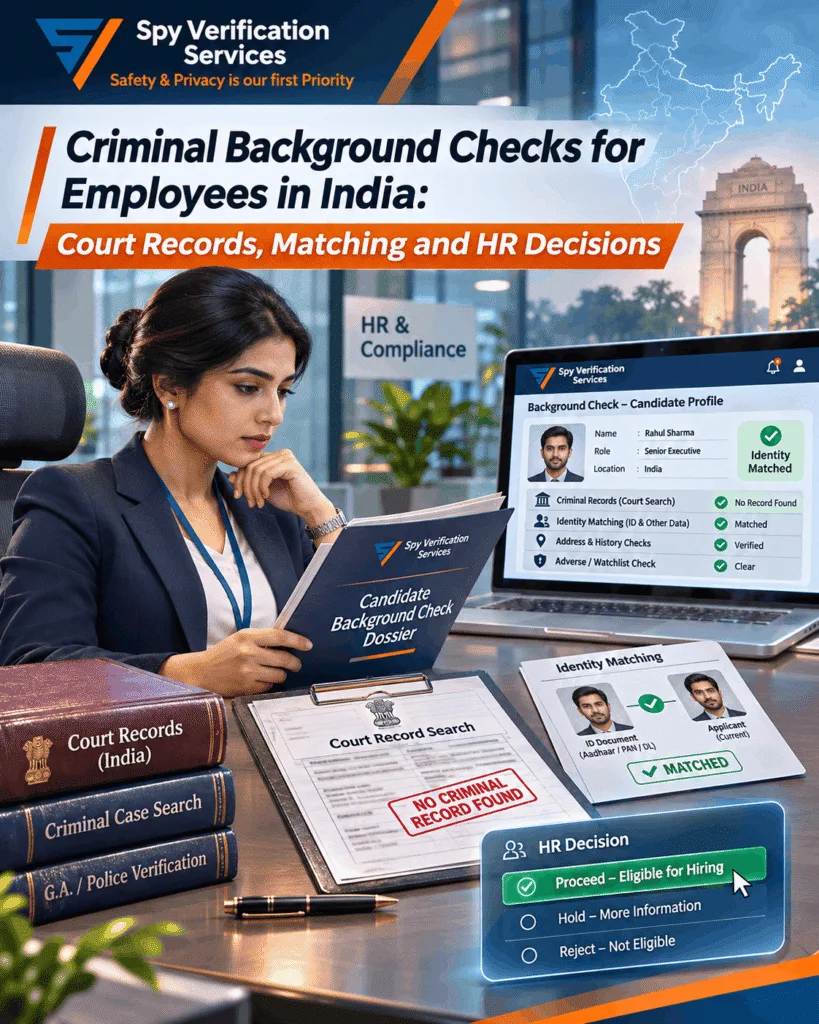

A warehouse hires seasonal workers through two staffing agencies. An IT company engages a contractor to maintain a critical system. A hospital uses outsourced support personnel who need controlled access to its premises. In each situation, the recruitment relationship differs-but the organisation still needs to know which worker information has been checked, by whom and for what purpose.
Quick answer: Background verification for contract employees is the role-relevant checking of information such as identity, employment, qualifications or appropriate records for people engaged on fixed-term or third-party arrangements. The client organisation and staffing provider should agree who obtains appropriate authorisation, orders checks, reviews findings and decides on workplace access. Not every worker requires every check.
This practical guide focuses on screening governance, staffing-agency coordination, onboarding decisions and worker privacy. For help assessing screening options, see Background Screening Companies in India from Spy Verification Services.
First, identify which type of worker is being engaged
The terms “contract employee,” “outsourced worker” and “independent contractor” are often used loosely. They are not interchangeable legal categories. Their exact status depends on the working arrangement and applicable law.
| Engagement type | Example | Screening coordination question |
|---|---|---|
| Direct fixed-term employee | An organisation recruits an employee for a defined project period | Which internal HR function sets and reviews checks? |
| Staffing-agency or third-party supplied worker | A vendor supplies people to a warehouse or facility | Which party notifies the worker and who receives the report? |
| Independent contractor or consultant | A specialist provides services under a separate contract | Which checks are relevant to system, premises or customer access? |
The company receiving the services should not assume that every third-party worker has already been screened. Equally, screening should not be expanded merely because a worker is temporary. Focus on actual responsibilities, access and lawful purpose.
When is contractor background screening appropriate?
A short assignment can involve high-impact responsibilities; a long assignment can involve limited access. A sensible policy considers the nature of the work rather than employment duration alone.
Possible triggers include access to restricted premises, customer information, financial systems, vehicles, hazardous equipment, regulated professional duties or valuable inventory. Identity verification may be relevant in many onboarding contexts, while professional registration is meaningful only for roles where it is required.
Background screening cannot guarantee safe conduct and should never replace safety training, competency tests, workplace supervision, access controls or legally required qualifications. It is one layer of due diligence.
A practical contract employee verification matrix
The following matrix is a suggested policy-design example, not a statutory schedule or a package currently offered by Spy Verification Services. Each employer should determine its own lawful and proportionate requirements.
| Role or work setting | Potentially relevant checks | Separate operational safeguard |
|---|---|---|
| Warehouse inventory worker | Identity and relevant prior employment; address only if justified | Site induction, inventory access controls |
| Delivery driver | Identity, relevant employment and appropriate driving licence verification | Licence class check, vehicle training |
| Contract IT administrator | Identity, relevant employment and role-related qualifications | Least-privilege access, log monitoring |
| Industrial maintenance technician | Identity, relevant employment and applicable trade credentials | Practical skills assessment, safety permits |
| Healthcare professional on contract | Qualification and current professional registration, plus other relevant checks | Credentialing and clinical supervision |
| Temporary retail support worker | Identity and limited role-based screening where justified | Cash handling procedures, supervision |
The matrix prevents two common extremes: treating every worker as a high-risk case and treating contract workers as outside the organisation’s onboarding controls.
Who should do what: staffing agency, client and BGV provider?
The responsibility split should be written down before screening begins. The table below is an illustrative model; it does not override contractual or statutory responsibilities.
| Task | Typical coordinating party | Essential control |
|---|---|---|
| Define acceptable checks | Client HR / compliance | Role-specific written screening standard |
| Explain screening and collect information | Authorised recruiter or staffing agency | Appropriate notice and lawful basis/authorisation |
| Place verification request | Agreed client or vendor contact | Clear scope and correct candidate reference |
| Perform source-based checks | Background verification provider | Reliable sources and documented limitations |
| Resolve missing data or discrepancies | HR or staffing coordinator with candidate | Secure escalation and opportunity for clarification |
| Approve workplace or system access | Client-designated decision maker | Policy-based review of verified and pending results |
| Revoke access at end of engagement | Client IT / facilities with vendor coordination | Prompt return of passes and access closure |
Editorial implementation note: A formal vendor agreement should specify report recipients, permitted uses, candidate communication, information security, data retention, rechecks and dispute resolution. A BGV provider reports findings; it should not make the client’s final hiring or access decision.
Seven steps to verify contract employees before onboarding
Step 1: Map the role to genuine risks
List the worker’s tasks, access permissions and any credentials required. Avoid adding court searches or other intrusive checks by default if they are not relevant or justified.
Step 2: Confirm the engagement and accountable parties
Is the worker engaged directly, through a staffing agency or under a service contract? Record who is responsible for the screening request, the worker’s questions and the final review.
Step 3: Provide appropriate notice and authorisation
Explain the purpose and scope of checks and obtain the lawful basis, authorisation or consent appropriate to the circumstances and applicable requirements. Avoid broad requests for documents unrelated to the role.
Step 4: Collect accurate information securely
Use a defined list of required details. Where relevant, confirm name variants, previous employers, employment dates and credentials before placing checks. Secure portals or other approved channels are preferable to unstructured sharing in group chats.
Step 5: Perform the selected checks
An appropriate provider may contact former employers, verify educational credentials, assess documents or conduct other agreed checks through appropriate sources. For further detail on tenure confirmation, refer to Employment Verification Services. For properly justified residence information, see Address Verification Services.
Step 6: Review statuses and unresolved cases
A report may show verified, discrepant, pending or unable-to-verify results. One unresolved check does not automatically prove misrepresentation. The employer should determine whether further information is needed and what access decision is appropriate under its policy and the law.
Step 7: Record the onboarding decision and manage changes
Document who approved access, whether any checks remained pending and the follow-up date. When the assignment ends or responsibilities change, review access rights and whether any further role-relevant verification is appropriate.

Worked example: seasonal warehouse onboarding
Fictional scenario-not a real customer project. A distribution centre plans to onboard 60 seasonal workers supplied by two staffing agencies. One agency has a complete set of candidate details; the other has missing past-employer dates for several workers.
The client establishes one screening standard for equivalent warehouse roles. Each agency communicates the screening notice, collects required details and submits candidates through an agreed process. The verification team records the checks requested, findings and pending items. Client HR reviews exceptions against the same decision criteria.
One worker’s previous employer has closed. Instead of labelling the worker as dishonest, the report records that the original source is unavailable. HR asks for appropriate supporting evidence and decides whether further review is needed. A second worker’s name has a spelling variation; identifying records are checked before the finding is attributed to that person.
The lesson: Fairness and accuracy come from shared screening standards and traceable exception handling. The scenario does not promise that any particular check will produce a result or a fixed turnaround time.
What if a contract worker’s background check is pending?
A pending result should be visible in the worker’s onboarding record rather than silently treated as clear. The client should define in advance which roles, checks or access categories require a completed result before work begins, and how exceptions are authorised.
For example, a company may have different controls for an office visitor and a contractor who administers production systems. Whether restricted or conditional access is lawful and appropriate requires assessment under the organisation’s policy, sector rules and actual duties. A BGV provider cannot guarantee the legality of provisional onboarding.
To interpret statuses and ambiguous results consistently, see What Does a Background Verification Report Include? after the companion article is published.
Contract workforce screening checklist for HR teams
Before deployment, confirm the following:
☐ The worker’s engagement category and assigned duties are documented.
☐ Screening checks have a stated role-related purpose.
☐ The client and vendor have agreed who contacts the worker and orders checks.
☐ Appropriate privacy notice and authorisation requirements have been addressed.
☐ Candidate records are collected through an approved secure channel.
☐ Any employment, qualification or licence claim critical to the role is routed to a suitable check.
☐ The report distinguishes confirmed, discrepant, pending and unavailable results.
☐ HR or a designated reviewer has a documented discrepancy process.
☐ Workplace and system access decisions are authorised and recorded.
☐ The end-of-contract access-removal process is assigned to an owner.
This checklist is intended as a starting framework, not a substitute for a company’s legal, HR or industry-specific policies.
How should a staffing company assess a BGV partner?
Ask about the provider’s verification methods, not just its promise to be fast. A credible evaluation should cover (1) role-relevant scope, (2) serviceability across required locations, (3) handling of common-name matches, (4) evidence and report format, (5) escalation of non-responsive sources, (6) secure data transfer, (7) correction and dispute processes, (8) practical processing timelines and (9) reporting across multiple hiring vendors.
A provider that can explain limitations is often more useful than one that promises every check will come back as a definitive pass or fail. Businesses comparing Background Verification Agencies in India should request an anonymised report example and written service scope before onboarding a vendor.
Privacy, fairness and Indian legal considerations
Background screening uses personal information. Employers and staffing vendors should define legitimate purposes, agree on responsibility for handling personal data, minimise collection, restrict report access and establish review and retention procedures appropriate to the situation.
India’s DPDP Act commencement notification and Digital Personal Data Protection Rules, 2025 set different commencement dates for different provisions. As of October 2026, employers should not assume all provisions are already in force. Other current laws, sector requirements, employment rules and contractual obligations may also apply.
Screening must not rely on unexplained adverse inferences. A missing record, employer non-response or address mismatch can have benign explanations. Candidate clarification and reliable record attribution matter. Legal and compliance teams should review the actual screening policy, particularly for regulated roles or record checks.
How Spy Verification Services can help
Spy Verification Services, based in Delhi NCR and operating since 2016, describes background screening support for employers and staffing firms across India. Its website lists employment, education, identity, address and other verification categories. Organisations planning third-party workforce screening can ask the team which checks are available, what the report will contain and how location-specific limitations are handled.
For a requirements discussion, visit Background Check Services or contact Spy Verification Services. Explain the types of workers, locations, approximate volume and the specific checks relevant to the roles rather than requesting the largest package by default.
Conclusion
Effective Background Verification for Contract Employees starts with clear responsibilities, relevant checks and fair review-not with screening every worker for everything. HR teams should know who authorised each check, which source supports each finding, who handles disputes and who approves workplace access.
If your organisation is recruiting contract, temporary or outsourced workers, speak to Spy Verification Services about screening options matched to the work and locations involved.
Frequently asked questions about contract employee background verification
1. Is background verification compulsory for every contract employee in India?
There is no universal requirement that every contract employee undergo the same set of checks. Requirements depend on role, applicable law, regulatory obligations, contracts and the organisation’s legitimate screening policy.
2. Who is responsible for background checks when a staffing agency supplies workers?
The responsibility should be expressly allocated among the staffing agency, client and verification provider. The actual legal duties depend on the working arrangement and applicable law; outsourcing recruitment does not automatically resolve all client responsibilities.
3. Are a contract employee and an independent contractor the same?
Not necessarily. They can involve different contractual and legal relationships. Employers should determine the genuine arrangement and define appropriate checks and data-handling responsibilities accordingly.
4. What checks are commonly considered for temporary warehouse staff?
Identity and relevant prior employment may be considered, with further checks only if justified. Screening does not replace site induction, training, access controls or supervision.
5. Can a staffing agency verify employment and education details?
Yes, where it has an appropriate basis and follows applicable requirements. Checks should rely on relevant sources and report unresolved findings rather than overstate certainty.
6. What happens if a previous employer has closed?
The verification team should explain the source limitation and evaluate whether suitable alternative evidence is available. An unavailable employer does not automatically prove the worker misrepresented their history.
7. Should work begin while verification is pending?
That depends on the role, pending check, employer policy and applicable requirements. Any conditional access arrangement should be properly assessed and authorised; it is not a universal recommendation.
8. Is police verification the same as a court-record search?
No. Police verification processes and court or criminal-record searches may use different legal routes and sources. Confirm which check is needed, lawful and available in the relevant jurisdiction.
9. When should an employer consider reverification?
Potential triggers include a material role change, new access permissions or a lawful, documented periodic policy. Reverification should not be automatic without a clear purpose.
10. What should HR request from a contractor background screening company?
Request a role-based scope, source and method descriptions, an anonymised sample report, realistic processing expectations, privacy arrangements, escalation rules and procedures for corrections or disputes.