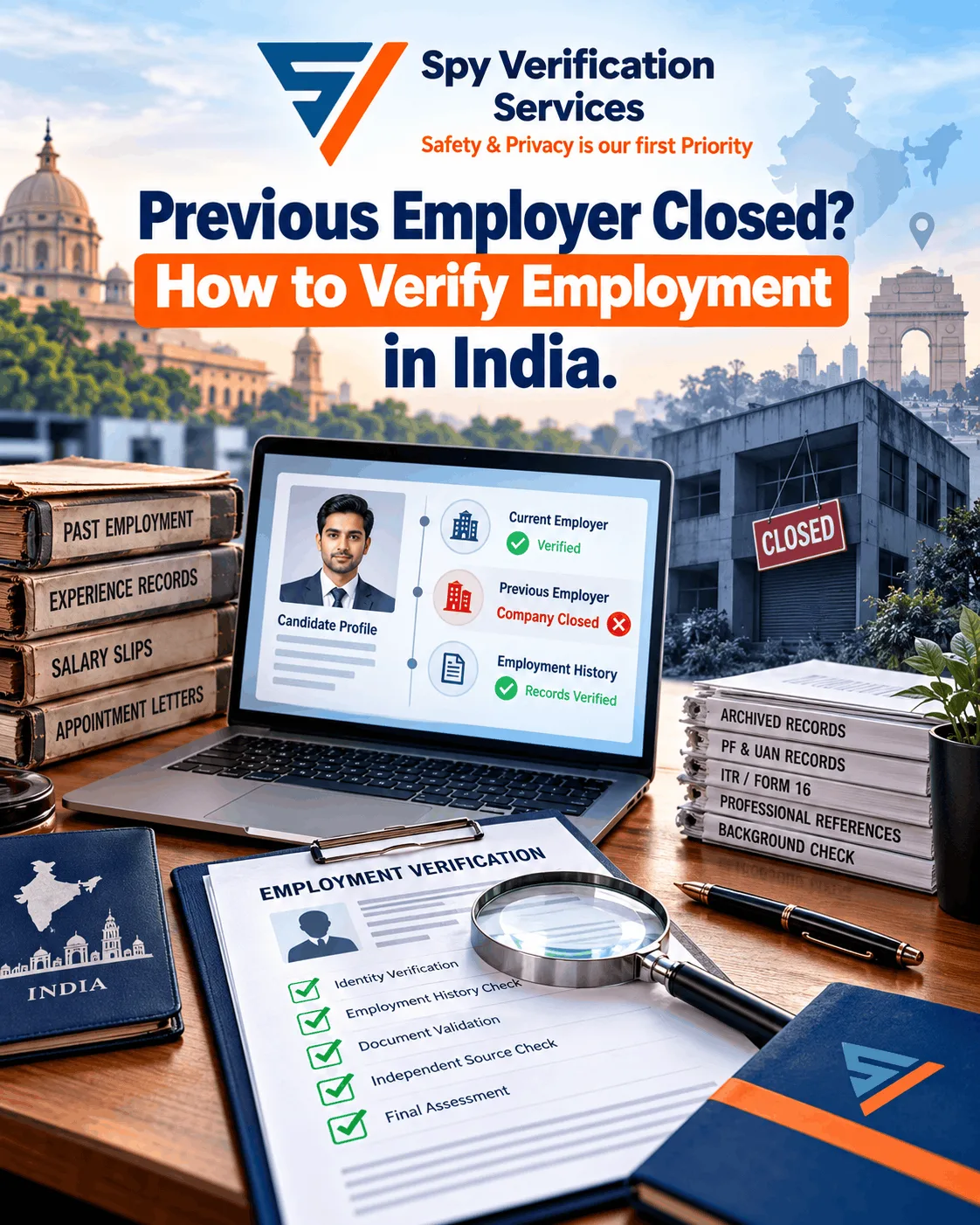
Employment history is an important part of employee background verification. Employers often need to confirm where a candidate previously worked, the period of employment and the professional designation claimed during recruitment.
But what happens when the previous company no longer exists?
A former employer may have permanently closed, merged with another organization, changed its name or stopped responding to employment-verification requests. In these situations, HR teams may struggle to independently confirm the information supplied by a candidate.
A previous employer’s closure or non-response does not automatically mean that the candidate provided false employment information.
Instead, a responsible verification process should examine available evidence, identify appropriate alternative sources and communicate what can and cannot be independently confirmed.
Spy Verification Services provides Employment Verification Services in India to help employers assess relevant work-history claims through appropriate verification methods.
This guide explains how employment verification works when a previous company is closed or unavailable, including the role of EPFO service records, MCA company information, Form 16, salary records and fair reporting procedures.
Can Employment Be Verified If the Previous Company Has Closed?
Yes. Employment history may sometimes be supported by alternative records when a previous company has closed. Depending on the circumstances, these may include authorized EPFO service-history information, employment letters, authenticated salary records, relevant tax documents and appropriate confirmation from other reliable sources.
However, these records do not necessarily provide the same evidence as direct confirmation from an authorized previous employer.
For example, bank salary credits may support the existence of payments, but they do not independently establish a candidate’s complete job responsibilities. Similarly, company registration records may help establish that an employer existed, but they do not prove that a specific candidate worked there.
A reliable background verification report should distinguish these different conclusions.
Why Would a Previous Employer Be Unavailable for Verification?
Several legitimate business circumstances can make employment history difficult to confirm.
1. Permanent Company Closure
A company may shut down because of financial difficulties, insolvency, restructuring or other business reasons. Its HR team may no longer operate, and historical employee records may not be readily accessible.
2. Company Merger or Acquisition
A previous employer may become part of another organization. The original contact details may stop functioning even though relevant records remain with a successor company or authorized records custodian.
3. Company Name Change
An employer may continue operating under a different registered or business name. An unfamiliar company name on a candidate’s resume should therefore be checked before drawing conclusions.
4. Non-Responsive HR Department
A business may still operate but not respond to screening requests. Possible reasons include outdated HR contact details, internal approval policies, staff changes or incomplete historical records.
5. Employment Through a Staffing Agency
A candidate may have performed work at a client organization while being formally employed and paid by a staffing vendor. In such cases, the actual employment-verification source may be the staffing company rather than the workplace where the candidate performed their duties.
6. Missing Historical Documentation
Older employment records may have been archived, transferred or retained under a different system. The absence of immediately accessible documents is not automatically proof that the employment never occurred.
How to Verify Employment When a Previous Employer Does Not Respond
HR teams should follow a structured process instead of relying on repeated informal calls.
Step 1: Confirm the Candidate’s Employment Details
Begin with the information submitted during recruitment:
- Previous employer’s name
- Employment start and end dates
- Designation or role
- Location of employment
- Relevant employee identification details
- Available previous HR contact
- Appointment or relieving documentation
Incorrect names or outdated contact details can delay verification.
Step 2: Identify the Correct Organization
Determine whether the candidate was employed directly by the named company or through another legal employer, such as a staffing agency. If the company has changed its name, review the historical and current organizational details.
Step 3: Check Whether an Appropriate Contact Exists
Where feasible, identify an authorized HR representative, records custodian or relevant successor organization. Information obtained from a candidate-provided contact should be assessed for authenticity and appropriateness.
Step 4: Document Appropriate Verification Attempts
Record meaningful verification activity, such as the source approached, the communication method and the response or limitation encountered. There is no universal number of unanswered emails that proves a company no longer exists.
Step 5: Examine Relevant Alternative Evidence
Where direct confirmation is unavailable, consider supporting records according to the legitimate verification requirement. Examples may include authorized EPFO employment records, relevant employer-issued documents, salary-related information and other lawful sources.
Step 6: Seek Candidate Clarification
If important details remain unresolved, provide the candidate with an appropriate opportunity to explain the circumstances and submit relevant additional information.
Step 7: Prepare an Accurate Report
The result should explain which employment facts were supported, which sources could not be contacted and what limitations remain. Do not automatically report non-response as deliberate misrepresentation.
Step 8: Allow Employer Review
The requesting employer determines whether the available findings meet its documented screening requirements. The final decision should consider source reliability, job relevance and the candidate’s clarification.
How to Check Whether a Previous Company Was Registered, Renamed or Closed
For an applicable Indian registered company or Limited Liability Partnership (LLP), the Ministry of Corporate Affairs provides company and LLP information services. An authorized reviewer may use publicly available corporate information to understand the business’s identity or recorded status.
Step-by-Step MCA Company Check
Step 1: Visit the official Ministry of Corporate Affairs website.
Step 2: Find the service for viewing Company/LLP Master Data.
Step 3: Search using an appropriate company name, Corporate Identity Number (CIN) or LLP identification information, where available.
Step 4: Review the matching entity details carefully.
Step 5: Examine information such as the registered name, relevant corporate identifiers, recorded status and available registration particulars.
Step 6: Where necessary and lawfully accessible, assess suitable historical filings or additional corporate records.
Step 7: Record what the corporate information establishes and what remains unknown.
What MCA Information Can and Cannot Prove
MCA information can help establish whether a registered company or LLP exists or has a particular recorded corporate status. It may also help identify a name change or related corporate information.
However:
- A company can exist without having employed a particular candidate.
- Corporate records do not generally establish an individual’s job designation.
- A recorded company status does not explain every circumstance affecting the availability of HR records.
- Not all business types are registered in the same way; sole proprietorships, for example, may need different evidence.
Important distinction: Verifying that a company existed is not equivalent to verifying that a candidate was employed by it.
For corporate record guidance, refer to official MCA services and master-data information.
Can EPFO Records Help Verify Previous Employment?
Records associated with the Employees’ Provident Fund Organisation (EPFO) may provide useful supporting evidence for covered employment.
An authorized EPFO service-history record may contain details such as:
- Establishment name
- Member identification information
- Date of joining
- Date of exit, where recorded
- Other relevant provident-fund-linked service information
These details can help HR teams review certain claims about a candidate’s employment history.
Limitations of EPFO Employment Verification
EPFO records should be interpreted carefully.
Not every job is represented: Some employment arrangements may not appear in the relevant EPFO history.
Records can be incomplete: Employer submissions, historical migrations or administrative updates may affect the available information.
Designations may not be established: EPFO service-history information does not necessarily confirm the candidate’s full job title or responsibilities.
Dates require context: A recorded joining or exit date should not automatically be assumed to resolve every employment-tenure question.
Access must be authorized: Employers should use lawful, approved methods to obtain or review personal records.
A candidate should not be asked to disclose their UAN account password, one-time password or other private authentication credentials.
The EPFO official website provides information on member services and employment-related records.
EPFO information can support verification, but it should not automatically be treated as conclusive evidence of every employment claim.
Alternative Documents for Employment Verification When a Company Is Closed
Different records can provide different forms of evidence. A professional verification review should not treat every document as equally authoritative for every question.
| Record or source | Information it may support | Important limitation |
|---|---|---|
| Authorized previous-employer response | Specific employment details confirmed by the employer | Depends on available records and authority of the source |
| EPFO service history | Recorded establishment and employment dates where available | Does not necessarily prove designation or all periods of employment |
| Appointment letter | Declared employer, role and proposed joining details | Does not alone prove that employment commenced |
| Experience certificate | Stated employment period and professional role | Authenticity and issuing authority may require checking |
| Relieving letter | Employer’s stated termination or relieving information | May not establish every employment detail |
| Payslips | Payroll-related information appearing on the documents | May be incomplete or altered and require independent validation |
| Bank salary credits | Receipt of identifiable payments | Does not alone establish job title, work performed or full tenure |
| Form 16 | Certain employer and salary/tax-related information | Does not independently establish every claim about employment |
| MCA company information | Registered corporate existence or recorded company status | Does not establish an individual’s employment |
| Former manager statement | Potentially relevant first-hand professional information | Relationship, identity and reliability must be assessed |
This table is an evidence-assessment guide, not a fixed legal hierarchy of documents. The strength of evidence depends on its authenticity, independence, relevance and the specific employment claim being checked.
How HR Should Evaluate Alternative Employment Evidence
When direct employer confirmation is unavailable, a structured evidence-review approach can help.
1. Identify the Claim
Determine exactly what needs verification. For example:
- Did the candidate work for the stated employer?
- Was the employment period accurate?
- Was the stated designation supported?
- Did the person work directly for the named company or through an agency?
Different claims may require different supporting evidence.
2. Assess the Source
Consider whether the record came directly from an appropriate source or was submitted by the candidate. A candidate-provided document may be useful, but its origin may need verification.
3. Examine Consistency
Compare relevant records for differences in company names, employment periods or other material information. Consistency between documents can be useful, but several mutually consistent documents do not necessarily prove independent authenticity.
4. Seek Independent Corroboration Where Appropriate
Where possible, seek additional support from an appropriate independent source. The exact method should be lawful and suited to the agreed verification scope.
5. Document Limitations
The report should explain which facts were confirmed, which received only supporting documentary evidence and which remain unresolved. This prevents an incomplete process from being presented as an unconditional verification.
What Does “Unable to Verify Employment” Mean?
Unable to Verify Employment generally means that the verification process could not establish a sufficiently reliable conclusion about the specified employment information using the available methods and sources.
It may occur when:
- The previous employer has closed.
- The appropriate records cannot be located.
- The previous HR team does not respond.
- Submitted information is incomplete.
- Available documents cannot be independently authenticated.
- A source provides insufficient information.
- The employment arrangement involves an unidentified staffing provider.
A UTV result is not automatically the same as a discrepancy or a failed verification. Similarly, a completed verification should describe only the information established within the agreed scope.
For more information, read What Does a Background Verification Report Include?.
Difference Between Discrepancy, Pending and Unable to Verify
| Status | Example | What HR should consider |
|---|---|---|
| Verified | Authorized source confirms the relevant dates | Record the supported finding |
| Discrepancy | Reliable source information differs from the submitted details | Assess materiality and seek clarification |
| Pending | Source response is still awaited | Follow the agreed monitoring procedure |
| Unable to verify | Direct confirmation cannot be obtained and evidence is insufficient | Document limitations and consider appropriate next steps |
| Partially supported | Some information is corroborated, but other claims remain unresolved | Identify the facts established and the remaining gaps |
The terms used by individual providers may differ. HR teams should read the supporting observations rather than rely exclusively on a single status label.
Illustrative Employment Verification Report: Previous Company Closed
Consider a fictional candidate applying for an Operations Manager position. The candidate states that they worked at ABC Manufacturing Pvt. Ltd. from April 2019 to March 2023.
During verification, the company appears to have ceased operations, and its former HR contact is unavailable. The candidate submits an appointment letter, historical payslips, bank records and a relieving letter.
Sample Verification Summary
| Report field | Illustrative observation |
|---|---|
| Candidate | Candidate A |
| Previous employer | ABC Manufacturing Pvt. Ltd. |
| Claimed employment | April 2019 – March 2023 |
| Direct HR confirmation | Unavailable |
| Company identity | Relevant corporate records examined |
| Supporting documents | Appointment letter, payslips, bank payment records, relieving letter |
| Independent employment confirmation | Not established through the former employer |
| Result | Some information supported; direct confirmation unavailable |
| Suggested next step | Employer review and clarification of any material unresolved claims |
How Should the Report Be Written?
A responsible illustrative conclusion could say:
“Direct employer confirmation could not be obtained. Relevant supporting records were reviewed and provide evidence relating to certain declared employment details. The specific facts not independently confirmed remain subject to the report’s stated limitations.”
The actual conclusion must depend on the records reviewed and the verification methods used.
What Should the Employer Do?
The hiring team should determine:
- Whether the unresolved claim is important to the position.
- Whether the available records are authentic and relevant.
- Whether independent corroboration is possible.
- Whether additional clarification is justified.
- Whether the screening result satisfies the organization’s approved requirements.
A closed company should not automatically cause the candidate to be rejected.
This scenario is fictional and does not describe an actual Spy Verification Services client engagement.
Sample HR Clarification Request to a Candidate
Where appropriate, HR teams can send a concise request for additional information.
Subject: Clarification Required – Previous Employment Verification
Dear Candidate,
We are reviewing the employment details provided for your previous organization. Direct confirmation has not yet been available through the relevant source.
Please share any appropriate supporting information you have, such as an experience letter, relieving document or other relevant employment record, through our approved secure channel.
The purpose is to review the outstanding information accurately. No adverse conclusion has been reached solely because the source has not responded.
Thank you for your cooperation.
HR Verification Team
The message should be adapted to the organization’s actual circumstances and candidate communication procedures.
What If the Previous Employer Has Merged or Changed Its Name?
Company restructuring can create apparent inconsistencies between historical and current information. For example, a candidate’s employment letter may carry an earlier operating name, while current company records use a new registered name.
A suitable verification process may examine:
- The historical name used during employment.
- Relevant corporate records.
- Whether a successor or renamed organization can be identified.
- Whether authorized historical employee records remain available.
- Whether the candidate’s supporting documents align with the relevant period.
- Which employment claims can be independently confirmed.
The reviewer should not assume that a name difference automatically establishes misrepresentation.
Can a Former Reporting Manager Confirm Employment?
A former supervisor may sometimes provide relevant professional information when the employer’s formal HR department is unavailable. However, such confirmation should be assessed carefully.
The verifier should consider:
- Whether the individual genuinely worked for the relevant organization.
- Whether they had a professional relationship with the candidate.
- Whether they are an appropriate source for the information requested.
- Which specific details they can reliably confirm.
- Whether suitable independent evidence supports their account.
A personal reference is not automatically equivalent to an official employer record. The report should distinguish between the types of confirmation obtained.
How Can HR Teams Reduce Delays When Previous Employers Are Unavailable?
A clear escalation procedure helps prevent employment verification from remaining unresolved without action.
Before Screening Begins
Collect accurate employer names, employment dates and appropriate contact information. Ask for relevant supporting records where justified. Explain how missing information will be handled.
During Verification
Use appropriate sources, document meaningful follow-up and identify reasons for source non-response where known. Avoid unnecessary repeated requests to inappropriate contacts.
When Direct Confirmation Fails
Evaluate lawful alternative evidence and seek appropriate candidate clarification. Record which claims remain unresolved.
Before Making a Hiring Decision
Review the reliability of the findings and their relevance to the position. Follow the employer’s documented hiring and escalation policy.
A professional Background Verification Company in India should communicate these limitations transparently.
Privacy and Responsible Employment Verification
Employment verification involves personal information and should be conducted for a legitimate, appropriately defined purpose. Employers and verification providers should follow applicable legal requirements, use appropriate notices and authorization procedures, limit unnecessary information collection and protect verification records.
India’s Digital Personal Data Protection Act, 2023 and the Digital Personal Data Protection Rules, 2025 include phased commencement provisions. As of October 2026, not all substantive provisions have commenced. Organizations should evaluate the obligations applicable at the relevant time together with other employment and privacy requirements.
Candidates should have an appropriate means to raise inaccuracies and submit relevant clarification. Private portal credentials, passwords and OTPs should not be requested as a substitute for lawful access to records.
Official information is available through the Ministry of Electronics and Information Technology.
How Spy Verification Services Supports Employment Verification
Spy Verification Services is a Delhi-based background verification provider established in 2016. The company offers employment verification and related employee screening services for organizations recruiting across India.
Where a previous employer has closed or does not respond, the appropriate verification approach depends on the information available, the nature of the employment claim and the approved screening scope. A responsible service should explain the methods used, any supporting findings and the limitations preventing direct confirmation.
Businesses can discuss their requirements through Employment Verification Services. Organizations requiring broader hiring checks can also explore Employee Background Verification Services.
Employer Closure Should Not Automatically Become a Failed BGV Result
When a previous company closes, merges or stops responding, employment verification requires careful evaluation rather than automatic conclusions. HR teams should determine exactly what needs confirmation, examine reliable sources, review appropriate supporting records and clearly document unresolved information.
Employment verification is most useful when it explains what the evidence supports-and what it does not.
Spy Verification Services supports organizations seeking structured employment verification and background screening across India.

Frequently Asked Questions About Closed Company Employment Verification
1. Can employment be verified after a company closes?
Sometimes. Appropriate historical documents, authorized employment-related records and other sources may support selected employment claims, but direct employer confirmation may remain unavailable.
2. What happens if a previous employer does not respond to BGV?
The verification provider may conduct appropriate follow-up, examine suitable alternative evidence and report what could not be confirmed. Non-response alone does not prove that employment was false.
3. Can EPFO records confirm previous employment?
EPFO records may support certain recorded establishment and employment-date information. They do not necessarily establish job title, full responsibilities or every period of employment.
4. Can MCA records prove that someone worked at a company?
No. MCA information may help establish a registered company’s or LLP’s identity or recorded corporate status, but it does not ordinarily prove that a particular candidate worked there.
5. Are payslips enough for employment verification?
Payslips may be supporting evidence, but their authenticity and the employment claims they support must be assessed. They are not always equivalent to independent employer confirmation.
6. Can Form 16 help verify employment?
Form 16 may support selected employer and tax-related salary information. It does not automatically confirm every detail of a candidate’s work history.
7. Is “Unable to Verify” the same as a failed background check?
No. Unable to Verify generally means sufficient reliable confirmation could not be obtained within the applicable verification process.
8. What if a previous company has changed its name?
The verification process may review appropriate historical and current corporate details and determine whether relevant authorized employment records remain available.
9. Can a former manager confirm employment?
An appropriate former manager may provide relevant information, but their identity, professional relationship and the reliability of the information should be assessed.
10. Can an employer reject a candidate because a previous company is closed?
A closed previous employer does not automatically establish false employment. The employer should evaluate the relevant evidence, unresolved limitations, candidate clarification, applicable law and its approved screening policy.