A candidate may present an impressive degree certificate, an online university transcript or a screenshot of a digital academic award. But HR still has to answer a practical question: Can the important qualification be supported by an appropriate issuing or authorized source?
Education verification becomes especially important when employers rely on a particular qualification to assess eligibility for a role. An engineering position may require a relevant degree; a healthcare role may depend on a professional qualification and separate registration; a teaching position may have defined credential requirements. Yet degree verification is not the same as rejecting every document that looks unfamiliar.
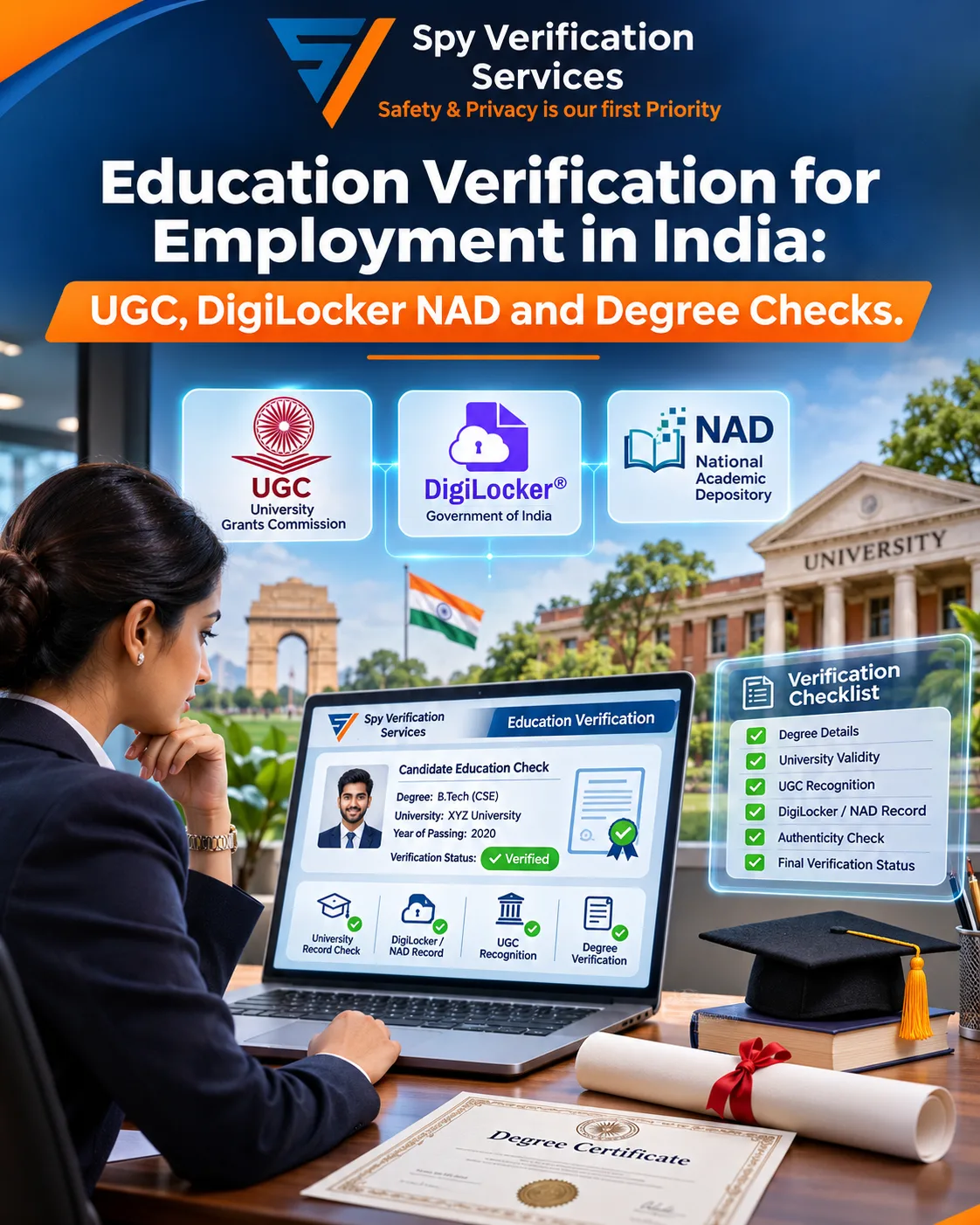
Quick answer: Education verification for employment in India is the role-relevant process of checking selected academic claims–such as the institution, award, programme, completion status and year–through appropriate institutional or authorized records. UGC information may help assess an institution’s status; DigiLocker NAD may support available digital awards; and direct university confirmation may be needed when a record is not in a digital repository.
This article shows HR teams how to use those sources responsibly, interpret common discrepancies and document what was actually verified. Businesses seeking an operational service can visit Spy Verification Services’ Education Verification page.
What does an education background check verify?
The appropriate scope depends on the qualification the employer actually requires. A request to “verify all education” may be unnecessarily broad. A clearer brief asks whether a named degree was issued to the candidate by the stated institution in the relevant year and which details matter to the position.
| Academic claim | Possible verification question | What to avoid assuming |
| Institution | Did the specified institution exist and have the relevant status? | A listed institution proves a specific degree was issued |
| Degree or diploma | Was the stated award issued by an appropriate source? | A visually convincing certificate is necessarily authentic |
| Programme | Does the academic source support the stated course or specialization? | Any similarly named course is equivalent |
| Year of passing | Is the completion year supported? | A small difference automatically indicates fabrication |
| Enrollment number | Does it correspond to the candidate and programme? | A number alone settles the identity match |
| Grades or marks | Are job-relevant marks available and authorized for checking? | Every employer needs complete academic grades |
| Professional registration | Is required current registration established separately? | A degree itself proves an active licence |
Employers should first identify the qualification-related requirement. A professional training certificate may need a different issuing body from a university degree. Records may also use historical institution names or different document formats.
UGC recognition and individual degree verification are different
The University Grants Commission (UGC) university directory provides information about higher-education institutions in India. The UGC also publishes information regarding institutions identified as fake or violating certain requirements. These resources are important, but they answer a different question from whether a particular candidate completed a specific programme.
For example, a university may be properly listed, yet a fabricated certificate could still use its name. Conversely, an older legitimate qualification may appear under a historical institution name or structure. Employers should examine both institutional information and the individual’s relevant academic record.
When reviewing degree validity, the employer may also need to understand specific programme, mode of study, period or professional regulator requirements. A UGC listing does not automatically establish professional recognition for every possible course in every year.
The UGC’s list of institutions violating regulations should be used carefully and checked against the latest official updates. Do not make an accusation about a candidate solely because of an ambiguous website match.
What is DigiLocker NAD and how can it help?
The National Academic Depository is an initiative for digital academic awards, including degrees, diplomas, marksheets and certificates lodged through participating institutions. The DigiLocker NAD FAQ explains that verifying entities such as employers can seek access to relevant awards through the appropriate authorization process.
The important distinction is between an issued digital document from an appropriate source and a file someone has simply uploaded or photographed. A screenshot or scanned document in a phone gallery is not automatically the same as an award retrievable through an issuer-backed repository.
Digital availability is not universal. An institution may not participate, an older award may not have been published, or a record may need correction. If a candidate cannot find the qualification in DigiLocker, the appropriate conclusion is usually “digital record unavailable through this route,” not “degree fake.”
A practical DigiLocker NAD review sequence
1. Confirm the candidate’s relevant academic claim and the purpose of verification.
2. Identify the institution and award type, including any historical name or programme variation.
3. Check whether the relevant institution participates in the digital award system for that record.
4. Use an authorized verification or candidate-sharing process where available.
5. Compare the issuer, candidate identity, award, programme and year against the requested claim.
6. Record which details are supported and any limitations.
7. If the record is unavailable, consider direct institutional verification or other appropriate sources.
Do not ask for a candidate’s DigiLocker password, OTP or unrestricted account access. Use the platform’s appropriate authorized pathways.
Direct university verification: what employers should expect
Not all degree checks can be completed through instant digital lookups. Depending on the institution, a verifier may contact an authorized registrar, examination office or designated verification department. Some institutions require prescribed forms, candidate authorization, a fee or time to retrieve historical records.
A suitable request should identify the candidate and specific qualification accurately, ask only for necessary information and provide an appropriate response route. The verifier should retain the confirmation method and relevant findings. If the institution declines to disclose certain fields, the report should explain the limitation.
A response confirming that a degree was awarded does not necessarily establish all marks, attendance details or professional registration status. Similarly, a university’s failure to answer within a short period should not automatically be treated as a fabricated record.
Professional Education Verification Services should explain whether the result came from direct source confirmation, an authorized repository, document consistency review or another method.
How to verify a degree in India: end-to-end HR workflow
Step 1: identify the job-relevant qualification
State the exact degree, diploma, licence or training requirement relevant to the position. If the role does not depend on a particular mark or percentage, avoid asking for every transcript detail without a reason.
Step 2: establish the candidate and source information
Collect the necessary institution name, programme, examination or enrollment details and completion year through a secure process. Confirm whether the certificate reflects an affiliated college and a separate awarding university.
Step 3: check institution and programme context
Where relevant, consult UGC information, the institution’s official records and the appropriate professional or sector authority. The institution’s legal status and a particular candidate’s award remain separate questions.
Step 4: select the verification route
Choose an authorized digital award, direct institutional confirmation or another suitable lawful source according to availability and the required claim. Do not promise that every degree has an instant API response.
Step 5: interpret the result with care
Distinguish confirmed issuance, year or programme differences, non-responsive source and an inconclusive identity match. A slight spelling variation in a historical record may warrant clarification, not an automatic fraud label.
Step 6: conduct appropriate quality review
Check whether the returned record belongs to the right person and addresses the actual question. A source response about an institution’s existence does not verify a named student’s graduation.
Step 7: produce an explainable report
The report should show what was requested, what source was consulted, what facts were supported and what remains open. Refer to the BGV report guide for reporting terminology.
Step 8: allow authorized employer judgment
HR should consider the qualification’s job relevance, materiality of differences and candidate explanation. Verification providers should report evidence, not automatically determine whether someone is employable.
Degree verification vs. document authentication vs. professional registration
These are often wrongly used as synonyms:
Document consistency review looks for visible or internal consistency issues in submitted records. It does not necessarily prove the issuer awarded the qualification.
Source-led degree verification attempts to establish selected award details through an appropriate university, board, repository or authorized source.
Professional registration verification checks a current credential or licence where required for a regulated occupation. The professional authority, registration status and renewal period may be relevant and a degree alone might not settle those questions.
An HR policy should specify which question it needs answered. For example, verifying a nursing qualification and verifying the person’s current required professional registration may be two separate checks.
Common education discrepancies and how to interpret them
| Scenario | Potential explanation | Sensible verification response |
| Course title differs slightly | Official short name or renamed programme | Confirm the programme with the issuer |
| Year of passing differs | Examination, result or convocation year recorded differently | Clarify which date the source supports |
| Candidate uses maiden or changed surname | Lawful name change or different document conventions | Review appropriate identity-linked evidence |
| College name differs from university | College was affiliated; award issued by the university | Identify awarding institution |
| Digital award not available | Record not published or institution not onboarded | Seek another authorized source |
| Institution does not respond | Retrieval delay, holidays or source policy | Record pending/unavailable status |
| Claimed degree not supported by source | Possible material mismatch | Request review and candidate explanation |
A provider should not turn an unavailable response into a statement that the candidate lied. The report should distinguish evidence of a contradiction from absence of confirmation.
Verifying qualifications for freshers and experienced employees
For new graduates, the highest relevant qualification may be the principal factual claim requiring verification. A candidate may hold a provisional degree or final-semester mark statement while waiting for the formal certificate. The employer should decide whether appropriate source information can establish completion status.
For an experienced professional, verification may focus on a required qualification plus relevant employment history. Checking the educational record does not replace confirming the candidate’s work experience; the two services answer different questions.
Where a job requires a named training certification or professional membership, identify the appropriate issuer and renewal process. It is misleading to treat all qualifications as ordinary university degrees.
For broader Employee Background Verification Services, employers can define an integrated screening scope that avoids asking for irrelevant information.
Why online or distance qualifications need careful review
Online, open and distance education formats can follow different regulatory and institutional rules. Employers should avoid a blanket assumption that all non-traditional study modes are invalid. At the same time, they should not assume every course marketed online had the appropriate approval in the period concerned.
The appropriate questions may involve the awarding institution, programme, academic session and rules applicable at that time. For regulated professional qualifications, an additional sector-specific authority may matter. Qualified advice may be necessary when the programme’s validity is genuinely disputed.
The goal is to establish a factual record that applies to the candidate’s actual course and year, rather than relying on general internet commentary about universities.
The importance of correct candidate matching
Academic records may contain initials, abbreviated middle names, different transliterations or older surnames. If a record uses a slightly different spelling, the verifier should compare appropriate enrollment identifiers, dates and authorized documentation rather than prematurely declare a mismatch.
Likewise, a common candidate name alone is insufficient to attach another person’s academic award. If reliable matching is impossible, report the limitation. A candidate should have a reasonable process to supply correction evidence or request source review.
For a separate guide to identifying information, see ID Verification Services.
An illustrative case: degree exists but the digital record is missing
Consider a fictional applicant for a technical analyst role who says they graduated from an Indian university in 2014. Their degree certificate and final marksheet appear consistent, but no issuer-backed award is visible in the digital repository. The applicant supplies an enrollment number and the name of the former examination office.
The verification team should not conclude that the degree is fake because the digital record is absent. It could attempt appropriate institutional confirmation. If the university confirms the award, the report can identify the facts supported by that response. If the institution cannot retrieve the record, the report may remain inconclusive and explain the attempts made.
This scenario is illustrative, not a real Spy Verification Services case. Its value lies in the distinction between digital availability, submitted evidence and direct confirmation.
Privacy and responsible handling of academic records
Education records are personal information. Employers should define the purpose, request only necessary data, use appropriate lawful authorization and restrict report access. A complete academic transcript can contain information that is unnecessary to decide whether the candidate holds a job-relevant degree.
India’s DPDP Rules, 2025 have phased commencement dates. As of 6 November 2026 not every provision is in force. Evaluate current applicable laws, institutional procedures and employer obligations rather than using an inaccurate blanket compliance claim.
Never collect candidates’ repository passwords, OTPs or unrelated personal account information. Use approved records and secure transfer methods and provide appropriate correction procedures where factual errors appear.
Official Source Checklist for Academic Verification in India
Use each official source for the question it can legitimately answer. The UGC university information portal helps users assess the institutional context, while the UGC FAQ on validity of degrees explains that award authority depends on the applicable statutory and regulatory framework. Neither page is a record of whether a named applicant graduated.
The DigiLocker NAD FAQ explains that participating academic institutions lodge digital awards and that verifying partners can seek access through a permission process. An award issued by the institution through the relevant repository differs from a candidate-uploaded scan. Availability is not universal for every institution and historical period.
| Source | Suitable question | Question it does not answer alone |
| UGC university information | What is the recognized institutional context? | Did this person receive this particular award? |
| University registrar or authorized issuer | Does its record support the specified award? | Is every other résumé claim correct? |
| DigiLocker NAD issuer-backed award | Is a relevant digital award available through authorized sharing? | Is a missing record necessarily fraudulent? |
| Professional registration authority | Is required registration current or recorded? | Is an academic degree alone sufficient for practice? |
| Candidate certificate photograph | What claim or document was submitted? | Is the document definitely authentic? |
Where the programme was offered via distance or online delivery, check the appropriate institution, programme and time period, not only a general name match. Avoid a categorical claim about validity without considering the relevant rules and records for the actual award.
HR checklist for academic verification
Before ordering, record the job requirement, correct awarding institution, qualification and relevant year. Confirm whether a provisional award or final result is acceptable under the employer’s policy. During verification, distinguish UGC institution-status research from an individual award check and distinguish an issuer-backed digital award from a screenshot.
Ask the provider which source actually confirmed the award, how candidate identity was matched and why any aspect remains pending. Before final review, document material differences and seek appropriate explanation. Keep the report within authorized HR access controls.
This fits within the broader Background Screening Policy in India, where a role-based qualification matrix can prevent unnecessary screening.
Frequently asked questions
1. What is education verification for employment in India?
It is the checking of relevant academic claims through appropriate institutional or authorized sources to establish which qualifications and details can be reliably supported.
2. Is a degree certificate photograph enough to verify a qualification?
No. It can be a supporting document, but the appearance of a certificate alone does not prove it was issued by the named institution.
3. Can DigiLocker NAD be used for degree verification?
Where the relevant award is available and suitable authorization exists, DigiLocker NAD can support verification of issuer-backed digital academic records.
4. Does a university’s absence from DigiLocker mean its degrees are fake?
No. Records and institutions are not universally available through the repository, particularly for older awards or where publication has not occurred.
5. Does a UGC university listing prove that a candidate graduated?
No. It may help with institutional context, but the candidate’s award requires a separate appropriate verification step.
6. Can employers verify an old degree?
Sometimes, subject to source availability and historical records. An older award may require manual institutional confirmation and may take longer to retrieve.
7. What if a candidate’s surname changed after graduation?
The reviewer should use appropriate identity evidence and academic identifiers, allowing for legitimate name changes and documenting the matching basis.
8. Is a professional licence the same as an academic degree?
No. Some occupations require verification of current professional registration in addition to academic qualifications.
9. What does “unable to verify education” mean?
It generally means adequate confirmation was not available through the selected process. It is not automatically proof that the academic claim was false.
10. How should employers handle a discrepancy in the year of passing?
Compare the issuing source’s actual dates, consider different academic milestones and seek relevant candidate clarification before treating the difference as material.
Check the issuer, not just the certificate design
The most useful education verification process identifies a specific job-relevant qualification and assesses what the issuing institution or an appropriate authorized source can confirm. UGC information, DigiLocker NAD and university communications can each contribute, but they serve different purposes and have different limitations.
Spy Verification Services supports employers with education and background verification requirements. Discuss education verification services or contact the team to explain the qualification, hiring role and locations involved.