An HR department is recruiting employees for three locations. The recruiter collects documents, another colleague calls previous employers, and the hiring manager reviews education certificates. Every team uses a slightly different spreadsheet. When a source fails to respond, nobody is sure who should follow up or record the limitation.
Would hiring a professional background verification provider solve the problem? It might, but outsourcing alone does not establish a better screening process. An external provider can carry out agreed checks, while the employer still needs to define the scope, communicate with candidates, protect information and make fair decisions.
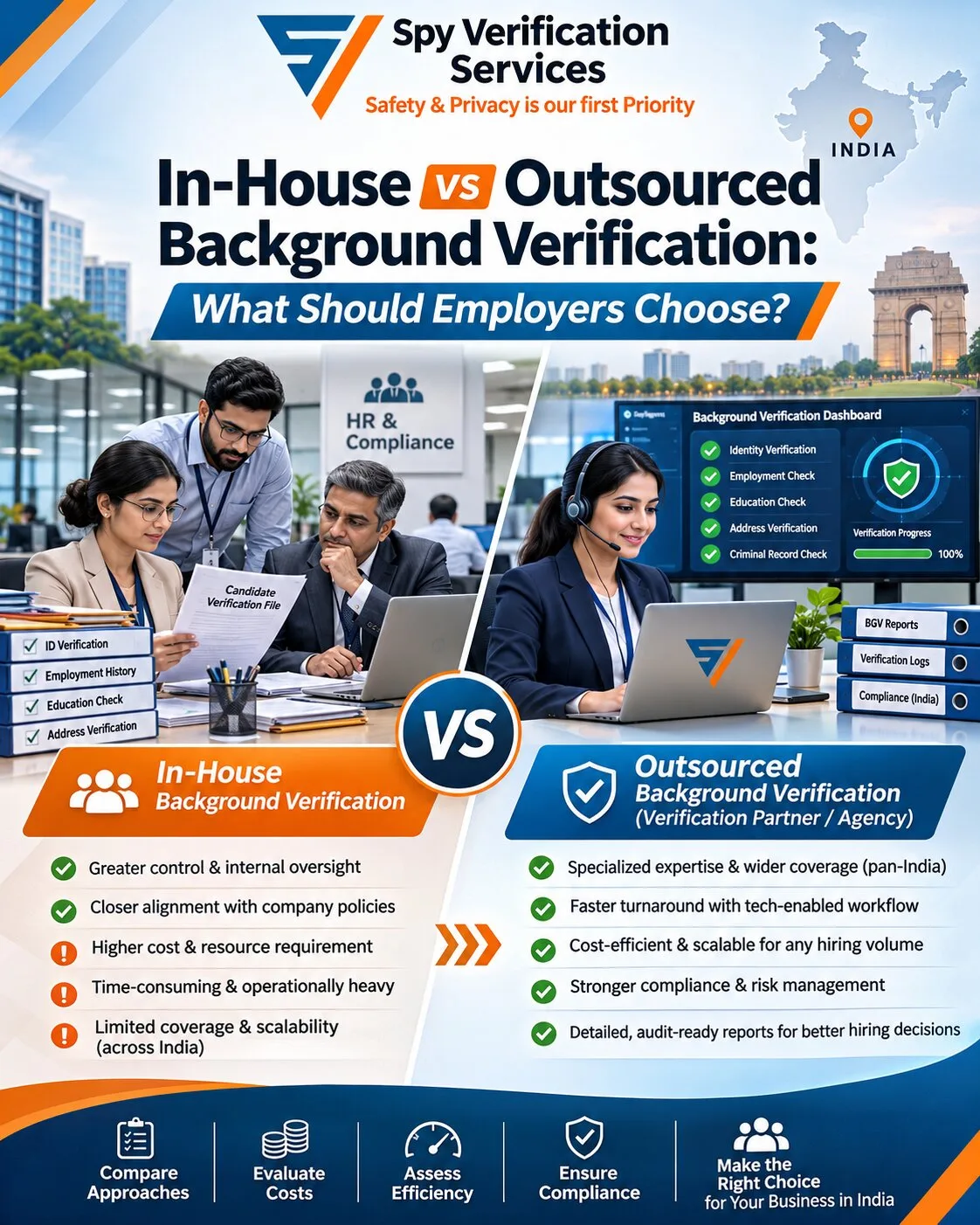
Quick answer: In-house background verification can be suitable for employers with competent staff, manageable workloads and appropriate source access. Outsourced background verification can support specialized, multi-location or recurring screening by assigning agreed verification tasks to a provider. A hybrid approach combines employer-owned governance and decision-making with selected external checks. Choose the model according to evidence requirements, actual capacity, total costs and lawful data handling, not company size alone.
Spy Verification Services offers background check services in India. This guide helps employers compare the three models objectively, including situations where internal checks may make more sense.
What is in-house background verification?
In-house verification means that the employer’s authorized personnel perform some or all screening activities directly. They may review candidate information, approach suitable employers or institutions, obtain relevant confirmations through lawful routes and maintain an internal record of the findings.
The method is not restricted to looking at photocopies or calling references. An organization with appropriately trained staff, approved systems and sufficient capacity may conduct a well-documented screening programme internally. Equally, an organization that simply checks documents for visual consistency should not describe its process as independent source verification.
An internal model works best when the employer understands which checks it can legitimately perform, how to establish the reliability of sources and how to convey unresolved results. Access to a public register does not necessarily answer every job-related question. A dedicated owner is needed to resolve exceptions and maintain consistent reporting.
What is outsourced background verification?
Outsourced BGV means appointing a third party to conduct specified verification activities under an agreed arrangement. These may include employment confirmation, education checks, certain permitted identity-document checks, address-related work and suitable record searches. The available methods and scope must be verified with the actual provider. Not every identity-verification activity is delegable: regulation 16A of the UIDAI authentication and offline verification regulations prohibits performing Aadhaar offline verification on behalf of another entity or person. Do not assume a general BGV outsourcing agreement or candidate authorization overrides that restriction. Confirm the precise lawful arrangement and use appropriate alternatives.
A professional agency may have specialized staff, agreed workflows and experience coordinating with sources that a small HR team approaches infrequently. However, its proposal should not be assumed to include unrestricted access to government records, every location or every type of credential. Ask for evidence of the capabilities relevant to your project.
Outsourcing does not transfer the employer’s authority to make employment decisions. HR should remain responsible for establishing the screening purpose, reviewing relevant findings and deciding how an unresolved or disputed result is handled. Explore the background verification agencies in India page when assessing the role a professional provider could play.
What is a hybrid background screening model?
A hybrid model allocates screening tasks according to capability and purpose. Internal HR may manage candidate communication, confirm the job-related requirements and review findings, while an appointed provider performs selected checks requiring specialized coordination or independent source review. Some organizations also use approved self-service tools for defined verification tasks; those tools do not automatically replace the broader review process.
For example, HR may collect the relevant degree details and verify the correct awarding institution, then commission independent academic confirmation. The provider reports what the source supported. The employer reviews any unresolved credential question in the context of the role.
The model should explicitly identify where responsibility changes hands. If both parties collect the same documents without a clear purpose, the hybrid model can duplicate costs and create unnecessary data exposure.
In-house vs outsourced background verification: detailed comparison
| Decision factor | In-house screening | Outsourced screening |
| Control over workflow | Direct, if the team has defined procedures | Requires agreed scope and coordination |
| Staff capacity | Employer manages workload and backups | Provider handles contracted tasks; HR retains review |
| Source methods | Limited to lawful methods the employer can use | Depends on provider’s verified capability and source arrangements |
| Evidence quality | Depends on internal training and documentation | Depends on provider’s methods, quality and reporting |
| Cost structure | Staff time, tools, direct fees and overhead | Package or per-check fees, extras and retained HR effort |
| Geographic coverage | Depends on staff, sources and arrangements | Depends on actual network and contracted service scope |
| Privacy | Employer manages internal controls | Both parties must manage their appropriate responsibilities |
| Exceptions | Internal team needs clear escalation ownership | Provider reports limitations; employer reviews outcomes |
Neither column is automatically safer. A well-managed internal check can be more useful than an externally supplied result that does not explain its source. A strong provider can make a meaningful difference when the employer lacks the capacity to complete relevant checks reliably. The comparison must use the same scope on both sides.
Which activities should employers retain even when outsourcing?
Defining the screening requirement
The employer knows what work a candidate will perform and which credentials or experience matter to that position. It should determine the relevant screening scope before asking a provider to recommend methods. Our background screening policy guide offers a role-based planning framework.
Candidate communication and appropriate authorization
Agree who communicates the purpose of the checks, handles the necessary information and establishes the applicable lawful basis or authorization. Do not assume the provider is solely responsible for notifying applicants or that a one-line contract resolves every privacy issue.
Final decisions and dispute handling
An external report may contain verified facts, discrepancies, pending items or unavailable records. The employer must decide how to review these results in light of the role and applicable requirements. It should have a clear way to reconsider incorrect or incomplete evidence. A vendor should not be asked to decide automatically whether a person is suitable for employment.
Oversight of data handling and contractual arrangements
When data is shared with another organization, agree purpose limitations, access arrangements, retention, subcontracting, correction and security responsibilities. The employer should verify appropriate safeguards and seek qualified advice where necessary. Outsourcing may change the process but does not remove the need for oversight.
Which checks might justify specialist support?
A recruitment team that rarely requests education records may spend considerable time identifying an appropriate university contact, dealing with document inconsistencies and managing case follow-up. An external provider may offer suitable support for these tasks, subject to the scope and available source methods. The same reasoning may apply to historical employment claims or authorized address verification across multiple locations.
Court-record searches are another area where source scope, identity attribution and careful interpretation matter. A general internet search is not necessarily competent court-record screening. If the organization has no appropriate matching and review procedure, specialist support may be sensible. But hiring a provider does not justify a broader search than the role requires.
The central test is whether a party has the ability to perform the specific check reliably and lawfully. A specialist provider’s broad service catalogue is not proof of competence in every individual case. Review sample findings, confirm what will be checked and ask how unresolved or ambiguous material is handled.
Relevant services include employment verification, education verification and criminal and court-record verification.
How to compare the true cost of internal and outsourced screening
A common procurement error is comparing a vendor’s per-candidate rate against the cost of an HR employee’s salary without including either team’s real work. The cost of an internal model includes staff hours, direct fees, supervision, tools and capacity commitments. A third-party model includes supplier fees, necessary HR coordination, extra checks, external charges and implementation expenses.
Published comparisons, such as SalaryBox’s guide to in-house and third-party verification, highlight the distinction between staff effort and vendor expenditure. However, such vendor-authored comparisons reflect particular product assumptions. They are not a universal price or speed benchmark. An employer should calculate using its own case mix and an equivalent verification scope.
Original cost model: the same 50 screening cases
Consider a fictional company with 50 completed candidate screening cases over a year. The company estimates that the comparable in-house check package requires 1.8 hours of HR time per case, with an assumed fully allocated hourly cost of ₹500. It expects an additional ₹350 per case for direct external source costs, plus ₹10,000 of annual overhead. A hypothetical outsourced offer costs ₹1,300 per case, with 0.4 hours of retained internal work and ₹5,000 in fixed oversight or implementation costs.
| Cost category | In-house | Outsourced |
| Staff time | ₹45,000 | ₹10,000 |
| Direct source costs | ₹17,500 | Included in assumed offer |
| Provider fees | Not applicable | ₹65,000 |
| Fixed annual costs | ₹10,000 | ₹5,000 |
| Total estimated pre-tax cost | ₹72,500 | ₹80,000 |
| Hours of internal effort | 90 | 20 |
In this hypothetical scenario, outsourcing costs ₹7,500 more but frees 70 internal hours. Those hours may be valuable if recruitment staff can use them for other priorities. The result could change if the provider charges for extra sources or the internal staff take longer than forecast. This is a planning demonstration, not an actual Spy client case or rate quotation.
What happens at different hiring volumes?
Using exactly the same hypothetical assumptions, the internal variable cost is ₹1,250 per case plus ₹10,000 fixed cost. The outsourced variable cost is ₹1,500 per case plus ₹5,000 fixed cost.
| Annual volume | In-house estimate | Outsourced estimate |
| 10 | ₹22,500 | ₹20,000 |
| 50 | ₹72,500 | ₹80,000 |
| 200 | ₹2,60,000 | ₹3,05,000 |
The example does not mean that outsourcing is generally cheaper for small businesses or internal screening is always cheaper at scale. Actual variable costs, staffing requirements, minimums, volume discounts and evidence methods may change as the workload grows. At 200 hires, the internal staffing model would require 360 hours under the example assumptions, which might exceed available capacity during a concentrated recruitment period.
For a defensible calculation, measure a small batch first, then compare realistic quotations. Include the actual cost of exception handling rather than assuming every case will follow the shortest route.
Where is the break-even point in this hypothetical model?
Under these fixed assumptions, the in-house estimate equals ₹10,000 plus ₹1,250 per candidate. Outsourced screening equals ₹5,000 plus ₹1,500 per candidate. Equating the two gives 20 annual cases and an estimated pre-tax cost of ₹35,000 on either side. Below that number the illustrative outsourced option costs less; above it the illustrated internal option costs less. Actual break-even volumes would change with real fee schedules, staff costs, scope and capacity.
At 50 cases, the fictional ₹7,500 additional outsourced cost divided by 70 internal hours released is about ₹107 per hour released. This is a useful way to discuss the value of capacity, not a saving of ₹107 per hour, and not a measured company outcome. Time released is not automatically a cash saving unless the organization actually reduces expenditure or deploys that time productively.
Include a sensitivity test: if external fees are not included, if internal follow-up time increases, or if a provider has a minimum purchase commitment, update the inputs rather than giving the old estimate the appearance of precision.

How to choose the right background verification model: a decision worksheet
The following framework helps HR and procurement teams decide what to test. Mark each item as supported, unsupported or uncertain for the proposed internal or external model.
| Decision question | Evidence to collect |
| Can the required checks be performed lawfully? | Approved method and authorization arrangements |
| Is the required source available? | Defined route and documented source limitations |
| Can staff handle the expected volume? | Measured time, peak workload and backup plan |
| Are records consistently matched to candidates? | Sample reporting and ambiguity procedures |
| Is there a secure information workflow? | Access controls, sharing rules and retention process |
| Are unresolved results handled consistently? | Evidence of escalation and correction practices |
| Can the total cost be forecast? | Fully scoped estimate and fee exclusions |
A missing lawful method is a blocking issue, not an inconvenience that a lower price can outweigh. Similarly, an unresolvable security issue should exclude the proposed arrangement until corrected. Cost, convenience and speed become meaningful comparisons only after essential safeguards and evidence requirements are satisfied.
Designing a small screening pilot before committing to a contract
Stage 1: Choose comparable cases
Select a limited representative set of legitimately authorized cases. Include ordinary candidates and a small number of cases likely to require clarification, without creating unnecessary duplicate checks. Confirm that the trial supports an actual legitimate screening purpose and appropriate information-sharing arrangements.
Stage 2: Agree the expected output
For each check, record the exact claim, intended source or method, required result and limitation categories. Ask for reports that separate independently supported information from document-only evidence. Use the BGV report guide to assess the output.
Stage 3: Measure operational results
Track elapsed time, actual HR minutes, fees, incomplete intakes, source delays, follow-up requirements and report corrections. Record why cases remain pending instead of treating every incomplete case as a provider failure. Evaluate whether the screening output was fit for the role.
Define the pilot measures before work begins
| Measure | Suggested definition |
| Internal effort | Total minutes spent by HR divided by initiated cases |
| First-pass intake readiness | Cases meeting the agreed input requirements divided by cases submitted |
| Evidence completeness | Checks with the expected source and limitation documentation divided by checks reviewed |
| Correction workload | Reports needing correction and the time required to resolve them |
| Source-dependent delay | Time waiting for the agreed external source, tracked separately |
| Total cost | Approved fees plus allocated HR time and other relevant expenses |
These are proposed measures, not industry performance standards. Set thresholds based on the employer’s actual needs and measure all outcomes using consistent definitions. Avoid evaluating a supplier solely by the percentage of green results; difficult cases require honest limitations rather than pressure to clear them.
Stage 4: Make a documented decision
Compare results against the agreed requirements and the expected case mix. If the internal model meets all the essential requirements, there may be no reason to transfer those activities. If specialist checks repeatedly consume time or require methods unavailable internally, consider outsourcing those specific tasks.
This pilot is designed to test a defined operating model, not to certify a provider’s accuracy across every candidate or future assignment.
How to assess a third-party BGV provider before appointing one
Ask for a current description of the verification methods, relevant geographic arrangements, sample report and procedures for handling disputed findings. Determine how the provider identifies the proper source, responds to incomplete intake and explains the limitations of a check. Clarify which tasks may be performed by subcontractors and the applicable safeguards.
The commercial proposal should specify fees, included check units, external charges, timeline assumptions and escalation responsibilities. Ask how the provider will respond if a source is unavailable and how it will correct demonstrably wrong information. A provider’s marketing claim should not be the only basis for awarding a contract.
If you are comparing background screening companies in India, evaluate relevant evidence and service scope instead of relying on the number of checks listed on the website.
What happens if the employer changes its BGV provider?
Plan the exit before committing to an external supplier. An employer should understand which records may be retained, which outstanding cases can be completed, how appropriate corrections will be communicated and who can continue to access reports when a contract ends. A supplier change should not lead to unauthorized transfer of entire candidate archives.
Agree on the status of each open case, export or return of agreed outputs, access revocation, lawful retention and deletion arrangements, and charges for remaining work. If a new provider requires additional evidence, check that the collection or sharing is appropriate rather than automatically reusing all historic data. The employer’s review and dispute process should remain available under its applicable arrangements.
A provider that offers a well-defined handover may be more useful than one limited to a polished demo. For staffing engagements, agree on agency and client access separately; see our background verification for staffing agencies page for the responsibilities associated with third-party workforce screening.
Privacy and fairness when sharing verification work
An appropriate screening model starts with a legitimate purpose, role-relevant checks and proportionate information collection. Employers and providers should agree on lawful access, candidate communication, report sharing, correction procedures and information security. India’s DPDP framework has phased commencement; check the official rules and enforcement timeline and any other applicable requirements. No engagement model guarantees compliance by itself.
Do not use an external company to obtain information that the employer could not lawfully request. Review the actual data flow: who receives documents, how they are used, who needs the results and what happens at the end of the engagement. A low-cost tool or outsourcing contract does not remove these questions.
How Spy Verification Services can support your chosen model
Based in Delhi NCR and operating since 2016, Spy Verification Services supports verification enquiries across India. Employers can discuss the check categories needed for a defined role, the available methods, expected volume and reporting requirements. Start by deciding which activities the HR team will retain and which tasks require external support.
Our background verification company in India page provides an overview of our service approach. Organizations looking for employee-specific checks can also visit employee background verification services. An agreed service scope, rather than a blanket claim of superiority, is the basis for a useful proposal.
Frequently asked questions about in-house and outsourced BGV
1. Is it better to outsource background verification?
It depends. Outsourcing may help with capacity or specialist methods, while an appropriately equipped internal team may perform some checks effectively. Compare the same scope and safeguards.
2. Can HR conduct background checks internally?
Yes, where the organization has appropriate authority, suitable methods, competent staff and lawful processing arrangements. Internal review of documents alone is not the same as independent confirmation.
3. Does a third-party agency make hiring decisions?
The provider supplies findings within the agreed scope. The authorized employer should review those findings and make employment decisions according to applicable requirements.
4. Is outsourced BGV always faster?
No. Timing depends on the check, source availability, case information and resource allocation. Outsourcing may reduce HR effort without reducing every source delay.
5. Can a business outsource only education or employment checks?
A modular arrangement may be possible if the provider offers it and the parties agree on the scope, data flow and responsibilities.
6. What is the cheapest BGV operating model?
There is no universally cheapest option. Compare staff time, fixed expenses, direct source fees, provider rates and the cost of handling exceptions for comparable checks.
7. Is a self-service identity check equivalent to full employee BGV?
No. A selected identity or document validation does not automatically verify employment, education, address or relevant court records.
8. How can a small company test a BGV provider?
Use a properly authorized limited pilot, define the expected evidence and review reports, costs, source delays and corrections before expanding the arrangement.
9. What happens when a third-party report is inconclusive?
The report should explain the limitations. The employer should assess materiality, review appropriate clarification and follow its approved exception procedure.
10. Should an HR team use both internal and external checks?
A hybrid approach can work when responsibilities are clear and duplicate collection is avoided. Assign each activity to the party able to perform it reliably and appropriately.

Conclusion
Choosing between in-house and outsourced background verification is an operating-model decision, not simply a choice of vendor. Define the checks, assess lawful capabilities, compare real costs and test the quality of the resulting evidence. Keep employer accountability and fair review at the centre of whichever model you select.