A company may need a new employee to join in five days while the university takes longer to answer a qualification request. A former employer may provide employment dates quickly but not the designation. Another case may be waiting for missing candidate information. These situations are often described as “BGV pending,” even though they have different causes and different next steps.
For HR teams, the objective is not simply to make every background check faster. It is to understand which checks are waiting, why they are waiting, what evidence is missing and who is responsible for the next action, without sacrificing reliability or fairness.
Quick answer: Background verification turnaround time is the elapsed time from an agreed start point to delivery of a specified verification result or report. It varies with the checks requested, completeness of candidate information, availability of employers or institutions, record access, location and quality-review requirements. A pending result is not automatically a negative result and there is no universal guaranteed completion time for every Indian BGV case.
This guide explains how to create realistic timelines, classify delays, build an escalation matrix and report unresolved checks accurately. Employers seeking a professional screening scope can explore Background Check Services at Spy Verification Services.
What does BGV turnaround time mean?
BGV turnaround time, often called TAT, measures how long a defined verification task takes to reach a stated completion event. An organization should specify exactly what it means by “complete.” Is the provider referring to one identity check, an individual employment verification, a preliminary case summary or a final report covering all requested checks?
Those are not equivalent milestones. A single promptly available digital record can be checked sooner than a historical degree requiring manual institutional confirmation. A status dashboard may show that three of four requested checks have results while one is still pending.
When comparing vendors, ask whether the quoted TAT is calendar days or working days, when the clock begins, which cases are excluded, how third-party delays are reported and whether outstanding checks are shown separately. Do not compare an “instant identity check” promise with a completed multi-check employee report.
Background Screening Companies in India may offer different scopes and operating arrangements. Procurement teams should request a written definition of timing and evidence quality, not choose solely on an advertised number.
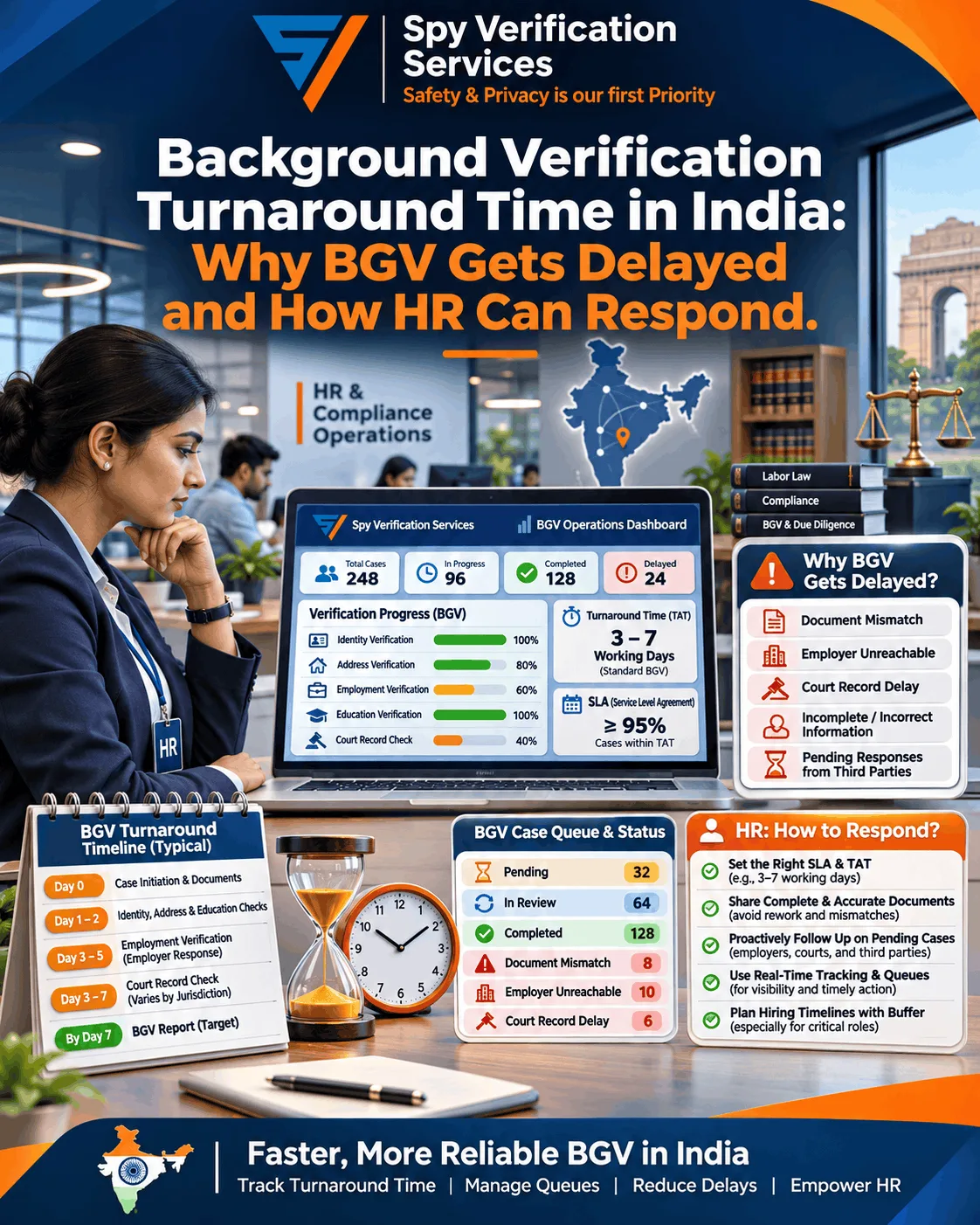
Why background checks get delayed in India
A verification case can pause at many points. Understanding the cause is necessary before escalating it.
Missing or inconsistent candidate information
A wrong enrollment number, an incomplete former-employer name or conflicting employment dates can prevent a source from locating the correct record. The fastest responsible action may be to request a precise correction rather than repeatedly contact the wrong institution.
Previous employer non-response
HR departments sometimes have limited record access, archived files or a policy restricting third-party disclosures. A closed company may have no functioning HR contact at all. Alternative evidence may support selected facts, but it does not necessarily substitute for direct confirmation.
University or board record retrieval
Some academic awards can be checked through appropriate digital records. Others require manual requests, fees, authorization or archival retrieval. A digital repository gap should not be treated as a false degree finding.
Source coverage and geography
An employee may have lived, worked and studied in several states. Different verification questions relate to different sources and jurisdictions. Physical visits, if justified, have different logistics from online source confirmation.
Possible identity or court-record matches
A common-name search hit may require careful identity matching and case-status review. Rushing this stage can produce a false positive with consequences for the candidate.
Holidays, staffing and operational queues
Institutions and employers may not respond according to a recruiting company’s working calendar. A provider should communicate meaningful delays, but should not promise control over independent institutions.
Different checks, different causes of pending status
| Verification type | Typical dependency | Why it may remain pending |
| Identity | Correct authorized identifying information and method | Incomplete information or mismatched identifiers |
| Previous employment | Appropriate employer or other lawful source | HR non-response, closed employer, missing work details |
| Academic qualification | University, board or authorized digital award | Archive retrieval, missing enrollment number, source policy |
| Address | Authorized documentation or justified field process | Incorrect details, unavailability, travel or jurisdiction |
| Court record | Defined jurisdiction and reliable identity matching | Possible namesake, incomplete record, uncertain case status |
| Professional registration | Correct regulator or awarding body | Renewal status, old registration identifier or unavailable source |
These are illustrative dependencies, not a statement about any vendor’s guaranteed capabilities. Each candidate and institution can be different.
The most useful change: track checks individually
A single overall “pending” label is rarely enough for HR operations. Consider an employer that ordered identity, employment, education and court-record checks. If the identity and employment results are complete while education remains open, the progress summary should make that distinction visible.
A recommended case tracker includes candidate reference, check name, requested evidence, source, case stage, last meaningful response, missing information, owner, next follow-up date and the decision-maker for exceptions. Even a well-designed spreadsheet can provide this control if the organization lacks dedicated workflow software.
The tracker should also distinguish source delay from candidate action required, because the next responsible person differs. Avoid sharing full candidate records in an unrestricted team sheet. Use the minimum operational status information necessary for coordination.
Build a practical BGV workflow with five checkpoints
Checkpoint 1: intake quality
Before submission, confirm the candidate identity, requested checks, employer names, academic institution, relevant dates and authorization status. Reject incomplete internal intake forms for correction–not the candidate’s employment application.
Checkpoint 2: source routing
Identify the appropriate source for each requested claim. A staffing payroll employer may differ from the company where the candidate worked. A college may be affiliated to a different awarding university. A court search must use an appropriate jurisdiction and identity-matching method.
Checkpoint 3: status definitions
Agree what “received,” “in progress,” “awaiting source,” “candidate clarification,” “verified,” “discrepancy” and “unable to verify” mean. Different status names can hide different operational facts if they are not defined.
Checkpoint 4: controlled escalation
At predetermined internal review points, check whether the next action is a source follow-up, corrected document, candidate explanation, provider clarification or authorized managerial decision. Escalation should not mean pressuring a source to issue an unsupported result.
Checkpoint 5: close-out quality review
Verify that each reported conclusion actually answers its assigned question and that unresolved items remain clearly labeled. The final employer review should address job relevance and any material discrepancies or information gaps.
For the wider end-to-end sequence, see Background Check Process in India. This article focuses on timing, exceptions and operational control rather than repeating all verification types.
How to define an appropriate TAT and service-level agreement
A useful screening agreement can clarify at least six elements. First, define the start event: for example, when complete authorized candidate information is received. Second, define the check-specific deliverables. Third, explain whether time periods use working days and which holidays are excluded. Fourth, document source-dependent exceptions and how they appear in reporting. Fifth, agree on status-update frequency. Sixth, explain how correction and re-verification requests are handled.
A provider may be able to commit to acknowledgment or update practices even when a third-party source’s response time cannot be guaranteed. That distinction makes service discussions more credible.
Avoid treating an industry article’s generic timeline estimate as a contract promise. Ask the actual provider for a written scope-specific assessment, especially for older academic records, manual field verification or difficult employment histories.

An illustrative escalation and ownership matrix
| Situation | Initial owner | Practical next action | What not to conclude |
| Wrong employment dates supplied | Candidate/HR intake | Seek accurate history and supporting details | Candidate intentionally lied |
| Previous employer does not respond | Verification provider | Appropriate source follow-up or approved alternative route | Employment is necessarily false |
| Degree record not in DigiLocker | Verification provider/HR | Check source availability and institutional route | Degree is automatically fake |
| Possible namesake in court results | Verification reviewer | Reassess lawful matching identifiers and source | Candidate is linked to the case |
| Pending due to a source closure | Provider plus HR | Disclose limitation and consider review options | Case is automatically failed |
| Candidate disputes a result | Authorized review team | Compare evidence and initiate correction process | Original report cannot be reconsidered |
This is a recommended governance matrix, not a representation that Spy Verification Services guarantees a particular SLA, platform or escalation service. The employer and vendor must agree on actual responsibilities.
How to communicate BGV delays to hiring managers
Hiring managers may ask HR for a simple “clear or not clear” answer. That is understandable but can create pressure to overstate the evidence. A useful status message should specify the outstanding check, reason where known, next action and any limitation on conclusions.
For example: “Three of four approved checks have been completed. Education verification remains pending because the awarding institution has not yet confirmed the relevant record. We have documented the request and will update the status following the next appropriate follow-up. No discrepancy has been established by non-response alone.”
This is illustrative wording and should be adjusted to the actual record. The employer must determine any employment or access decision under applicable requirements and its own policy.
What does pending BGV mean for the candidate?
A pending status generally indicates the process has not reached a final result for a selected check. It may reflect a source wait, a document issue or an unresolved clarification. It should not automatically be described as a negative finding.
Candidates should receive clear requests for information, preferably through a secure and authorized channel. HR should avoid asking for unrelated bank credentials, account passwords or private verification-portal OTPs to speed up a case.
If a candidate disputes a factual observation, an appropriate correction route should be available. The verification provider should distinguish the source’s reported facts from its own interpretation and the employer should not assume an internal color code establishes misconduct.
Employment verification delays: a common real-world problem
A previous employer may have merged, closed or outsourced personnel records. A verifier might receive a confirmation of employment dates but no formal designation. In such circumstances, the report should describe partial confirmation rather than mark every declared item verified.
Alternative evidence, where appropriate, can be assessed for specific facts. EPFO-linked service records or relevant tax documentation may support certain details for covered employment, but these are not identical to full direct employer confirmation.
The detailed guide Previous Employer Closed? How to Verify Employment in India discusses MCA records, EPFO limitations and fair UTV reporting. The commercial Employment Verification Services page is the best destination for an employer requesting a quote.
Academic verification delays: digital record gaps are not automatically errors
India’s National Academic Depository offers digital academic award services for participating institutions. The DigiLocker NAD FAQ makes clear that awards depend on publication by the institution and a candidate may not find every university or historical certificate in the system.
If the record is unavailable digitally, the next question is whether the relevant institution can confirm it through another suitable pathway. This might require additional information, fees or time. Avoid labeling a degree invalid only because a repository search did not return an award.
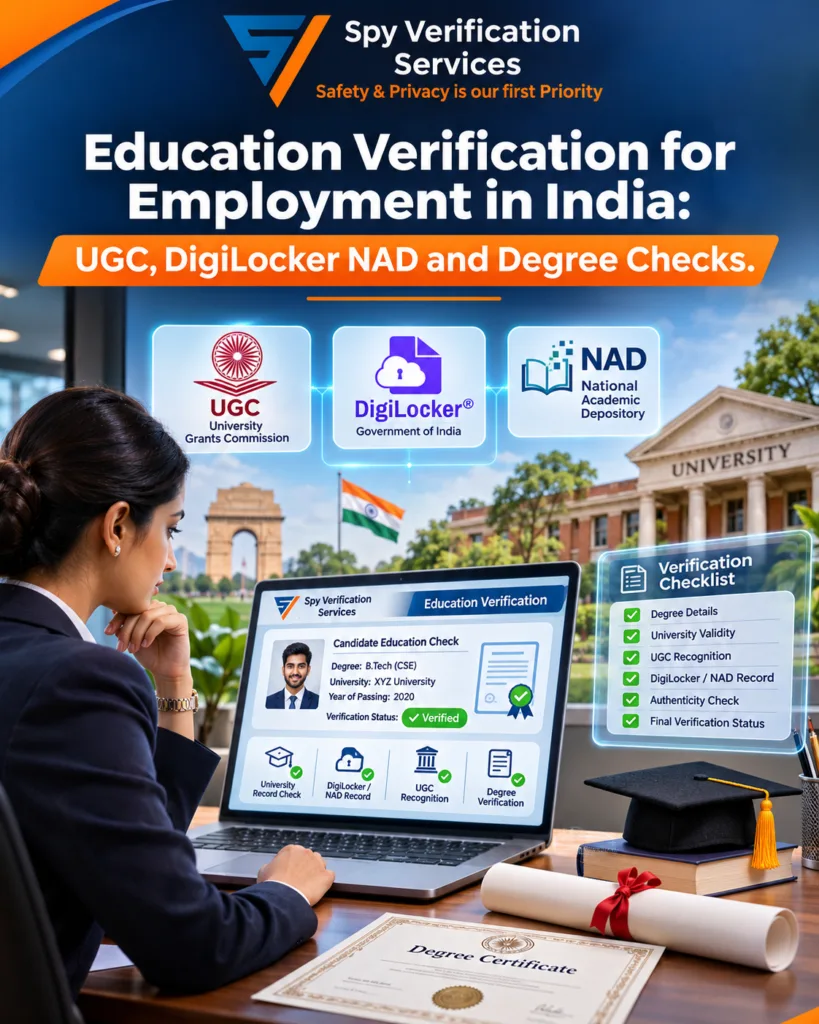
For an employer checklist, see Education Verification in India: UGC, DigiLocker and Degree Checks once published. The main Education Verification Service should remain the commercial landing page.
Court-record delays and the danger of premature matches
The official eCourts case-status system can surface party-name matches and case-history data within its available coverage. A matching common name is not enough to establish that the record belongs to the candidate. The result may also involve a civil proceeding or a party in a non-accused role.
Identity matching and case-status interpretation are quality activities, not avoidable bureaucracy. Rushing them can be harmful. When additional checks cannot resolve the ambiguity, the report should explain that a possible match remains unconfirmed.
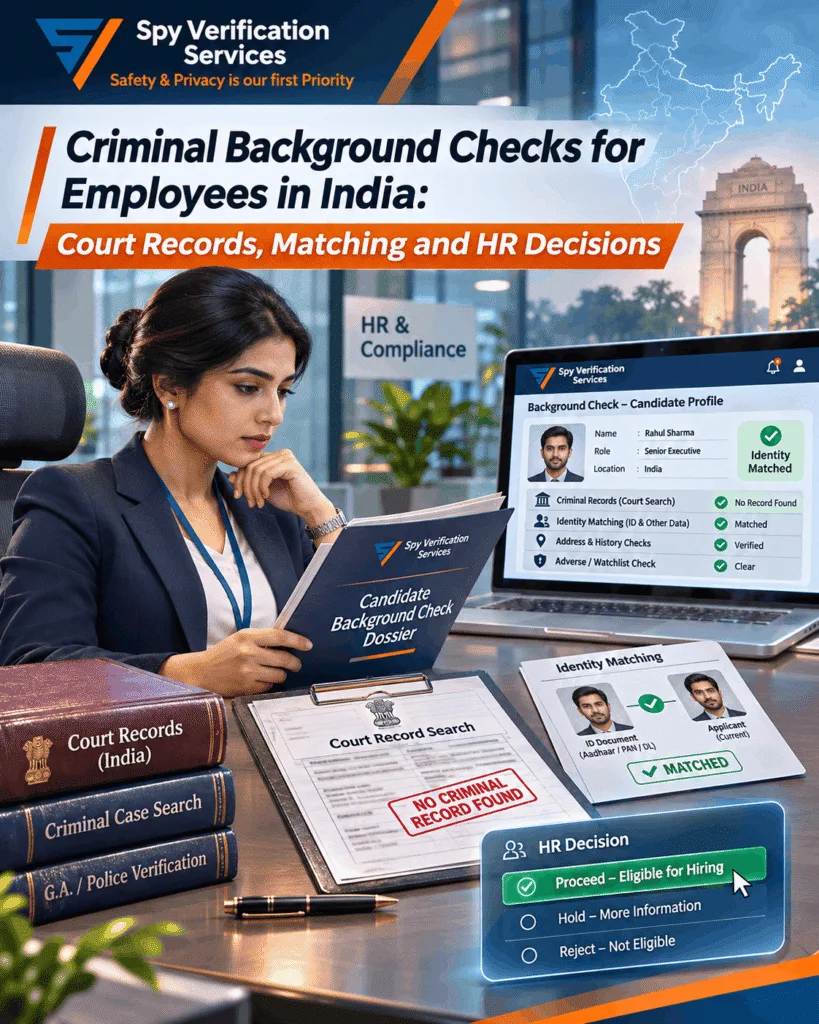
See Criminal Background Checks for Employees in India when published and Criminal and Court Record Verification for the corresponding service.
What should a weekly HR BGV status review include?
A short, disciplined review can be more useful than chasing every case individually. Start with the total number of initiated cases and the number of completed checks–not just completed candidate files. Group pending items by reason: awaiting source, awaiting candidate information, identity matching, manual review or other documented cause.
Next, look at which cases have no assigned next action. Review material discrepancies separately from administrative delays. Confirm that candidate updates are consistent and secure. Record whether a repeated bottleneck suggests a need to change the intake form or the approved source workflow.
The review should help management improve the process without encouraging an artificial “pass” status simply to make a dashboard look better. Quality, fairness and reliability remain primary.
Three useful performance indicators for BGV operations
Check completion by type: Track the percentage of checks completed for each approved category within a defined period. This helps distinguish identity checks from slower manual university or employer-dependent cases.
Pending reason distribution: Measure whether open cases are awaiting sources, candidates, quality review or other specified inputs. That reveals where process changes may help.
Clarification and correction cycle: Track time and frequency of material corrections, false matches or missing input requests. This indicates whether better intake and source matching could reduce unnecessary effort.
Avoid treating a faster result as automatically more accurate. HR should interpret these measures alongside case complexity and actual evidence quality. A rate is useful only when its numerator, denominator and time window are clearly defined.
An illustrative multi-check hiring case
A fictional employer recruits a finance operations analyst and requests four job-relevant checks. The identity record and employment dates are confirmed. A court-record search returns no identified relevant match in its recorded scope. The university has not responded to a qualification query, so education remains pending.
The candidate supplies an additional enrollment identifier. HR records an updated request and sets a follow-up owner. The report does not call the education check “clear” or “failed.” Instead it separates three completed checks from the one pending item and documents its status.
The employer reviews whether the pending qualification is essential to the role and determines the appropriate next step under its policy. This example is hypothetical; it is not a Spy Verification Services case study or a claim of a particular timeline.
Privacy, security and the limits of automation
Verification involves personal data. Restrict operational dashboards to appropriate staff, avoid circulating full candidate documents unnecessarily and apply lawful collection, access and retention procedures.
India’s Digital Personal Data Protection Rules, 2025 use phased commencement. As of November 2026, not all substantive requirements are in force. Organizations should confirm the currently applicable framework rather than describing every future obligation as already effective.
Automation may help route cases or organize updates, but it should not remove human review where a name match, document contradiction or ambiguous source could harm a candidate. Do not advertise guaranteed “instant BGV” for source-dependent checks without robust substantiation.
Calculate TAT Without Hiding Source Delays
A useful background verification turnaround time metric should state the clock start and end, the unit and any permitted pause treatment. Otherwise two vendors can quote similar numbers while measuring different stages. The sample below is a process-design illustration, not a Spy Verification Services SLA.
| Measurement | Definition to agree in writing | Common source of confusion |
| Intake-to-submission | Time from receiving a complete case to sending correct requests | Excludes missing candidate details? |
| Source-wait time | Time awaiting an external response | Vendor cannot guarantee an independent source will reply |
| Review time | Time spent assessing evidence and discrepancies | Complex namesakes require human assessment |
| Check completion | A specific check receives a concluded status | Not equivalent to the complete multi-check report |
| Final report time | All agreed deliverables are issued or clearly marked unresolved | Incomplete cases can remain outstanding |
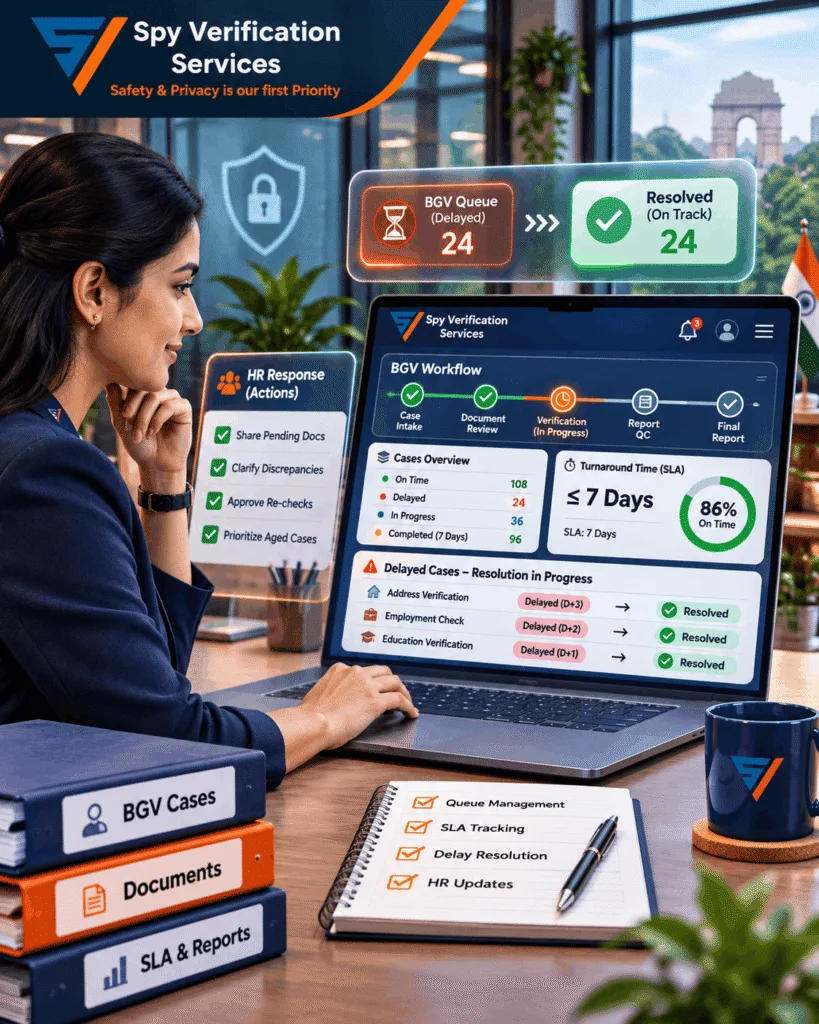
A practical status report should list each check individually and identify the action owner. For example, “Education: awaiting registrar response; last meaningful action recorded; next follow-up planned” is more actionable than “Candidate BGV: red.”
Illustrative escalation rule: If a case passes the internally agreed follow-up checkpoint, the case owner should explain the blocker and next action. Escalation does not authorize the team to fabricate a conclusion or replace source confirmation with an unsupported promise.
HR checklist to reduce delays without reducing accuracy
Before initiation, define the role and approved checks; confirm correct candidate identifiers; obtain the required documents securely; and select the actual issuing sources. During verification, ensure every check has an owner, record the reason for pending cases and distinguish source delay from an adverse result. For escalation, define update intervals and a correction path without inventing universal turnaround promises.
After reporting, confirm that the final HR decision rests with an authorized employer representative. Review repeated bottlenecks, but do not penalize the verification team for refusing to make unsupported conclusions.
Organizations that need a governance document can use Background Screening Policy in India alongside the Background Verification Report Guide.
Frequently asked questions
1. How long does background verification take in India?
It depends on the chosen checks, available records, employer and university responses, candidate information and quality-review needs. Request a scope-specific estimate rather than relying on one universal timeline.
2. Does BGV pending mean a candidate failed?
No. It usually means a check remains incomplete. The reason and evidence should be documented before any employer decision.
3. Why is employment verification delayed?
Common causes include wrong employer contacts, closed businesses, archived records, source disclosure restrictions and incomplete candidate details.
4. Why does degree verification sometimes take longer?
Historical records, institutional response procedures, unavailable digital awards and missing enrollment information may require manual follow-up.
5. Can a vendor guarantee every check is complete in 24 hours?
A provider may be able to complete certain source-available digital checks quickly, but universal guarantees for employer, university and field-dependent checks need careful scrutiny.
6. What is the difference between pending and unable to verify?
Pending indicates the check is not finished; unable to verify generally means adequate confirmation could not be established through the agreed process. Providers may use different definitions.
7. Can HR onboard someone while verification is pending?
The decision depends on job requirements, employment terms, applicable law and the employer’s policy. A provider should not automatically make that decision.
8. Will an EPFO record always resolve an unresponsive previous employer?
No. EPFO records may support selected employment details for covered work, but they may not establish designation or every aspect of the employment claim.
9. How should HR report a delayed check to managers?
State the check, reason where known, responsible owner, next action and limitation. Avoid ambiguous “red” or “green” summaries unsupported by the actual evidence.
10. What is the best way to reduce repeated BGV delays?
Improve intake accuracy, define check-specific sources and milestones, assign owners to pending cases and review recurring problems without sacrificing necessary source checks.
A pending case needs an action, not an assumption
BGV turnaround time becomes manageable when the employer and provider define exactly what is being checked, what counts as complete and how source-dependent delays will be communicated. Clear scopes, accurate candidate data, appropriate follow-ups and honest reporting produce more useful results than unrealistic speed promises.
Spy Verification Services supports employers planning verification programmes for different roles and locations in India. Explore Background Check Services or contact the team with the required checks, hiring volume and expected onboarding schedule.