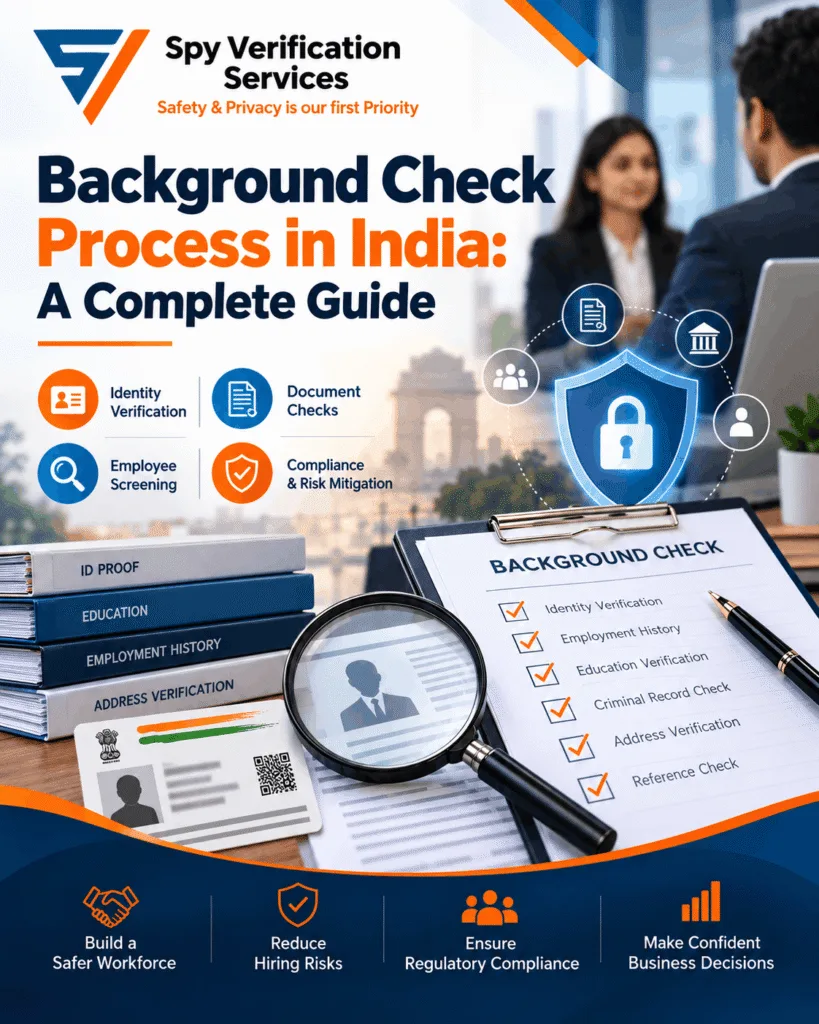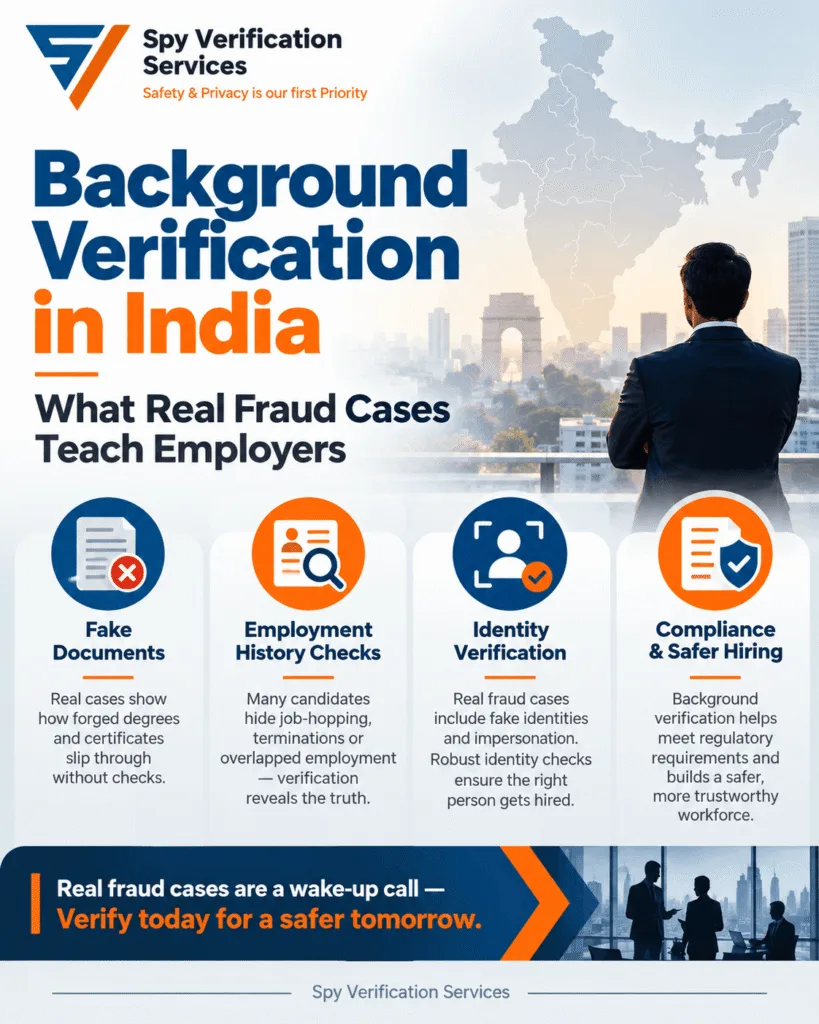

Background Check Verification is a structured process used to confirm an individual’s identity, employment history, education, address and other information relevant to a hiring or business decision. It helps employers identify material discrepancies, reduce avoidable risks and build a more dependable workforce.
Spy Verification Services provides professional Background Check Verification services in India for employers, staffing companies, businesses and organisations seeking better-informed hiring and onboarding decisions.
Established in 2016, Spy Verification Services offers multiple verification services, including employment, education, identity, address, criminal and court records, financial, social media and certificate verification.
According to the company information supplied for this page, Spy Verification Services has achieved:
- 80+ happy clients
- 10+ successful years
- 1,000,000+ verifications
These figures should be supported by internal records and reviewed periodically before publication.
What Is Background Check Verification?
Background Check Verification is the process of checking whether the personal, academic, professional or role-relevant information provided by an individual is accurate and verifiable.
It may be conducted for:
- Prospective employees
- Existing employees
- Contract workers
- Consultants
- Vendors
- Business partners
- Drivers and delivery personnel
- Domestic or field staff
- Tenants
- Individuals are being placed in positions of trust
The checks required in each case should depend on the purpose, responsibilities and risk level of the role. A person applying for a financial position may require different checks from a warehouse worker, driver, healthcare professional or software engineer.
Responsible background screening is not intended to invade an individual’s privacy. Its purpose is to verify relevant information through an authorised, proportionate and carefully documented process.
Why Is Background Check Verification Important?
A resume, application form and interview help an employer understand a candidate, but they do not independently establish that every statement or document is accurate.
Information submitted during hiring may occasionally contain:
- Incorrect employment dates
- Inflated designations
- Unverified qualifications
- Incomplete address details
- Altered certificates
- Undisclosed employment
- Identity inconsistencies
- Unexplained career gaps
- Misrepresented job responsibilities
- Records that require further clarification
Professional Background Check Verification allows employers to review such issues before completing an important hiring or onboarding decision.
Key benefits of background verification
A properly designed employee background check may help an organisation:
- Confirm a candidate’s identity
- Validate employment and education details
- Detect material differences in submitted information
- Protect confidential information and company assets
- Support workplace safety
- Maintain consistent recruitment procedures
- Reduce credential and document fraud risks
- Meet client or contractual screening requirements
- Improve trust in the onboarding process
- Make decisions based on verified information rather than assumptions
A verification result should be treated as one part of a broader decision-making process. Employers should review the relevance, accuracy and circumstances of every finding before taking action.
What Does a Background Check Include?
The scope of a Background Check Verification depends on the role, client policy, candidate information, available records and applicable requirements.
1. Identity Verification
Identity Verification helps determine whether the candidate’s name, photograph, date of birth and identification information are consistent across the submitted documents.
It may involve checking:
- Name and spelling
- Date of birth
- Photograph
- Identification number
- Document validity
- Cross-document consistency
- Other authorised identifying details
Identity Verification is generally an important first step because all other checks must be associated with the correct person.
2. Employment Verification
Employment Verification helps confirm whether the candidate’s declared work history corresponds with information available from previous employers or authorised supporting records.
Depending on availability and company policy, it may verify:
- Employer name
- Employment period
- Designation
- Department
- Employee identification details
- Job responsibilities
- Last working date
- Reason for leaving, where lawfully available
- Eligibility for rehire, where permitted
An employer’s failure to respond should not automatically be treated as an adverse finding. Alternative documents or candidate clarification may be necessary.
3. Education Verification
Education Verification examines whether the institution stated by the candidate issued an academic qualification.
It may include confirmation of:
- Institution or university
- Course or programme
- Qualification
- Registration or roll number
- Year of passing
- Completion status
- Submitted certificate details
- Recognition or accreditation, where relevant
Older records, institutional closures and manual university procedures can affect completion time.
4. Address Verification
Address Verification helps establish whether the current or previous residential address supplied by an individual can be reasonably confirmed.
Depending on the assignment, it may use:
- Submitted address documents
- Digital verification
- Authorised database checks
- Field verification
- Contact with an authorised respondent
- Location-supported confirmation with consent
Address checks can be particularly relevant for field employees, drivers, contractors, domestic staff and people who regularly visit client locations.
5. Criminal and Court-Record Verification
Criminal and court-record checks search authorised and relevant sources for records that may require employer review.
Such checks should be conducted with care. A similar name does not necessarily mean that a record belongs to the candidate. Identity details, jurisdiction, record type, case status and other matching information must be considered.
A responsible review should distinguish between:
- An allegation
- A pending matter
- A disposed matter
- An acquittal
- A conviction
- A possible name match
- A confirmed identity match
The existence of a record should not automatically determine the hiring outcome. Employers should consider accuracy, relevance, age, circumstances, role requirements and applicable law.
6. Reference Verification
Reference Verification provides professional feedback from authorised referees who have worked with or supervised the candidate.
A structured reference check may cover:
- Working relationship
- Key responsibilities
- Professional conduct
- Reliability
- Communication
- Strengths
- Areas for improvement
- Suitability for the relevant role
Reference feedback should be documented objectively and should not be treated as a substitute for factual employment verification.
7. Financial Verification
Financial Verification Services may be relevant for certain authorised positions involving financial responsibility, access to funds or fiduciary duties.
This type of check should only be conducted where it is relevant, properly authorised and permitted. Information should not be collected merely because it is available.
8. Social Media Screening
Social Media Screening may review publicly available information that is directly relevant to professional suitability, workplace safety or a clearly defined organisational policy.
It should not become an unrestricted investigation into a person’s private life, beliefs or legally protected characteristics.
A fair social-media screening process should consider:
- Whether the correct individual has been identified
- Whether the content is publicly available
- Whether the information is role-relevant
- Whether the content may be false, satirical or manipulated
- Whether context is missing
- Whether the candidate should be asked to clarify the finding

Background Check Verification Process
The exact process varies according to the checks selected. A structured verification workflow generally includes the following stages.
Step 1: Define the scope
The employer identifies the checks that are necessary for the role. Screening should be proportionate rather than applying every available check to every candidate.
Factors may include:
- Seniority
- Financial authority
- Access to confidential information
- Customer interaction
- Access to company assets
- Work location
- Industry requirements
- Position-related risks
Step 2: Inform the candidate and obtain authorisation
The candidate should be informed about the purpose and intended scope of the verification.
Consent and personal-data handling must reflect applicable requirements. India’s DPDP framework provides rights relating to access, correction, erasure and grievance redressal and includes official rules and a phased enforcement timeline.
Employers should obtain appropriate legal advice for their exact industry, data practices and verification programme.
Step 3: Collect the required information
Only information required for the selected checks should be collected.
Documents may include:
- Identity proof
- Address proof
- Academic records
- Employment information
- Appointment or relieving documents
- Professional licences
- References
- Candidate authorisation
Step 4: Verify through relevant sources
Submitted information is reviewed through appropriate sources, which may include institutions, previous employers, public records, authorised databases, references and field-verification methods.
Step 5: Review inconsistencies
Not every difference is evidence of fraud. A spelling variation, administrative error, incomplete source response or date-format difference may require clarification.
Potential discrepancies should be categorised according to their relevance and materiality.
Step 6: Perform a quality review
Before the report is finalised, important identifiers, dates, source responses and findings should be checked for consistency.
Quality review is particularly important in court records, employment and education verification, where a matching error could unfairly affect an individual.
Step 7: Issue the verification report
The report should communicate what was checked, what was confirmed and what remains unresolved.
Possible report statuses include:
| Status | Meaning |
| Clear | Information was confirmed without a material discrepancy |
| Minor discrepancy | A limited difference was identified |
| Major discrepancy | A significant difference requiring employer review was identified |
| Unable to verify | The source or required record was unavailable |
| Insufficient information | Additional information or documents are required |
| In progress | Verification has not yet been completed |
The final employment decision remains with the employer.
How Long Does Background Check Verification Take?
There is no single completion time for every verification.
The turnaround time depends on:
- Type and number of checks
- Availability of records
- Response from employers or institutions
- Completeness of candidate documents
- Number of locations involved
- Need for field verification
- Court or government record availability
- Public holidays and institutional closures
- Whether clarification is required
Some digital checks may be completed quickly, while manual employment, university, address or court-record checks may require several working days or longer.
A reliable Background Check Verification company should communicate realistic estimated timelines and explain the reason for any delay.
Background Verification for Different Industries
Spy Verification Services publicly lists support for industries including workforce, pharmaceutical, manufacturing, BFSI, logistics, BPO, telecom, retail, transportation, healthcare, hospitality, aviation and IT/software.
IT and IT-enabled services
Relevant checks may include identity, education, employment, address and screening for roles that provide access to confidential systems or customer information.
Banking, financial services and insurance
A risk-based package may include identity, employment, education, address, financial integrity and court-record checks appropriate to the role.
Healthcare and pharmaceuticals
Screening may focus on identity, education, professional qualifications, registrations, employment history and role-relevant records.
Manufacturing and industrial organisations
Common requirements may include identity, address, employment history, technical qualifications and contractor verification.
Logistics and transportation
Employers may consider identity, address, employment, driving licence and role-specific record checks.
Staffing and workforce companies
Staffing organisations often require scalable verification for candidates working across clients, roles and geographic locations.
Retail and hospitality
Screening may be appropriate for positions involving customer interaction, cash handling, inventory, property access or personal information.
Privacy, Consent and Fairness
Background Verification Services involve personal information and must therefore be conducted responsibly.
A trustworthy programme should incorporate:
- Clear candidate notice
- Appropriate authorisation
- Purpose-specific data collection
- Data minimisation
- Secure document transfer
- Role-based access controls
- Controlled report sharing
- Defined retention periods
- Candidate clarification procedures
- Correction and grievance mechanisms
- Secure deletion or anonymisation where appropriate
- Confidentiality obligations for employees and vendors
Spy Verification Services currently states that safety and privacy are priorities. However, its public privacy page remains largely a general website template. It should be replaced with a policy explaining how verification-related personal data is collected, used, secured, shared, retained and deleted. The page also presently contains an unrelated external link that should be removed immediately.

Why Choose Spy Verification Services?
Spy Verification Services was established in 2016 to support organisations seeking a safer and more dependable business environment.
Businesses may consider Spy Verification Services for:
- Multiple verification services under one provider
- Support for diverse industries
- Employment and education verification
- Identity and address checks
- Criminal and court-record searches
- Financial and social-media checks
- Certificate verification
- Requirement-based screening packages
- Structured communication and reporting
- Pan-India enquiries and support
Company-reported experience
- 80+ clients served
- 10+ years of experience
- 1,000,000+ verifications completed
How to Choose a Background Check Company
Before appointing a Background Check Company in India, ask the following questions:
- Does the provider obtain appropriate candidate authorisation?
- Are checks performed through relevant sources?
- Does the report explain discrepancies clearly?
- Is there a documented quality-review process?
- How is personal information protected?
- What are the retention and deletion practices?
- Can the candidate request correction or clarification?
- Is the package customised according to the role?
- Are turnaround times realistic?
- Does the provider have genuine client references or case studies?
- Is its business identity and office information clearly displayed?
- Does it have a dedicated escalation or grievance contact?
Leading competitor pages commonly strengthen credibility with candidate support, client help centres, case studies, compliance information, detailed service workflows and verifiable operating statistics. Spy should implement these trust elements using authentic company evidence.
Frequently Asked Questions
What is Background Check Verification?
Background Check Verification is the process of confirming information supplied by an individual. Depending on the purpose, it may include identity, address, education, employment, criminal or court records, reference and other role-relevant checks.
Why do employers conduct background checks?
Employers use background checks to confirm credentials, identify material discrepancies, protect workplace interests and make better-informed hiring decisions.
Is employee background verification legal in India?
Background verification may be conducted for a lawful and defined purpose with appropriate notice, authorisation and responsible handling of personal data. Employers should obtain legal advice for their specific programme and industry.
Is candidate consent required?
Candidates should be clearly informed of the purpose and scope of the verification and appropriate authorisation should be obtained before processing personal information, in accordance with applicable requirements.
What documents are needed for verification?
The required documents depend on the selected checks. They may include identity proof, address proof, educational certificates, employment records, professional licences and candidate authorisation.
How many days does background verification take?
Timelines vary. Digital checks may be relatively quick, while employment, education, field and court-record verification may take longer because they depend on the availability of sources and response times.
What happens when a discrepancy is found?
The discrepancy should be reviewed for accuracy, context and relevance. The candidate may be asked to provide clarification or supporting documents before the employer reaches a decision.
Does a discrepancy mean the candidate has committed fraud?
No. Differences can result from spelling variations, incomplete records, administrative errors, institutional delays or misunderstandings. Each discrepancy should be evaluated individually.
Does a criminal record result automatically disqualify someone?
Not necessarily. Employers should consider whether the result is correctly matched, current, reliable, relevant to the role and appropriate under applicable policy and law.
Can existing employees be verified?
Existing employees may be screened when the process is supported by a legitimate business purpose, company policy, appropriate notice and applicable requirements.
Does Spy Verification Services provide customised checks?
Verification requirements differ by role and industry. Businesses should discuss their risk profile, workforce type and required checks before selecting a package.
Does Spy Verification Services verify India?
Spy Verification Services markets its offering as Pan-India and lists services for organisations across a broad range of industries. Businesses should confirm location coverage and turnaround time for each assignment.
How can a business start a background check?
The business can contact Spy Verification Services, explain the role and the required checks, confirm the authorised scope, securely submit information and receive verification updates and a structured report.
Make Better-Informed Hiring Decisions
Hiring is ultimately a decision about people, responsibility and trust. A structured Background Check Verification process helps employers verify relevant information before granting access to customers, systems, workplaces, funds, or company assets.
Spy Verification Services supports businesses with employment, education, identity, address, criminal and court records, financial, social media and certificate verification services.
Contact Spy Verification Services to discuss a background verification package tailored to your workforce, industry and hiring requirements.